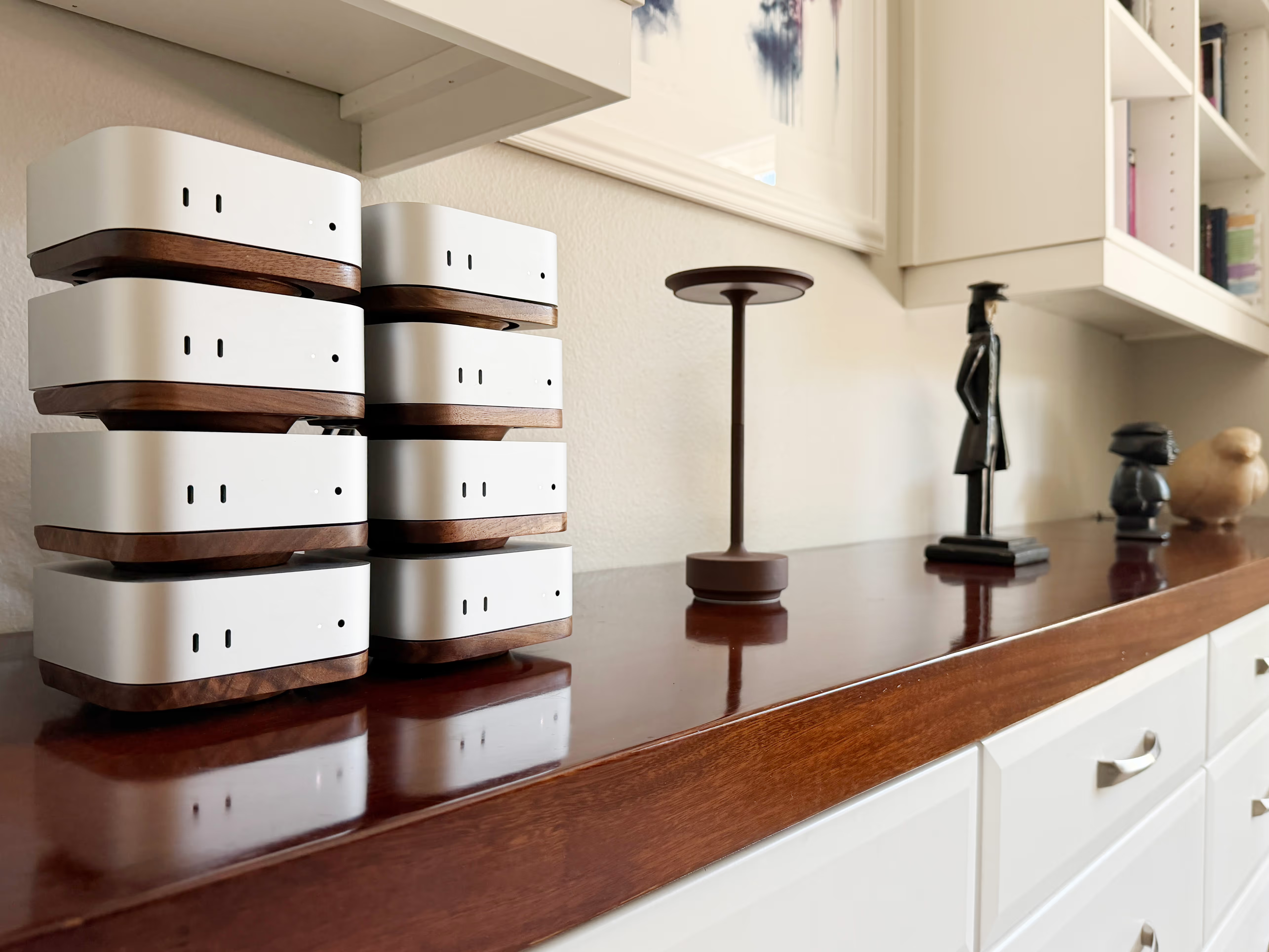
My Mac mini cluster outgrew its walnut stacks at twelve machines. So I went looking for a better rack and didn’t stop: shelves Apple could sell, racks for the wall, and sculpture built for a gallery floor.
The one turning here is the shadow a four-dimensional cube casts in our world, with a Mac mini on each of its twelve faces. Drag it around. Every design below works the same way.
My Mac mini cluster keeps growing. The hand-stacked walnut standoffs that looked great with three machines are
hard to keep orderly with twelve, and the
spacing that keeps the cluster cool
only works while every level stays aligned. This is a search for a stylish but functional way to hold them
all.
It's also an experiment in how far AI coding tools can take physical design. I didn't model any of these by
hand. Each concept is a short program an AI coding agent wrote against a kit of parts sized from Apple's specs,
and a script checks every one for twelve minis and no machine passing through another. The designs worth
building go a step further, into STEP files and dimensioned drawings ready to send to a shop like
SendCutSend,
Xometry, or
CraftCloud3D.
Every concept below is a working 3D model holding all twelve machines, with the size measured from the model
and each part named with the vendor and stock it would be made from. Each one respects what a Mac mini needs:
about 75 millimeters behind it for the power, Ethernet, and HDMI plugs, an open underside for the intake
around its foot, and at least 10 millimeters between machines that stand on edge.
Drag any model to orbit it, double-click to reset the view, or expand it to zoom. The filters narrow the set
by where it lives, what it is made of, and whether it reads as a product or as a piece for a gallery.
Two shelves of six stand on edge in a single routed walnut tray. Polished aluminum fins file each mini like a book, and a dark trough between the rows swallows the front row's cables.
Size
Measured from the model
Holds
12 Mac minis
Grow
Trays butt end to end on dowels: each new tray adds two more files of six.
Make
Xometry CNC walnut tray (one 8/4 board, kerfed for fins) · SendCutSend 6061 .063 fins, polished + clear anodized · SendCutSend 6061 .063 bent trough, black anodized
The breakfast-table toast rack, scaled up and slowed down: fourteen polished hoops rise in a single crescendo toward the handle, and the twelve machines are just the slices.
Size
Measured from the model
Holds
12 Mac minis
Grow
Each bank is a row of identical sockets: a longer plinth adds slices to both banks.
Make
Xometry CNC-bent 6061 rod Ø8 hoops, polished · Xometry CNC-bent 6061 rod Ø12 handle · Xometry CNC walnut plinth, oiled
A single walnut wave breaks forward under twelve blades of aluminum: the domestic knife block, turned into a monument to the tools of a different kitchen.
Size
Measured from the model
Holds
12 Mac minis
Grow
The block is cut in 4-slot segments that dowel together; add a segment for four more.
Make
Xometry CNC walnut block, glued-up 8/4, slots routed open to the back · CraftCloud3D TPU slot liners
Four laser-cut plates and no fasteners: two combs carry the minis on edge and key into trestle ends with wedge pins, so the whole rack ships flat and assembles in a minute.
Size
Measured from the model
Holds
12 Mac minis
Grow
Longer combs from the same file, or a third trestle in the middle to splice two pairs end to end.
Make
SendCutSend 6061 .250 combs + trestle ends, laser cut, tab-and-slot · SendCutSend Class II anodize (clear combs, black ends)
Nine slotted aluminum sheets half-lap into a 4 × 3 grid, no fasteners. Every cubby floor is cut open under the mini's foot, and the back stays open for plugs.
Size
Measured from the model
Holds
12 Mac minis
Grow
Cut longer sheets with another slot pair: one more column or row per sheet set.
A mid-century walnut case, four bays by three, with thin vented aluminum shelves in dados. The back is open for plugs; short tapered legs keep the bottom breathing.
Size
Measured from the model
Holds
12 Mac minis
Grow
Cases stack or sit side by side on the same legs; each adds twelve bays or four.
Every mini sits on its own walnut tray that slides out on aluminum runners, so you can reach one without disturbing the rest. The frame is open at the back and every tray floor is cut open under the foot.
Size
Measured from the model
Holds
12 Mac minis
Grow
Posts and runners are a repeat unit: bolt on another column, or longer posts for another row.
Make
SendCutSend 6061 .500 posts + .125 bent runners, black anodized · Xometry CNC walnut trays with routed pulls
Every mini rides in an anodized sleeve that slides into a long, low walnut deck like a tape. Pull a cassette to swap a machine; the sleeves sit on rails so air reaches the underside, and the back is open.
Size
Measured from the model
Holds
12 Mac minis
Grow
Housings stack on locating pins, or a wider housing adds bays; cassettes are all the same part.
Three bent aluminum frames step back five, four, three into a temple silhouette. Each frame's roof is the next terrace's floor, cut open under every foot; the backs are open to a cable wall.
Size
Measured from the model
Holds
12 Mac minis
Grow
Add a six-wide frame underneath: the ziggurat grows a terrace and six minis.
Three slim aluminum towers of different heights, each crowned with a walnut cap, set out like buildings on a street. Every level is a vented shelf between four corner posts; nothing sits behind the plugs.
Size
Measured from the model
Holds
12 Mac minis
Grow
Add a tower, or longer posts and one more shelf on any tower.
A single bent aluminum sheet folds into two tilted terraces like a factory roofline. Every mini leans 15° toward you on felt pads, and a flat landing between the terraces takes the front row's cables.
Size
Measured from the model
Holds
12 Mac minis
Grow
Longer sheet, same bends: each 141 mm of width adds a mini to both terraces.
A single bead-blasted aluminum enclosure with two bays, open front and back. Minis slide in on edge between low guide ribs like blades in a server; the corner radii are the mini's own.
Size
Measured from the model
Holds
12 Mac minis
Grow
Chassis stack on recessed feet; each adds twelve blades.
Make
Xometry CNC 6061 shell, two halves machined from plate, bead-blasted + clear anodized · SendCutSend 6061 .125 guide ribs
A real 19-inch rack, shrunk to desktop height: dark anodized rails between thick walnut cheeks, and four standard 2U vented shelves of three minis each.
Size
Measured from the model
Holds
12 Mac minis
Grow
Standard rack units: taller cheeks for more 2U shelves, or 1U spacers anywhere.
A body worn on the outside: a polished aluminum cage traces every edge of twelve machines set back to back on a plinth, and the void at its heart carries their cables down and away.
Size
Measured from the model
Holds
12 Mac minis
Grow
Weld on another ring and a level of rails: four more minis per level.
One polished blade rises from a turned base and twelve walnut leaves branch off it, each carrying a mini: a column of machines stacked like a carved totem, and they can never drift out of line.
Size
Measured from the model
Holds
12 Mac minis
Grow
A taller blade takes more leaves at the same 70 mm pitch; a second totem stands beside it.
Two columns of six share one shelf per level, threaded on three polished rods between a solid walnut plinth and a walnut cap. Rods sit at the sides, so the backs stay clear.
Size
Measured from the model
Holds
12 Mac minis
Grow
Longer rods add a level of two; a wider plinth and a fourth rod add a third column.
A twisting skyscraper in miniature: each walnut level turns 7.5° past the one below, and four polished rods spiral through the corners to lock the turn in place.
Size
Measured from the model
Holds
12 Mac minis
Grow
Keep stacking: every level adds 7.5°, and at 48 levels the tower completes a full turn.
Make
Xometry CNC walnut levels · Xometry CNC bent 6061 .375 rod, polished · Xometry CNC turned 6061 base, black anodized · Honed basalt pedestal, 15 × 30 in (local stone fabricator)
A spiral staircase that goes nowhere: twelve walnut treads climb a turned walnut column one full turn, each mini facing outward like a step, cables gathered at the core.
Size
Measured from the model
Holds
12 Mac minis
Grow
Stack a second column section on the first: twelve more treads, another full turn.
A fairground carousel at rest: two walnut tiers of six ride a polished drum under a turned walnut canopy, and the whole thing spins on a bearing so every back comes round to you.
Size
Measured from the model
Holds
12 Mac minis
Grow
Add a tier of six on a longer drum; a larger platter takes eight per tier.
Twelve computers become twelve hours: the minis stand on edge as hour marks around a walnut dial on a turned aluminum stem, with two bronze hands set at ten past ten; every cable drops through the hub into the hollow stem.
Size
Measured from the model
Holds
12 Mac minis
Grow
A wider dial takes a second ring of twelve, as the minutes, outside the first.
Twelve moons around a polished mast: each mini floats on a puck hidden under its foot, at the tip of a swept arm too thin to look like it could hold anything.
Size
Measured from the model
Holds
12 Mac minis
Grow
Slide another collar of six onto a taller mast; collars clamp anywhere.
Make
Xometry CNC bent 6061 1 in round bar arms, polished · Xometry CNC turned 6061 mast, collars + pucks · Xometry CNC walnut base
The slab from 2001, at the scale of a person: a space-black 4:9 monolith hovering on a recessed plinth, its only mark twelve slots where twelve machines look out.
Size
Measured from the model
Holds
12 Mac minis
Grow
Taller slabs take a fourth row; two slabs stand side by side as a pair.
Make
SendCutSend 6061 .250 slotted face, black anodized · SendCutSend 5052 .125 bent shell + shelves, black anodized · Xometry CNC 6061 plinth
The 2019 Mac Pro, reborn as a rack: a bead-blasted tower with a machined lattice face, polished handles over the top, and twelve minis on rails behind the holes.
Size
Measured from the model
Holds
12 Mac minis
Grow
A taller shell adds levels of two; towers stand side by side, handles and all.
Make
SendCutSend 6061 .313 lattice face, laser cut + clear anodized · SendCutSend 5052 .125 bent shell, divider + rails · Xometry CNC bent 6061 .625 rod handles, polished · Honed Carrara pedestal, 15 × 36 in (local stone fabricator)
The 2013 Mac Pro stretched into a column: one space-black cylinder, split open down its back, with twelve minis stacked inside and their heat rising up the open spine to a polished vent ring.
Size
Measured from the model
Holds
12 Mac minis
Grow
Stack a second cylinder section on a sleeve joint: twelve more minis, one taller column.
Make
Xometry CNC rolled + welded 6061 .250 shell, black anodized · SendCutSend 6061 .187 shelves · Xometry CNC turned 6061 vent ring + foot, polished · Honed basalt round pedestal, 15 × 30 in (local stone fabricator)
Furniture first: a walnut-topped side table whose aluminum frame holds the minis three high and back to back, so it serves from both sides and the cables drop down a hidden centre channel.
Size
Measured from the model
Holds
12 Mac minis
Grow
A longer table adds a bay of six per 290 mm of length; legs and rails repeat.
A hallway console in solid walnut, its top folding down into the legs like a waterfall; two anodized shelves underneath carry six minis each, standing on edge like records.
Size
Measured from the model
Holds
12 Mac minis
Grow
A longer top adds slots to each shelf; a third shelf fits under the top.
Make
Xometry walnut slab top + legs, mitred waterfall joint · SendCutSend 6061 .250 shelves with .125 comb ribs, bronze anodized
A slatted walnut bench on bent aluminum sled legs, with two slatted shelves of six beneath the seat: sit on it, and the gaps between the slats let the minis breathe.
Size
Measured from the model
Holds
12 Mac minis
Grow
Longer slats and a middle sled add a bay of three per shelf.
Make
Xometry CNC walnut slats · Xometry bent 6061 1/2 × 2 in flat bar sleds, bead-blasted · SendCutSend 6061 .500 rungs
Dressed as a 1970s floorstanding speaker: fluted walnut cheeks, a black anodized baffle with two port slots per level, and polished spikes. Behind each slot, a mini stands on edge.
Size
Measured from the model
Holds
12 Mac minis
Grow
A pair, like real speakers: a second tower holds twelve more.
Make
Xometry CNC fluted walnut side panels, top + plinth · SendCutSend 6061 .125 baffle, black anodized · SendCutSend 5052 .125 shelves · Xometry CNC turned spikes
Puts the minis on display the way a museum shows a rare object: a walnut plinth, a glass hood on a hairline aluminum frame, and four floating shelves of three, the back left open to breathe.
Size
Measured from the model
Holds
12 Mac minis
Grow
A taller hood adds a shelf of three; vitrines line up along a wall.
Two tall aluminum plates and eight polished rods, nothing else: the minis rest on the rods by their feet and seem to hover in a 3 × 4 grid, walnut collars keeping them in register.
Size
Measured from the model
Holds
12 Mac minis
Grow
Longer rods take a fourth column; taller plates take a fifth row.
Nothing touches: each walnut shelf hangs by a single steel tie from the hooked strut of the shelf below, pulled taut by four corner cables, so three levels of machines appear to levitate.
Size
Measured from the model
Holds
12 Mac minis
Grow
Hook a fourth shelf onto the top one: each level is the same module.
Make
Xometry CNC walnut shelves + base · SendCutSend 6061 .750 bent bar struts, polished · 1/16 in stainless cable + swaged turnbuckles (McMaster)
A Roman arch built from computers: the twelve minis are its voussoirs, each seated on a walnut wedge between two curved aluminum bands, springing from tapered walnut piers.
Size
Measured from the model
Holds
12 Mac minis
Grow
A deeper arch takes a second ring of twelve behind the first; arches line up as an arcade.
Twelve computers hung as a portrait of themselves: a deep walnut shadow box and aluminum mat around two rows of six, the status lights the only brushstrokes.
Size
Measured from the model
Holds
12 Mac minis
Grow
Frames hang edge to edge on one French cleat: each new frame adds a 6 × 2.
Four thick walnut shelves on hidden steel brackets, three minis each. A slot routed along the back of every shelf drops the cables straight down the wall.
Size
Measured from the model
Holds
12 Mac minis
Grow
Hang another shelf; each one is the same 3-mini module.
Three slotted aluminum rails on the wall, pin-on brackets and walnut shelves: the Vitsœ 606 system scaled to a pair of minis per shelf, moved a slot at a time.
Size
Measured from the model
Holds
12 Mac minis
Grow
Add a rail for another bay, or a shelf in any free slot.
Make
SendCutSend 6061 .250 rails with laser-cut slots, gray anodized · SendCutSend 5052 .125 bent brackets · Xometry CNC walnut shelves
A perforated aluminum panel stood off the wall, and bent cradles that hook into any hole. Rearrange the twelve in seconds; the open arms leave the plugs and intake clear.
Size
Measured from the model
Holds
12 Mac minis
Grow
Mount a second panel beside it; cradles hook anywhere on the 38 mm grid.
A floating shelf above the counter, with twelve minis hung on edge underneath in bent aluminum U-hangers. The counter stays clear and the minis read as a row of spines.
Size
Measured from the model
Holds
12 Mac minis
Grow
Lengthen the two mounting bars along the shelf; hangers are identical.
Make
SendCutSend 5052 .090 bent U-hangers, clear anodized · SendCutSend 6061 .250 mounting bars, tapped · Xometry walnut floating shelf, or an existing one
Computation as a cascade: twelve minis hang from a walnut beam on polished aluminum rods, each column a step lower than the last, like water falling down a terrace.
Size
Measured from the model
Holds
12 Mac minis
Grow
A longer beam takes another column; longer rods take another ring.
Make
Xometry CNC walnut beam on a hidden steel cleat · SendCutSend 6061 .250 rings, laser cut, clear anodized · SendCutSend 6061 rod, 8 mm, polished, tapped ends
Two walnut picture ledges with a slot routed at 5° for each mini. They stand on edge, fronts out, leaning back like framed prints, with 85 mm of air behind for the plugs.
Size
Measured from the model
Holds
12 Mac minis
Grow
A longer ledge holds more; a third ledge adds six.
A staircase that gets steeper as it climbs: twelve walnut treads, one mini on each, hung from a single bent aluminum tube that draws the curve of exponential growth across the wall.
Size
Measured from the model
Holds
12 Mac minis
Grow
Bend a longer tube, or start a second flight where this one ends.
Twelve computers held in balance: aluminum arms, walnut pivots and lever ratios of one to two let every mini float at its own height under one ceiling point.
Size
Measured from the model
Holds
12 Mac minis
Grow
Hang another branch: any arm end can take a 1-to-2 lever with three more.
Make
Xometry CNC-bent 6061 tube arms, 10 mm, power cords inside · SendCutSend 5052 .190 C-hooks and .063 trays, anodized · Xometry CNC walnut pivot beads · Joist anchor rated 60 kg, pinned joints so it turns slowly
The machine as the painting: twelve minis set tops-out on an aluminum canvas, propped on a walnut studio easel as if still being worked on.
Size
Measured from the model
Holds
12 Mac minis
Grow
Panels are 4 × 3 modules: a wider ledge carries two, or hang the panel on the wall.
Make
Xometry CNC walnut legs, mast, ledge and clamp · SendCutSend 6061 .375 panel, bead-blasted + clear anodized · SendCutSend 5052 .100 bent cradles; cables run down slots in the panel back
A Pro Display XDR stand for twelve minis: one machined arm with a window, a polished hinge, and a finned panel that holds them tops-out like a screen made of computers.
Size
Measured from the model
Holds
12 Mac minis
Grow
Panels are 4 × 3 modules: a second stand sits beside it, or a taller panel takes a fourth row.
Make
Xometry CNC 6061 arm and hinge knuckle, bead-blasted + clear anodized · SendCutSend 6061 .313 panel and .250 fins, slotted, anodized · SendCutSend 6061 .500 base plate
Twelve slots milled through a single block of aluminum, its outer corners at the mini's own 17 mm radius. Slide a mini in from the front; it plugs in out the open back.
Size
Measured from the model
Holds
12 Mac minis
Grow
Shells stack and sit side by side on keyed feet: each one adds twelve.
Mid-century credenza, server-room job. Perforated aluminum doors slide over two bays of six; the back is open and a chase behind the shelves drops every cable to the floor.
Size
Measured from the model
Holds
12 Mac minis
Grow
A three-bay carcass holds eighteen; the doors and shelves are the same.
Four walnut trays of three and a lid. Aluminum keys inlaid in each end wall drop into pockets in the tray above, so the stack lines itself up with no rods.
A single space-gray spine on one side and four shelves that cantilever off it into thin air, so the minis read as floating. Front, back and the open side stay clear for plugs and air.
Size
Measured from the model
Holds
12 Mac minis
Grow
A taller spine takes another shelf; a second spine mirrored on the right makes a pair.
A ladder you climb with your eyes: two bowed walnut rails lean on the wall and six aluminum rungs carry the minis upward, each pair stepping back toward the wall as it rises.
Size
Measured from the model
Holds
12 Mac minis
Grow
Lean a second ladder beside it, or make taller rails with a seventh rung.
Make
Xometry CNC walnut rails, cut from 8/4 slab along the bow · SendCutSend 5052 .125 bent tray rungs, clear anodized, bolted through · Felt top pads; strap to a wall stud
Four tall aluminum towers with the Mac Studio's soft square plan and round foot. Each holds three minis behind an open face, open at the back for plugs and air.
Size
Measured from the model
Holds
12 Mac minis
Grow
Add a pod: three more minis, same footprint.
Make
Xometry CNC 6061 side walls, caps and shelves, bead-blasted + clear anodized · SendCutSend 6061 .250 foot discs, black anodized
Two rows of minis hung like hanging files: a bent aluminum sling hooks over twin rails, ports face down into a trough that carries the cables away sideways. Lift one out like a folder.
Size
Measured from the model
Holds
12 Mac minis
Grow
Longer rails take more slings; another rail pair adds a row.
Make
SendCutSend 5052 .125 bent slings, clear anodized · SendCutSend 6061 .500 rod rails and .250 end brackets · SendCutSend 5052 .090 bent cable trough
A low walnut plinth checkered in oiled and smoked walnut with aluminum inlay lines; each mini owns a square and drops its cables through a grommet behind it.
Size
Measured from the model
Holds
12 Mac minis
Grow
Add a rank of squares: the plinth is a grid of identical tiles.
Make
Xometry CNC walnut and smoked-walnut squares, glued up · SendCutSend 6061 .125 inlay strips, clear anodized · SendCutSend 6061 .250 recessed base, black anodized
A single quarter-inch aluminum ribbon folds back on itself like pulled taffy. Each landing carries two minis, and the stack reads as one continuous gesture.
Twelve minis on edge, each on its own folded bracket, rise and fall across the wall in a single sine wave. A polished rod traces the curve through every bracket.
Size
Measured from the model
Holds
12 Mac minis
Grow
The wave keeps going: add brackets at the next phase.
Make
SendCutSend 5052 .125 bent brackets, black anodized · Xometry walnut cheek pads · Xometry bent 12 mm 6061 rod, polished
Twelve gondolas hang from a twin-ring aluminum wheel on a walnut plinth. Each mini stays level as the wheel turns, so any one can be brought down to hand height.
Thirteen polished blades rise from a walnut base, tallest at the centre, with a mini standing on edge in each gap. Pipe organ, city skyline and server rack at once.
Size
Measured from the model
Holds
12 Mac minis
Grow
Add a blade and a bay at either end; the curve stretches.
Make
SendCutSend 6061 .250 blades, tumbled + clear anodized · Xometry CNC walnut base with routed blade slots
Twelve computers hang in a cube drawn only in steel wire. The lid is held up by tension alone, two interlocked hooks pulling against each other at the centre, so nothing appears to bear the weight.
Size
Measured from the model
Holds
12 Mac minis
Grow
Lengthen the wires and clamp on another tray pair; a third column fits between new outer wires.
Make
Xometry CNC walnut base + lid · SendCutSend 6061 .500 hook plates, polished · SendCutSend 6061 .125 trays, black anodized · 1.2 mm stainless museum wire + crimp sleeves · Black basalt pedestal 18 in, local fabricator
A mid-century starburst at architectural scale: twelve polished rays of two lengths burst from a walnut hub, each carrying a computer face-out. The cables run home along the rays.
Size
Measured from the model
Holds
12 Mac minis
Grow
The hub is drilled for 24 rays; screw in more long rays for 16 or 24 minis.
Twelve computers topple like dominoes and stop. The fallen lean, the wavefront hangs in mid-air, the rest stand waiting: one instant of a chain reaction, held by rods you only find from behind.
Size
Measured from the model
Holds
12 Mac minis
Grow
Add dominoes at the standing end; a second base butts on with a key.
Make
Xometry CNC walnut base with rod sockets · SendCutSend 6061 10 mm rod, polished, bent · Xometry CNC 6061 foot pads
After Brancusi: walnut rhomboids rise from a black stone pedestal, and each narrow waist holds four computers turned in a pinwheel. The column implies it could go on forever, and it can.
Size
Measured from the model
Holds
12 Mac minis
Grow
Every bead-and-neck is the same module: stack another for four more minis.
Make
Xometry CNC walnut beads (laminated blanks) · SendCutSend 6061 .313 neck plates, polished · SendCutSend 6061 10 mm rod posts · Black basalt pedestal 18 in, local fabricator
After Judd: twelve identical anodized sleeves climb the wall, spaced exactly their own height apart. Each holds one computer, recessed and open at the back, so the stack breathes through its gaps.
Size
Measured from the model
Holds
12 Mac minis
Grow
Hang another sleeve at the same pitch; the stack runs floor to ceiling.
Make
SendCutSend 5052 .125, bent into a sleeve + welded seam, champagne anodized · SendCutSend 6061 .250 hidden wall cleats · In-wall raceway for cables behind the stack
After Serra: a two-and-a-half-metre aluminum plate, rolled into an arc and leaning back past plumb. Twelve computers pass through it in a rising line of walnut-lined pockets, small against its mass.
Size
Measured from the model
Holds
12 Mac minis
Grow
Weld on another section and the arc continues; each section carries four pockets.
Make
Xometry 6061 .750 plate, waterjet pockets, rolled to R3200 in three welded sections, bead-blasted · Xometry CNC walnut pocket shelves · Concealed floor anchors
After Cornelia Parker: twelve computers thrown outward from a single bare bulb and stopped in the air. Each hangs on its own wire from a walnut canopy, held aloft by one polished arc.
Size
Measured from the model
Holds
12 Mac minis
Grow
The canopy is drilled on a grid; hang another fragment anywhere in the cloud.
Make
Xometry rolled 6061 50 mm tube arc, polished · Xometry CNC walnut canopy + ballasted base · 1.2 mm stainless museum wire + crimp sleeves · Braided power/Ethernet leads up each wire into the canopy
One aluminum band with a single side. Twelve computers ride its surface round the loop, rolling from flat to sideways as the band turns its half-twist; follow them and you come back on the other face.
Size
Measured from the model
Holds
12 Mac minis
Grow
A longer band of the same strip on a larger radius takes 16 stations; the pads are identical.
Make
Xometry sheet fab: 5052 .250 strip, rolled and twisted over a form, welded, polished · Xometry CNC 6061 foot pads · SendCutSend 6061 16 mm rod posts · Xometry CNC walnut disc base
Orion, drawn as a star chart two metres high: twelve computers sit at the bright stars on walnut standoffs, joined by polished rods, with the faint stars as small steel points.
Size
Measured from the model
Holds
12 Mac minis
Grow
Taurus is next door: rods run on from Betelgeuse and Bellatrix to new stars.
Make
Xometry CNC walnut standoffs with wall anchors · SendCutSend 6061 8 mm rod, polished, cut to length · Xometry CNC 6061 star points
A walnut tree, three limbs dividing twice into twelve twigs, each bearing one computer like fruit. The cables run down grooves in the branches and vanish into the root.
Size
Measured from the model
Holds
12 Mac minis
Grow
Every twig joint is the same socket: graft another twig onto any fork.
Make
Xometry CNC walnut limbs (laminated, 5-axis), doweled joints with cable grooves · Xometry CNC 6061 tip pads, polished · Xometry CNC walnut root base with steel ballast
A two-by-two-by-three puzzle caught mid-move: the middle layer has turned and not yet clicked home. Each layer really turns on a brass bearing, and the four computers inside are pinwheeled so every one exhales outward.
Size
Measured from the model
Holds
12 Mac minis
Grow
Lift the top layer and drop in another: 2×2×4 is sixteen minis.
Make
SendCutSend 6061 .250 layer plates, black anodized · SendCutSend 6061 10 mm rod posts, polished · Xometry CNC brass bearing rings · Xometry CNC walnut plinth · Black basalt pedestal 18 in, local fabricator
Twelve slender rods rise from a walnut ground, their tips tracing one rolling wave. Each computer tilts to the slope of the surface beneath it, so the invisible wave becomes something you can read.
Size
Measured from the model
Holds
12 Mac minis
Grow
Add a row: the wave function just keeps going; every rod is cut from the same stock.
Make
SendCutSend 6061 16 mm rod, polished, cut to length · Xometry CNC 6061 tilted pads · Xometry CNC walnut slab with rod sockets and cable channels
A ten-centimetre walnut slab reaches nearly two metres out from a single black blade, as if it weighed nothing. Six computers ride on top; six more hang beneath it in folded cradles.
Size
Measured from the model
Holds
12 Mac minis
Grow
A longer slab and foot take more cradles; the cradles are identical and bolt anywhere along the underside.
Make
Xometry 6061 1 in plate, welded Z (foot, blade, saddle), black anodized · Xometry CNC walnut slab, laminated 100 mm · SendCutSend 5052 .125 bent cradles, black anodized
A gate in walnut and black aluminum, standing on two basalt stones. Six computers sit along the upswept top beam and six on the tie beam below, so passing through means passing under them.
Size
Measured from the model
Holds
12 Mac minis
Grow
Gates repeat: a second torii a metre behind adds twelve more, the start of a tunnel.
Make
Xometry CNC walnut pillars (turned, hollow for cables), shimaki and strut · Xometry CNC 6061 kasagi + nuki, black anodized · Basalt footings, local fabricator
A two-metre ring of mirror-polished aluminum stands on edge in a walnut cradle. Twelve computers sit on its inner face at the hours of a clock, the one at noon hanging upside down.
Size
Measured from the model
Holds
12 Mac minis
Grow
Each hour is one segment with one pocket; a ring of sixteen segments takes sixteen minis.
Make
Xometry CNC 6061 ring in twelve segments (one per hour), bolted from behind, polished · Xometry CNC walnut cradle · Cable channel milled in the ring back
Twelve computers hang in the air at twelve heights, each on a brass tray no thicker than a coin and four strands of museum wire. The rack has been taken away; only the machines and the lines that hold them remain.
Size
Measured from the model
Holds
12 Mac minis
Grow
Lengthen the ceiling tracks and hang another tray at any height.
Make
SendCutSend brass .063 trays, laser cut + brushed · STAS / Arakawa 1.2 mm museum cable with grippers + crimp sleeves · STAS cliprail ceiling track, black (or SendCutSend 6061 bar, black anodized)
Three brass strands hang from a picture rail and end in plumb bobs a hand above the floor. Four computers are threaded onto each strand at uneven intervals, like beads on a string, or notes on a staff.
Size
Measured from the model
Holds
12 Mac minis
Grow
Hang another strand from the rail, or slide a fifth collar onto a strand.
Make
Xometry 10 mm brass rod + CNC brass collars and plumb bobs · SendCutSend brass .125 bead trays, brushed · STAS / Arakawa museum cable from a STAS picture rail
Eight honed Carrara plinths, from knee to shoulder height, gathered like a sculpture court. Each presents one or two computers; where two share a plinth, the second stands on a small brass table above the first.
Size
Measured from the model
Holds
12 Mac minis
Grow
Add a plinth to the court; tables stack a third mini on any of them.
Make
Local stone fabricator: honed Carrara plinths, mitred 20 mm slab over a hollow core (cables run inside) · Xometry CNC brass tables + engraved brass labels
A fragment of a Roman stair in honed travertine, four treads rising away from you. Three computers rest on each tread; the cables drop into a shadow slot cut along the foot of every riser.
Size
Measured from the model
Holds
12 Mac minis
Grow
Add a step behind, or set a second flight beside the first.
Make
Local stone fabricator: honed + filled travertine, each step a hollow box of mitred 30 mm slab with a routed cable slot
A tapering block of black basalt, split clean through. Twelve computers stack in the fissure on brass blades set into the stone, with the cut open front to back so they breathe. Shown on a travertine pedestal.
Size
Measured from the model
Holds
12 Mac minis
Grow
A taller block takes more blades; a second monolith stands beside it.
Make
Local stone fabricator: honed basalt halves, kerfs sawn for the blades · SendCutSend brass .187 blades, brushed · Gallery pedestal, 18 in travertine, 30 in tall
Twelve computers, each seemingly cast in a block of clear acrylic like a specimen, stacked two high and six across on a Carrara pedestal. Each block is pocketed from the back and bottom, so the machine inside still breathes.
Size
Measured from the model
Holds
12 Mac minis
Grow
Blocks are identical: stack a third course, or set a second pedestal.
Make
Xometry CNC cast acrylic blocks, pocketed + vapor polished · Gallery pedestal, 18 in honed marble, 36 in tall
A tall lantern of frosted acrylic glows warm from inside. Twelve computers appear only as soft silhouettes on six brass shelves, like figures behind a paper screen. The back is open to the air; it stands on a round walnut pedestal.
Size
Measured from the model
Holds
12 Mac minis
Grow
A taller lantern adds tiers; set a second lantern on its own pedestal.
Make
SendCutSend acrylic .236 panels (frosted), laser cut · SendCutSend brass .125 shelves, brushed · Xometry CNC walnut base + cap · Warm 2700 K LED strip · Gallery pedestal, round walnut veneer, 30 in tall
Twelve smoked-acrylic vitrines, four by three, each holding one computer under a single warm light. Open at the back and slotted underneath, they stand off the wall on brushed rails so the cables run unseen behind.
Size
Measured from the model
Holds
12 Mac minis
Grow
Lengthen the rails and hang another column; add a rail for a fourth row.
An Art Deco aviary in polished brass: four tiers of fine bars on a stepped basalt plinth, under a ziggurat crown. Twelve computers perch three to a tier, kept rather than stored.
Size
Measured from the model
Holds
12 Mac minis
Grow
Braze on a fifth tier; the bars are one length per tier.
Make
Xometry 6 mm brass rod, cut + brazed into SendCutSend brass .125 bands and slotted shelves · Xometry CNC brass crown steps + finial · Local stone fabricator: stepped basalt plinth
Two polished brass ladders, each closed with a bent loop at the top, carry four oiled walnut shelves. A crossed pair of museum wires braces the back, and every shelf has a slot where the cables drop through.
Size
Measured from the model
Holds
12 Mac minis
Grow
Taller ladders take a fifth shelf; a third ladder adds a second bay.
Make
Xometry 1 in brass tube, mandrel bent + brazed, polished · Xometry CNC walnut shelves, drilled for the posts + slotted · STAS museum cable X brace with turnbuckles
Four slabs of thick low-iron glass, staggered up the wall on slim brass pins. Three computers on each seem to float, and their cables run straight back into a chase in the wall.
Size
Measured from the model
Holds
12 Mac minis
Grow
Pin another shelf above; shelves and pins are identical.
Make
Local glass shop: 19 mm low-iron tempered glass, polished edges, drilled for pins · Xometry CNC brass pins + wall flanges
Thirteen fins of amber acrylic, each lit along its foot so it glows like a held flame, stand in a smoked walnut base. Twelve computers stand on edge between them, silver set in honey.
Size
Measured from the model
Holds
12 Mac minis
Grow
A longer base adds a fin and a bay at either end.
Make
SendCutSend acrylic .500 amber, laser cut + flame polished · Xometry CNC ebonized walnut base, slotted for fins + LED channel · Warm 2700 K LED strip
Twelve computers hang from a brass beam on museum wire, each line a little shorter than the last. Every one is stopped at a different point in its swing, so together they draw a single wave in the air, held still.
Size
Measured from the model
Holds
12 Mac minis
Grow
A longer beam takes another pendulum, the next length in the series.
Make
Xometry 40 mm brass tube beam + A-frame legs, brazed + polished · SendCutSend brass .063 trays · STAS / Arakawa museum cable, fixed at its swing angle by a fine back-stay
A brass beam rests on a knife edge above a block of Carrara. Four computers hang at twice the distance and balance eight hung at once: the lever law, worked out in hardware. Nothing is fixed; it simply holds.
Size
Measured from the model
Holds
12 Mac minis
Grow
Move the hang points to keep the ratio: five at 2a balance ten at a.
Make
Local stone fabricator: polished Carrara pivot block · Xometry CNC brass knife edge + post, 16 mm brass rod beam · SendCutSend brass .063 trays · STAS / Arakawa museum cable with crimp stops
Four slabs of travertine, each seventy millimetres thick, threaded onto four stainless rods and held on steel collars. Nothing else: the weight of the stone is the design.
Size
Measured from the model
Holds
12 Mac minis
Grow
Longer rods take a fifth slab; a second bay shares two rods.
Make
Local stone fabricator: honed travertine slabs, core-drilled for rods + routed cable slot · Xometry 304 stainless 32 mm rod + CNC collars and feet, brushed
A brass vitrine on a black basalt pedestal, the kind a jeweller keeps watches in. Twelve computers stand on edge in two tiers of dark felt behind glass, while a slotted brass back lets them breathe.
Size
Measured from the model
Holds
12 Mac minis
Grow
A wider case on a 24 in pedestal holds eight across.
Make
SendCutSend brass .250 sides + slotted back, brushed · Xometry CNC brass base + 10 mm frame bars · Local glass shop: 6 mm low-iron glass, polished edges · Wool felt over CraftCloud3D printed PETG tiers · Gallery pedestal, 18 in basalt, 36 in tall
A slab of black basalt, broken into thirteen pieces and mended with brass. Where each seam reaches the surface it keeps rising, and the twelve computers stand between the repairs, held by the places the stone was broken.
Size
Measured from the model
Holds
12 Mac minis
Grow
Split another piece onto the end: one more seam, one more bay.
Make
Local stone fabricator: honed basalt slab, waterjet split along the seam lines · Xometry sheet brass .125, press-brake folded to each seam line + polished
A walnut table whose top is a sheet of frosted acrylic lit from below, the kind photographers lay slides on. Twelve computers sit on it in a grid, dark silhouettes on a field of warm light.
Size
Measured from the model
Holds
12 Mac minis
Grow
A longer top on the same apron joinery adds a column of three.
Make
SendCutSend acrylic .750 → Xometry CNC cast acrylic 20 mm, frosted, drilled for grommets · Xometry CNC walnut legs + apron · Warm 2700 K LED panel · SendCutSend 6061 grommets, black anodized
Inside a tall brass frame, twelve computers climb in a spiral, each held in place by eight taut museum wires, four pulling up and four pulling down. The wires cross and re-cross into a net, and the machines hang in it like caught light.
Size
Measured from the model
Holds
12 Mac minis
Grow
A taller frame continues the spiral; each tray only needs its own eight wires.
Make
Xometry 22 mm square brass tube frame, brazed + polished · SendCutSend brass .063 trays · STAS / Arakawa 1.2 mm museum cable with gripper tensioners at the posts
A long slab of Carrara laid across two blocks of walnut, and on it twelve computers in a single, even row behind a low brass rail. Arranged with the care usually given to relics; the cables fall away into a shadow slot behind.
Size
Measured from the model
Holds
12 Mac minis
Grow
A longer slab (or a second one butted end to end) carries more of the row.
Make
Local stone fabricator: polished Carrara slab 90 mm, routed cable slot · Xometry CNC walnut blocks, laminated · Xometry CNC brass rail posts + 12 mm brass rod
A power station cooling tower, four metres of weathering steel, standing on open legs over twelve working computers. Their waste heat (48 W idle, 780 W flat out) is its only draft: warm air climbs the throat and turns a vane at the lip, faster under load.
Size
Measured from the model
Holds
12 Mac minis
Grow
Edition of 6 + 2 AP, each at 12 machines. A second ring of 12 adds a 1 m bolted course to the shell; two towers make a pair, as at a power station.
Make
Local steel fabricator: 3 mm corten gores, rolled to the hyperbola and bolted on flanges (demountable, no welds); wattages stamped into the lip ring · Local foundry: ring plinth sand-cast from scrapped computer enclosures · SendCutSend 6061 .125 vane blades on a sealed bearing
A three-metre envelope of recycled ripstop, tethered over twelve working computers and filled by nothing but their exhaust. It swells and lifts against its lines when the cluster works hard and sags when it idles: the cloud, made of the heat it costs.
Size
Measured from the model
Holds
12 Mac minis
Grow
Edition of 6 + 2 AP. Each added row of six machines takes a longer grate and a larger envelope from the same pattern; at 48 it fills a room.
Make
Local sailmaker: envelope + sleeve sewn from recycled ripstop nylon offcuts, zip-off for washing · SendCutSend A36 .187 grate frame + bar grating, bolted, raw mill scale · STAS 1.2 mm museum cable tethers to sand-cast iron weights (local foundry)
Three blades from a decommissioned wind turbine, turned not by wind but by the waste heat of twelve computers mounted on the mast. A turbine is meant to make power; this one spends it, slowly, at the speed of the cluster's load.
Size
Measured from the model
Holds
12 Mac minis
Grow
Edition of 6 + 2 AP. The mast grows in bolted 1 m bays of three machines; a 24-machine mast takes the next blade size up.
Make
Salvaged 3.5 m small-turbine blade set (end-of-life GRP blades are landfilled; broker via a wind-farm repowering yard) · Local fabricator: galvanized angle mast, bolted lattice (demountable) · SendCutSend A36 .187 shelves + 16 ga corten flue panels · Low-friction slewing bearing; blades pitched 12° to the rising air
Two tonnes of aluminium ingots, recast from scrapped computer enclosures and stacked in alternate courses. Twelve working machines lie in the open channels, and the whole stack becomes their heat sink: warm to the hand, a few degrees above the room, all day.
Size
Measured from the model
Holds
12 Mac minis
Grow
Edition of 6 + 2 AP at 26 courses. Every three courses more hold two more machines; the stack is sold by weight and can be recast.
Make
Local secondary-aluminium foundry: 23 kg ingots sand-cast from shredded computer housings, heat number and source weight cast into each end · Dry-stacked, no fixings or glue: every ingot lifts off and returns to the melt · Cables in the channels to one rear socket
A three-metre hearth of reclaimed stone under a four-metre chimney breast, and in the firebox, on the fire-irons, twelve working computers where the logs would be. They are the only fire. Sit on the hearth and you feel what the cloud spends: about 400 W on a busy day.
Size
Measured from the model
Holds
12 Mac minis
Grow
Edition of 6 + 2 AP. A wider firebox takes another 12 on a second set of irons; the hearth seat grows by one reclaimed slab per bay.
Make
Local salvage yard: reclaimed granite hearth slabs, dry-laid on a steel sub-frame · Local fabricator: 6 mm corten breast and hood, bolted panels (demountable) · Blacksmith-forged mild-steel fire-irons; running wattage stamped into the fender bar
A six-tonne glacial boulder held up on three steel blades over twelve working computers. Their exhaust rises into the underside of the stone, which takes the heat all day and gives it back all night: lean on it and it is warm. The weight over the machines is not a metaphor.
Size
Measured from the model
Holds
12 Mac minis
Grow
A series of 6, each a different found stone sized to its cluster: about half a tonne of granite per machine, so 24 machines take a twelve-tonne stone.
Make
Found granite erratic from a local quarry overburden pile, unworked except for three sawn bearing pads · Local fabricator: 40 mm corten blades, bolted to a floor ring (engineer-stamped) · Local foundry: plinth ring sand-cast from scrapped computer enclosures; 6.1 t and 400 W cast into it
Twelve working computers face a heap of coal. Above it, a hopper drops one 50 g lump for every 135 Wh the cluster draws, the coal a power station would burn to supply it: about one every twenty minutes under load, 1.3 tonnes a year. The heap is the meter.
Size
Measured from the model
Holds
12 Mac minis
Grow
Edition of 6 + 2 AP. More machines widen the ring (one stake each) and speed the feeder; the heap is never reset, it travels with the work.
Make
Local fabricator: 4 mm corten hopper, legs and floor ring, bolted (demountable) · Rotary-valve feeder on a small stepper, triggered by the cluster's own power meter (ATtiny + current clamp) · Coal from a heritage-railway supplier, returned to it after the show; SendCutSend A36 .187 stake trays
A five-metre lattice pylon, the grid walked indoors. Twelve working computers hang from its arms on strings of salvaged glass insulators where the conductors would be, and their own power leads sag back to the steel and run down its legs to one socket. The cloud, hanging off the grid.
Size
Measured from the model
Holds
12 Mac minis
Grow
Edition of 6 + 2 AP. A taller body adds a fourth pair of arms (four more machines); a line of pylons carries the cables across a hall.
Make
Local fabricator: galvanized steel angle, bolted lattice in the pattern of a 132 kV suspension tower (demountable, no welds) · Salvaged glass cap-and-pin insulator discs from a utility scrapyard · SendCutSend A36 .187 trays; STAS 1.2 mm museum cable to the strings
Twelve working computers, each hanging by its own power lead from a single junction box on the ceiling. The cable that feeds each one also carries its weight, so the line you see is the dependency: no support but the supply.
Size
Measured from the model
Holds
12 Mac minis
Grow
Edition of 6 + 2 AP. Each added machine is one more lead from the same box; a second box hangs the next twelve.
Make
Custom H07RN-F power leads with a 2 mm stainless strain core, terminated in swaged forks (rigging shop) · SendCutSend A36 .187 junction box + yokes, raw mill scale; wattage of each machine stamped on its yoke · STAS 1.2 mm museum cable for the four-point yokes
A 2.4 m flywheel, sand-cast from scrapped computer enclosures, turned by a low-temperature Stirling engine. Its hot plate sits over twelve working computers, and the ten or fifteen degrees their exhaust adds to the room is all it runs on: the wheel turns about once a minute, faster when they work.
Size
Measured from the model
Holds
12 Mac minis
Grow
Edition of 6 + 2 AP. A second ring of 12 under a wider plate doubles the torque; the wheel stays the same, it only turns faster.
Make
Local foundry: flywheel rim + spokes sand-cast in three bolted segments from scrapped computer housings · Local fabricator: hot-rolled steel A-frames and engine bed, bolted; Stirling displacer chamber spun from 3 mm aluminium (metal spinner) · Sealed bearings, graphite piston; stamped plate: Δt, watts, rpm
A thousand-litre steel tank stands over twelve working computers and lets fall one drop at a time onto a plate their exhaust keeps warm, where it evaporates. The drip runs at a data centre's cooling rate, 1.8 litres per kilowatt-hour of the cluster's live draw. The tank lasts one exhibition.
Size
Measured from the model
Holds
12 Mac minis
Grow
Edition of 6 + 2 AP. Each added side of three machines widens the square; the tank is sized to empty in one show at the cluster's load.
Make
Salvaged 1000 L galvanized stock tank, cut down and re-flanged; legs hot-rolled steel angle, bolted · Solenoid needle valve pulsed by the cluster's power meter (current clamp + microcontroller) · Local foundry: evaporator plate sand-cast from scrapped computer housings; SendCutSend A36 .250 grate
A decommissioned grid transformer, opened at the front and emptied of oil and windings. Twelve working computers sit where the copper was, and the cooling fins that once shed a substation's losses now shed theirs. The power cables leave by the old bushings, up to the ceiling.
Size
Measured from the model
Holds
12 Mac minis
Grow
A series of 6 found units, each sized to its cluster (a larger transformer holds 24). Each is unique; the rails are the only new parts.
Make
Decommissioned 500 kVA distribution transformer from a utility scrapyard: drained, PCB-tested, cleaned, front cut open by waterjet · Original fins, bushings and conservator kept as found; nameplate (kVA, losses) left on · SendCutSend A36 .187 rails bolted to the old core clamps
A 2.4 m slab of wax, melted down from used church and restaurant candles, with twelve working computers resting on it on thin steel plates. Their warmth softens the wax beneath them, and each machine sinks at the rate it works: the busiest go down first.
Size
Measured from the model
Holds
12 Mac minis
Grow
Edition of 6 + 2 AP. The slab is poured in 400 mm bays of two machines; a longer form makes a longer slab.
Make
Recovered candle ends from a candle-recycling cooperative, recast into one slab in a plywood form (low-melt blend, softens near 40 °C) · SendCutSend A36 .187 plates + hot-rolled tray, raw mill scale · Each plate stamped with its machine's cumulative kWh; slab re-melted and recast between shows
The desk-toy heat engine, blown in glass at 2.4 m. Twelve working computers sit either side of its bulb, and their exhaust is the temperature difference it runs on: it tips, dips its beak, and rises again, every half minute or so. A perpetual-motion joke, paid for in electricity.
Size
Measured from the model
Holds
12 Mac minis
Grow
Edition of 6 + 2 AP. Longer rails take more machines and the bird bows faster; a flock is three birds on one row.
Make
Scientific glassblower: borosilicate bulb, neck and head, dichloromethane fill (sealed, as in the toy) · Local foundry: legs and pivot sand-cast from scrapped computer housings · Hot-rolled steel rails and beaker stand, bolted; felt head and hat by a milliner
A 1.6 m block of ice on a weathering-steel drain tray, with twelve working computers aimed at its base. Their exhaust cuts a groove into it, deeper where they work hardest, until sometime in the second week the block leans and falls. The meltwater is measured and stamped on the tray after each show.
Size
Measured from the model
Holds
12 Mac minis
Grow
Edition of 6 + 2 AP. Longer rails and tray take a longer block and six more machines per side; the melt time is the measure.
Make
Ice block from a local ice-sculpture supplier, replaced per show (the edition is the tray, rails and certificate) · Local fabricator: 6 mm corten tray falling to a centre drain, bolted · Hot-rolled steel rails raise the machines 300 mm above the water line; SendCutSend A36 .250
Twelve blades of steel bonded to copper, 2.8 m tall, each standing in the exhaust of one working computer. Copper grows more than steel when warmed, so each blade leans as its machine works and straightens when it rests: a field of grass in a wind that is only waste heat.
Size
Measured from the model
Holds
12 Mac minis
Grow
Edition of 6 + 2 AP. The field grows one blade and one machine at a time, on the same 650 × 700 mm grid.
Make
Thermostatic bimetal (steel / copper, roll-bonded) strip, 3 mm, from a bimetal mill; cut to length, no fixings but the root clamp · Local foundry: plinths sand-cast from scrapped computer housings, each with its machine's wattage cast in · SendCutSend A36 .375 root clamps, raw mill scale
An electricity meter at the scale of a wardrobe, its 840 mm aluminium disc turning behind glass at the speed of twelve working computers' draw. Their power cables run across the floor to it in twelve straight lines, so the drawing on the floor and the spin in the case are the same fact.
Size
Measured from the model
Holds
12 Mac minis
Grow
Edition of 6 + 2 AP. Each added machine is one more radial line and block on the arc; the register only counts higher.
Make
Local fabricator: hot-rolled steel case, bolted; reclaimed glass from a demolished shopfront · Disc spun from 3 mm aluminium, driven by an eddy-current motor sized like a Ferraris meter (calibrated, rev/kWh stamped on the dial) · Local foundry: blocks sand-cast from scrapped computer housings; cables in black rubber, unhidden
A hanging mobile whose weights are twelve working computers. Over each one hangs a tilted vane of weathering steel, and the warm air rising off the machine pushes on it, so the cluster turns itself, slowly, faster under load. Their power leads climb the wires and leave through one slip ring at the top.
Size
Measured from the model
Holds
12 Mac minis
Grow
Edition of 6 + 2 AP. Each arm takes a fourth machine further out; a fifth arm rebalances the piece for 16.
Make
Local fabricator: hot-rolled steel arms and 3 mm corten vanes, pinned (no welds), balanced on a ceiling thrust bearing · Slip ring (12-circuit, 10 A) at the hub carries every power lead · SendCutSend A36 .187 trays; STAS 1.2 mm museum cable
A single bare lamp throws the shadow of twelve working computers, stacked on steel pins, onto a four-metre wall. Above the small dark shape of the machines rises a much larger one: the shimmer of their hot air, made visible as moving shadow. You can see what they burn.
Size
Measured from the model
Holds
12 Mac minis
Grow
Edition of 6 + 2 AP. A taller stack of more machines throws a taller plume; a second lamp casts a second shadow.
Make
Point-source lamp: bare 50 W LED chip in a hot-rolled steel housing on a steel tripod (a shadowgraph needs a pinpoint, not a flood) · Stack: SendCutSend A36 .250 plates and turned steel pins, bolted, no glue · Wall: painted gallery partition, or any white wall
A 3.7 m public bench made of granite kerbstones lifted from a resurfaced street, with twelve working computers beneath the seat. Their exhaust warms the stone a few degrees above the room, so the warmth you sit on is the cluster's draw; each kerb is cut with its share in watts.
Size
Measured from the model
Holds
12 Mac minis
Grow
Edition of 6 + 2 AP (the kerbs differ, the drawings do not). Every extra kerb adds 914 mm of seat and four machines underneath.
Make
Reclaimed 914 mm granite kerbs from the municipal depot, sawn and dry-laid (no mortar, no glue) · Local stone fabricator: watt figures sand-blasted into each seat stone · Hot-rolled steel flat bar rails through notches in the legs; SendCutSend A36 .250
A freestanding steel stair in which every riser is 1.3 times the one below it, the shape of the scaling curve. Visitors may climb the first five treads; the twelfth is 3.6 m up. A running computer sits on each tread, and its power cord drops straight to the floor behind, so the cords lengthen with the curve.
Size
Measured from the model
Holds
12 Mac minis
Grow
Edition of 6 + 2 AP at twelve treads. A thirteenth tread, 1.3 times the last riser, would stand at 4.7 m: commissions add treads until the stair meets the building.
Make
Local steel service centre: 20 mm hot-rolled plate stringers, plasma cut, mill scale left on · SendCutSend mild steel .500 treads, intake hole cut under each machine, rise and year stamped on the nosing · Stringers and treads bolted through slotted cleats, no welds: it ships flat and comes apart
Fourteen plates of hot-rolled steel, 1.6 tonnes in all, lean on one another like playing cards three storeys high, held by nothing but their own weight. Two running computers shelter in each tent, warming the plates; their cords drop out of the back to the floor.
Size
Measured from the model
Holds
12 Mac minis
Grow
Edition of 6 + 2 AP at three storeys (six tents). A fourth storey adds four tents and eight machines; Serra stopped at four plates.
Make
Local steel service centre: 20 mm hot-rolled plate, sheared, edges ground, mill scale left on · Seats milled into the plate edges by Xometry so each card locates on the next, no welds or bolts · SendCutSend mild steel .250 riser strips under each pair of machines
Twelve reclaimed oak beams stacked so each overhangs the one below by exactly 1/2, 1/4, 1/6 … 1/22 of its length: the furthest a stack can lean without falling. A machine rides on the face of each beam, at its centre so the sum still holds, and the top one hangs 2.7 m beyond the base. Under the overhang nothing touches the floor but the power cords.
Size
Measured from the model
Holds
12 Mac minis
Grow
Edition of 6 + 2 AP at twelve. A thirteenth beam adds only 1/24 of a length: the overhang can grow without limit, but more and more slowly.
Make
Reclaimed oak beams, 1800 × 200 × 300, from a local salvage yard (barn demolition), planed on two faces only · SendCutSend mild steel .250 bent ledges bolted through each beam face, intake hole under each machine · Each fraction (1/2 … 1/22) burned into its beam end; beams sit by gravity on one steel dowel per joint, no glue
Twelve machines climb four steel rods, each gap 1.21 times the one below, and the column goes up through a tile lifted out of the gallery’s own suspended ceiling. From the floor you can see nine of them; the last three run in the dark above, where only their heat and their cords come back down.
Size
Measured from the model
Holds
12 Mac minis
Grow
Edition of 6 + 2 AP. In taller rooms the curve continues: the next gap is 1.21 times the last, so a thirteenth machine sits 0.8 m higher, still out of sight.
Make
Local foundry: base and twelve trays sand-cast in recycled aluminium from scrapped computer enclosures, as-cast skin · 25 mm hot-rolled steel rod, cut to 4.3 m, threaded ends · One tile removed from the venue’s own suspended ceiling; the grid is not modified
Twelve stock steel tubes, from 219 mm down to 34 mm, each sliding out of the last, reach 5.4 m into the room from a post on a found granite block. Every section carries one more machine further out on a thinner arm, so the boom sags as it goes and bounces when anyone walks past.
Size
Measured from the model
Holds
12 Mac minis
Grow
Edition of 6 + 2 AP. The series stops at 33.7 mm because the next stock size down cannot carry a machine: the work ends where the material does.
Make
Local steel stockholder: EN 10219 circular hollow section, 219.1 / 193.7 / 168.3 / 139.7 / 114.3 / 101.6 / 88.9 / 76.1 / 60.3 / 48.3 / 42.4 / 33.7 mm, each sliding inside the last · Found granite block (about 2 t) from a local stone yard, as quarried, drilled for the post · SendCutSend mild steel .250 saddles and trays, bolted with U-clamps; cast iron counterweights from a scrap dealer
A 215 kg reclaimed oak beam rests on twelve running computers, 18 kg on each, and each computer stands on a hired steel building prop. Take any one away and the beam is still up, just; the props are wound to the height where they all bear equally.
Size
Measured from the model
Holds
12 Mac minis
Grow
Edition of 6 + 2 AP. A longer beam takes more props and more machines; the load per machine is always the beam’s weight divided by their number.
Make
Reclaimed oak beam, 300 × 300 × 3400, from a local salvage yard, as found (old mortises left in) · Twelve galvanised Acrow props, hired for each show from a local plant-hire yard and returned · SendCutSend mild steel .250 head plates with four felt pads, so the intake under each machine stays open; the load per machine stamped on each
Twelve machines, each alone on a bare steel rod, the rods growing by a quarter each time from knee height to 3.5 m. Visitors walk among them; the short ones are easy to reach, the tall ones sway slowly overhead, and each power cord runs the full length of its rod to the floor.
Size
Measured from the model
Holds
12 Mac minis
Grow
Edition of 6 + 2 AP. A thirteenth rod would be 4.4 m; a museum can commission the next ones in sequence, never out of order.
Make
28 mm bright steel bar from a local stockholder, cut to length, ends tapped · Local foundry: twelve 360 mm bases poured in cast iron from scrap, as-cast · SendCutSend mild steel .250 trays with intake hole; cords clipped to the rods with stainless wire, no tape
A hired tube-and-fitting scaffold four lifts high, three running machines on each lift. The ladder reaches only the first; the guard rails thin out as it climbs, and the top lift, at 3.6 m, has none. It is still being built.
Size
Measured from the model
Holds
12 Mac minis
Grow
Edition of 6 + 2 AP at four lifts. Each further lift adds 0.9 m and three machines; the hire firm will always supply more tube.
Make
48.3 mm galvanised scaffold tube, couplers and base plates, hired for each show from a local scaffolding firm and returned · Used scaffold boards (225 × 38) bought back from the same firm, stamped with the lift heights · No part is bought new: the edition certificate lists the hire contract
A 2.5 m column of twelve machines stands on a cast-iron rocker. A rocking body stays up only while its rocker’s radius is larger than the height of its centre of gravity; here the radius is 1.50 m and the centre of gravity 1.46 m. It rocks slowly, and so far it has always come back.
Size
Measured from the model
Holds
12 Mac minis
Grow
Edition of 6 + 2 AP, fixed at twelve: each added machine raises the centre of gravity about 40 mm, so the thirteenth would make it fall. Growth means a second column.
Make
Local foundry: rocker cast in iron from scrap, 1500 mm radius machined true; frames sand-cast in recycled aluminium from scrapped computer enclosures · 20 mm bright steel rods, threaded through each frame · Floor plate 20 mm hot-rolled, with both numbers (R 1500, G 1460) and the angle scale engraved
All twelve machines hang by their own power cords from one outlet in the ceiling. The cords are the structure: each carries its machine’s weight and its electricity, and they meet at a single point. The cluster turns very slowly on it.
Size
Measured from the model
Holds
12 Mac minis
Grow
Edition of 6 + 2 AP. The rose takes up to 24 cords; every machine added hangs from the same point.
Make
Twelve custom power cords with a 1.2 mm stainless museum cable laid inside the jacket, rated and tested to 10× each machine’s weight · Local foundry: ceiling rose sand-cast in recycled aluminium from scrapped computer enclosures, with one socket · Swivel and load cell from a rigging supplier; the live load (8.1 kg) engraved on the rose
A 2.8 m helium balloon lifts all twelve machines off the ground. Nothing holds them down but their own power cords, gathered into one cast-iron weight on the floor. It drifts and turns a little all day, and it has to be topped up every week to stay inflated.
Size
Measured from the model
Holds
12 Mac minis
Grow
Edition of 6 + 2 AP. Every machine added needs another 0.7 m³ of helium, so the balloon grows with the cluster: at 24 machines it is 3.5 m across.
Make
Polyurethane envelope, 2.8 m, from a scientific-balloon maker; 11.5 m³ of helium, recovered and recompressed between venues · Knotted polyester net and a 12 mm steel ring; trays SendCutSend 5052 .040 with intake holes, on museum wire · Local foundry: floor weight cast in iron from scrap, the gross lift (11.7 kg) cast into its top
A 4.4 m beam rocks on a steel knife-edge set in a granite post. One arm carries twelve working computers; the other carries a 7.8 kg bale of crushed circuit boards, the e-waste an average person now discards in a year. The two weigh almost exactly the same, so the beam never quite settles.
Size
Measured from the model
Holds
12 Mac minis
Grow
Edition of 6 + 2 AP. Add a machine to one arm and the recycler adds its share of boards to the bale: the balance is always kept, the bale always grows.
Make
Found granite gatepost (about 1.5 m) from a local stone yard, slotted for a hardened steel knife-edge · Reclaimed oak beam, 160 × 160 × 4400, from a local salvage yard · Bale pressed by a local e-waste recycler from boards they were about to shred, strapped, and returned to them when the work is broken down; the source figure (UN Global E-waste Monitor 2024, 7.8 kg per person per year) is stamped into the strap
Three steel trays, two machines on the lowest, four on the next, six on the top, widen upward into an inverted pyramid that stands on the tip of a steel cone. Four guy wires hold it upright. The more there is above, the more depends on one point.
Size
Measured from the model
Holds
12 Mac minis
Grow
Edition of 6 + 2 AP at three tiers. A fourth tier would carry eight more on the same point; the guys get heavier, the point does not.
Make
Local machine shop: cone turned from 320 mm hot-rolled steel bar, tip hardened, seated in a ground steel floor plate · SendCutSend mild steel .750 trays with intake holes, joined by 20 mm threaded rod · STAS museum cable guys with turnbuckles to four cast-iron floor weights
A 4 m lattice crane, built like the ones over every new data centre, lowers a twelfth machine onto a stack of eleven, slowly, and lifts it again before it lands. The cluster is always one machine short of finished.
Size
Measured from the model
Holds
12 Mac minis
Grow
Edition of 6 + 2 AP. The stack grows one frame at a time; the crane is always lowering the next.
Make
Local fabricator: mast and jib in 40 mm hot-rolled steel angle and 16 mm bar lacing, bolted sections, no welds on site · Counterweights and base ballast poured by a local precaster in recycled-aggregate concrete · Stack frames sand-cast in recycled aluminium from scrapped computer enclosures; hoist on a slow geared motor
Twelve machines stand in a line on top of a 1.6 m block of found granite, closer and closer together as they near the end. The last one stands half over the drop, its centre of gravity exactly on the edge. Their cords run back over the stone and down its far face.
Size
Measured from the model
Holds
12 Mac minis
Grow
Edition of 6 + 2 AP. More machines join at the back of the line; the gaps close up, and the front one never moves.
Make
Found granite block, about 2600 × 1600 × 600 (7 t), as quarried, from a local stone yard; top sawn flat, all other faces left raw · Each machine on its own foot, the last one held by a 6 mm stainless pin through a hole drilled at the edge · Spacings (132 mm × 1.095ⁿ) cut into the top as a line of fine saw kerfs
A 2.7 m tower of reclaimed oak blocks, laid three to a course like the stacking game. Twelve blocks have been pulled out, and a running machine sits in each hole, drawing air through it. Every machine added is one more block taken out of the tower that holds it.
Size
Measured from the model
Holds
12 Mac minis
Grow
Edition of 6 + 2 AP at eighteen courses and twelve holes. A thirteenth machine means a thirteenth hole; at some number the tower falls, and no one knows which.
Make
Reclaimed oak floor joists, cut to 900 × 150 × 300 blocks by a local salvage yard, edges left as found · SendCutSend mild steel .250 slide plates in each hole, intake holes cut · Dry-stacked, no fixings; the course and date each block was pulled are branded on its neighbour
A raft of reclaimed oak floats in a tank of black water with twelve running machines on its deck. Oak is three-quarters as dense as water, so the raft floats with 30 mm showing; the machines press it down another 4 mm. Freeboard: 26 mm. Their cords loop out over the water to the rim.
Size
Measured from the model
Holds
12 Mac minis
Grow
Edition of 6 + 2 AP. Each further machine sinks the raft 0.3 mm: it can take about eighty more before the deck is awash.
Make
Local fabricator: tank in 10 mm weathering steel plate, bolted corners with EPDM gaskets, drains and packs flat · Reclaimed oak beams, 120 × 120 × 1700, from a local salvage yard, drawn together with stainless tie rods, no glue · Mains water, dyed with food-grade black; the freeboard is marked in the deck edge in millimetres
A 3.2 m bar of hot-rolled steel juts from a cast wall plate and bends under its own weight and twelve machines hung beneath it on wires, each tray finding level by itself. The tip sags 480 mm, and at the wall the steel is stressed to within a few percent of its yield point; both numbers are measured on site and cast into the plate. The cords run back along the bar, a bundle that thickens towards the wall.
Size
Measured from the model
Holds
12 Mac minis
Grow
Edition of 6 + 2 AP. The bar is already at its limit: a thirteenth machine would bend it for good. Growth means a second bar, from the same plate.
Make
Local steel stockholder: 120 × 12 hot-rolled flat bar, 3.2 m, mill scale left on · Local foundry: wall plate and knee sand-cast in recycled aluminium from scrapped computer enclosures; deflection and load cast in · SendCutSend 5052 .063 trays with intake holes on STAS museum cable
Four bales of crushed computers, each about the size of an armchair and a tonne in weight, are stacked 3.2 m high, a little out of true. Twelve new machines run on top, out of reach, their cords hanging down the face of everything that came before them.
Size
Measured from the model
Holds
12 Mac minis
Grow
Edition of 6 + 2 AP at four bales: the certificate names the recycler, and each venue’s bales are its own. A fifth bale is the next year’s waste.
Make
Bales borrowed from a local e-waste recycler before shredding, returned after each show; their weights and intake dates stencilled on the straps · Steel strapping as the recycler applies it; bales located on each other with four steel dowels, nothing else · SendCutSend mild steel .375 top plate with twelve intake holes
A single steel rope is strung between two weathering-steel posts 4 m apart, and twelve machines hang from it on wires. Their weight pulls it into a deep curve, until the lowest machine swings a hand’s width above the floor. One more, and it would touch.
Size
Measured from the model
Holds
12 Mac minis
Grow
Edition of 6 + 2 AP. The rope can take more, the room cannot: a thirteenth machine touches the floor, so the work grows by moving the posts apart.
Make
Local fabricator: 200 mm square weathering-steel posts on base plates, guyed back to cast-iron floor weights · 12 mm galvanised wire rope with swaged eyes and turnbuckles from a rigging supplier; the tension (1.9 kN) stamped on the turnbuckle · SendCutSend 5052 .063 trays on STAS museum cable; cords lashed along the rope with waxed linen
A foundry pours metal down a sprue and out along runners into the castings, then saws the tree off and melts it again. This tree was cast from 60 scrapped computer enclosures and kept whole. The twelve running computers sit where the castings would be, and their cables run back down the runners to the pour.
Size
Measured from the model
Holds
12 Mac minis
Grow
Edition of 6 + 2 AP, each poured from its own scrap and never repeated. A collector can commission a taller tree with one more ring of three runners; the flanged sections bolt on.
Make
Local art foundry: sand-cast A356 recycled from shredded e-waste enclosures (ITAD feedstock), poured in 4 sections and bolted at flanges; heat number and enclosure count cast into the base · Sections unbolt for transport and melt back down at end of life
A three-metre granite slab that broke on a forklift, taken from the stone yard's skip. Its four real cracks are stitched with butterfly keys cast from scrapped computer aluminium, bolted in, not glued. Each key holds one running computer, and its cables fall through the crack to the floor.
Size
Measured from the model
Holds
12 Mac minis
Grow
Edition of 5 + 2 AP, each a different broken slab, so no two crack maps match. More machines need more breaks: the work grows only when the stone yard breaks another slab.
Make
Local stone yard: broken granite blank from the offcut skip, cracks left as found, edges unpolished · Local foundry: butterfly keys sand-cast from shredded e-waste enclosures, bolted through with M10 studs (no adhesive) · Hot-rolled steel offcut plates as legs, one under each piece
A four-metre wall of earth, rammed on site in lifts of soil from the nearest building dig, so its layers read like a quarry face. One seam, at waist height, is twelve running computers: the newest stratum, still warm. When the show closes the wall is broken up and goes back to the ground.
Size
Measured from the model
Holds
12 Mac minis
Grow
A site-specific edition of 6: each wall is rammed from the ground under the venue that shows it, and its lift colours are logged. A longer wall takes a longer seam; the tray comes in 1 m bolted lengths.
Make
Local rammed-earth contractor: subsoil from a nearby excavation, rammed in 150 mm lifts in reusable plywood formwork, unstabilised (no cement) so it returns to soil · Hot-rolled steel seam tray and lintel angle, bolted, reused show to show
A granite block the quarry rejected, split by hand into thirteen slabs the old way: a line of drilled holes, steel feathers, a driven plug. The half-holes stay on every face. The twelve running computers stand in the twelve splits, on the same steel feathers that broke the stone.
Size
Measured from the model
Holds
12 Mac minis
Grow
Edition of 5, each from a different reject block, with the splitting filmed and the drill log stamped on a feather. A longer block splits into more slabs; every new machine costs one more split.
Make
Local quarry: reject granite block (flawed for dimension stone), hand-split on site with 22 mm plug-and-feather sets, faces left as split, nothing sawn · The splitting feathers, re-used as the shelf pins · Reclaimed oak dunnage beams from the quarry yard
Two bales of crushed computers, about a tonne each, borrowed from a recycler and stacked. The twelve running computers stand in the slot between them, with the upper bale resting on four steel posts a few centimetres above. After the show the bales go back to be shredded, and the work keeps only the posts.
Size
Measured from the model
Holds
12 Mac minis
Grow
Edition of 8 + 2 AP sold as the steel, the instructions and the weighbridge tickets: each showing borrows fresh bales from the nearest recycler, so the edition is never the same scrap twice. For more machines, stack a third bale on another slot.
Make
Loan from a local WEEE recycler: two mixed e-scrap bales (approx. 1,200 × 1,000 × 1,000 mm, 1 t each), weighed in and out, returned to the shredder line · Hot-rolled steel tray and four 80 mm square posts, bolted, the only part that is kept · Bale strapping as delivered
A cupola is the furnace a foundry fills with scrap to melt it down. This one is 3.8 metres of weathering steel and is never lit. Its only heat is the twelve computers stacked inside the charging door, and their warm air rises up the stack, which is how they are cooled.
Size
Measured from the model
Holds
12 Mac minis
Grow
Edition of 4 + 1 AP, one per foundry the shells come from. The spine is bolted in 1 m sections, so a taller stack takes another turn of the spiral, three more machines.
Make
Salvaged foundry cupola shell, or local fabricator: 10 mm weathering steel rolled + seam welded in 3 flanged sections · Hot-rolled steel spine and trays, bolted · Open legs: room air in underneath, warm air out the stack
A thirteenth computer, dead and decommissioned, hangs above the others, taken apart down to the screws, each part on its own wire. Below it, twelve working ones run in a ring. It is the same machine, five or six years on.
Size
Measured from the model
Holds
12 Mac minis
Grow
Edition of 6 + 2 AP. The hanging is a score, not a fixed object: each time one of the twelve fails, it is taken apart and hung beside the first, so the cloud grows as the cluster ages.
Make
One dead machine from an ITAD recycler, disassembled by hand; parts hung on 1.2 mm museum cable with crimp sleeves from a ceiling grid · Ring of 12 trays: local foundry, sand-cast recycled aluminium, bolted to a hot-rolled steel ring · The parts go to a certified recycler when the work is deinstalled; the next showing hangs the next machine to die
A five-metre steel beam from a demolished telephone exchange, cut in two by the demolition torch. It has been repaired the way engineers repair steel, with bolted splice plates, not replaced, and hung on chains at head height. The old network's bones carry the new one: twelve running computers along the top, their cables hanging to the floor.
Size
Measured from the model
Holds
12 Mac minis
Grow
Edition of 3, one per salvaged beam, each with its demolition ticket. A second beam spliced on the end carries another row; every addition is a repair.
Make
Salvaged steel I-beam (approx. 360 × 250 mm section) from a demolition yard, primer and torch cut left as found · Local steel fabricator: 16 mm splice plates, drilled to match, assembled with structural bolts (no welding) · Rated lifting chain and shackles to the ceiling structure
Lithium is won from brine by letting the sun evaporate it in vast shallow ponds. This four-metre pan of brine has no sun. Twelve computers on a low steel bridge, set back to back, blow their warm exhaust into the gap between them and out across the surface, and over the months of the show a crust of salt grows under them: the cluster's heat, doing a mine's work.
Size
Measured from the model
Holds
12 Mac minis
Grow
Edition of 6, each with the salt it grew weighed and kept in a jar beside the certificate. More machines go on a longer bridge over a longer pan, and the crust grows faster.
Make
Local fabricator: 6 mm weathering steel pan, folded and seam welded, 4,000 × 2,400 × 160 mm · Hot-rolled steel bridge, bolted, with an open slot between the two rows over the brine · Brine mixed from food-grade salt; crust and water returned to a salt works after the show
Basalt cracks into hexagonal columns as a lava flow cools, slowly, over years. Twelve of those columns, unworked, stand as one cluster up to 2.4 metres, and each carries a running computer, a machine that has to be cooled every second. The cables run down the joints between the stones.
Size
Measured from the model
Holds
12 Mac minis
Grow
Edition of 5 + 1 AP, each from a different flow, with its cooling date from the geological survey. The cluster grows the way a causeway does: one more column on the outer ring per machine.
Make
Natural columnar basalt from a landscape-stone quarry (sold as cut-to-length columns), faces as found, only the ends sawn · Hot-rolled steel base plate with locating pins; columns stand dry, no adhesive, and are re-sold as landscape stone if the work is broken up
A three-metre heap of crushed rock, about five tonnes: our estimate of the ore dug to win the metals in twelve small computers, worked out from published ore grades and printed on the delivery ticket. The twelve run on a steel plate at the top, their cables trailing down the slope.
Size
Measured from the model
Holds
12 Mac minis
Grow
An edition of 6 by certificate: the plate, the calculation and the instruction to borrow the rock locally. Each added machine adds its share of rock to the heap, about 400 kg.
Make
Local aggregate quarry: 5 t of 40–100 mm crushed granite, delivered on the day, tipped and raked, collected and returned to stockpile after · Hot-rolled steel summit plate, 1,100 mm round, 15 mm, bedded on the heap · Calculation sheet and weighbridge tickets displayed with the work
An open-pit mine, 3.6 metres across, built in weathering steel and stepped down in benches like the copper pits the metals in a computer come from. You stand at the rim and look down. Twelve running computers work the benches, and their cables run down the faces and drain away through the floor of the pit.
Size
Measured from the model
Holds
12 Mac minis
Grow
Edition of 3 + 1 AP. The pit deepens: a collector adds a lower bench ring (and the next machines) without changing the rim, the way a mine pushes back its walls.
Make
Local fabricator: 6 mm weathering steel, rolled bench risers and laser-cut bench treads in 8 bolted segments per ring, left to rust outdoors before install · Cable drain: steel sleeve through the pit floor to a floor box · Segments unbolt and stack flat for shipping
A mine headframe, the tower over a shaft that winds ore and miners up to daylight, rebuilt at 3.8 metres from salvaged steel. Its cage carries the twelve running computers. Every ten minutes it lifts them slowly out of the shaft and lowers them back, with the sheave turning and their cables trailing beneath.
Size
Measured from the model
Holds
12 Mac minis
Grow
Edition of 3 + 1 AP. The cage is the module: a taller headframe takes a second cage on the counterweight side, twelve more machines, so one rises as the other sinks.
Make
Local steel fabricator: salvaged 150 mm H-section and angle from a scrapyard, bolted (no welds), shot-blasted only where it bolts · Sheave: a salvaged 1.2 m crane or winding wheel; geared motor winch, 2 mm/s, with limit switches · Cage: hot-rolled steel angle and expanded-mesh decks; travelling cable on a festoon loop
A boulder of about two and a half tonnes, carried here by a glacier twelve thousand years ago, hangs on a single chain forty centimetres above twelve running computers set in a ring on the floor. The machines will be obsolete in six years. Their heat rises into the underside of the stone, and they run beneath it.
Size
Measured from the model
Holds
12 Mac minis
Grow
A unique work, plus an edition of 6 by instruction: each venue finds its own erratic within 50 km and returns it to the field after. More machines widen the ring under the same stone.
Make
Found glacial erratic (approx. 1.5 m, 2.5 t) from a farm or quarry clearance, lifting eye a drilled through-bolt with backing plate, no resin · Rated 13 mm Grade 80 chain and shackle to a structural beam; installation engineered and load tested · Hot-rolled steel floor ring with 12 cast recycled-aluminium pads
A boulder of copper ore sits on the floor, green with malachite. Twelve power cables come out of it and rise in long curves to twelve running computers hanging in the air on museum wire. Every watt they use runs through a hole drilled in the rock, along copper that came out of rock like it.
Size
Measured from the model
Holds
12 Mac minis
Grow
Edition of 6, each with its own boulder and its assay certificate. More machines hang from the same grid, each with one more cable out of the stone, until the core is full.
Make
Copper-ore boulder (chalcopyrite / malachite, approx. 700 mm) from a mineral dealer or mine-museum spoil heap; one 60 mm core drilled through for the power strip, nothing else cut · 1.2 mm museum cable with crimp sleeves from a ceiling grid; hot-rolled steel trays 3 mm · Bare-copper braided power leads, made up by a local electrician to code
Twelve running computers stand in a column on top of a casting of the same column, made from scrapped computers, that sags, spreads and runs out into a puddle on the floor. Read from the top down it is a life cycle: working, softening, melted.
Size
Measured from the model
Holds
12 Mac minis
Grow
Edition of 6 + 2 AP, each slump modelled freshly, so no two run the same way. The live column takes more machines on longer rods, and each casting carries the weight of the scrap that went in.
Make
Local art foundry: sand-cast recycled A356 from shredded computer enclosures, modelled by slumping a wax stack with heat guns, cast in 3 bolted pieces · Hot-rolled steel rods and flat bars for the live stack, bolted, no welds
A three-metre mobile of raw steel bars that turns slowly in the air. On every arm a running computer is balanced by a dead one of the same weight: a laptop, a router, a phone, a hard drive from a recycler's bin. Each working machine is held up by one that has been thrown away.
Size
Measured from the model
Holds
12 Mac minis
Grow
Edition of 6 + 2 AP; the counterweights are replaced at each showing from that city's e-waste, so every edition is weighted with local scrap. Another arm can be hung from any bar end with its own dead twin.
Make
Hot-rolled steel flat bar 40 × 10 mm, hand-forged ends, pinned pivots (no welds) · Counterweights: dead devices from a local WEEE recycler, weighed and trimmed with steel washers, returned when the work is deinstalled · 1.2 mm museum cable; power leads ride the wires to a ceiling slip ring
Twelve computers hang in a grid on museum wire, and under each one, slung from its tray, hangs a rough stone of about thirty kilograms: one tenth of the ore that was dug to make it, by our estimate. Each line is a different length, so they swing slowly out of step, every machine carrying its rock.
Size
Measured from the model
Holds
12 Mac minis
Grow
Edition of 6, with the ore-estimate worksheet. The grid takes any number of lines; each new machine hangs with its own stone at its own length.
Make
Field stones (25–35 kg) from a local quarry's reject pile, each weighed and its weight stamped on its steel tag; through-drilled lifting eye, no resin · Hot-rolled steel 5 mm trays with a central intake hole; 2 mm stainless rope rated for the load, swaged · Ceiling grid on the building structure, engineered; power leads ride the lines
A conveyor from an e-waste recycling plant climbs six metres to the hopper of a shredder. The twelve running computers ride the belt, plugged in, their cables trailing in a festoon beside them. The belt moves so slowly you can only tell by coming back later, and the first machine is already at the lip.
Size
Measured from the model
Holds
12 Mac minis
Grow
Edition of 3: each conveyor comes from a different plant, with its service record. A longer belt carries more machines; when one reaches the lip it is unplugged, shown in the hopper, and replaced at the tail.
Make
Decommissioned infeed conveyor (600 mm belt) and shredder hopper bought from a WEEE plant refit, cleaned, left in its paint and wear · Geared drive slowed to about 1 m per week; limit switch stops the lead machine at the lip · Festoon cable trolley on a hot-rolled steel C-rail, as used on cranes
Twelve stacks of aluminium ingots, each ingot recast from about ten scrapped laptops, rising along the growth curve of computing: 1, 1, 2, 3, 4, 5, 7, 9, 12, 17, 23, 32 layers. A running computer sits on top of each stack. The last one is 2.4 metres up and out of reach, and its cable hangs all the way down.
Size
Measured from the model
Holds
12 Mac minis
Grow
Edition of 6, sold as the curve, the stamps and the 348 ingots on loan. The series continues: a thirteenth stack would be 44 layers, 3.3 m, and needs a taller room.
Make
Local secondary-aluminium smelter: 6 kg ingots poured from e-waste enclosure scrap in open steel moulds, heat number and source batch stamped on each · Stacked dry, three to a layer, crossed like a smelter's yard; no fixings · After the show the ingots go back into the smelter's stock
Twelve working computers swing beneath a salvaged steel beam, each line tuned so that together they drift into a wave and back to unison once a minute. A coil at each pivot pushes harder the busier its machine is, so the wave swells and slackens with the work, and the power cables swing with them.
Size
Measured from the model
Holds
12 Mac minis
Grow
Edition of 6 + 2 AP at twelve pendulums. The beam bolts up in 1.2 m sections; a commission adds the next lines in the series (period 60 s ÷ (20 + n)).
Make
Salvaged 200 mm steel I-beam from a demolition yard, shot-blasted + waxed, hung on two M20 rods · SendCutSend 3 mm hot-rolled steel stirrups, laser cut + bent, bolted (no glue) · Knife-edge pivots + drive coils, Xometry CNC 4140 steel, hand-wound copper · STAS 1.2 mm stainless museum cable; black braided power leads up each line
An envelope sewn from four hundred anti-static shielding bags, the kind every component ships in, hangs open-mouthed over a ring of twelve working computers. It is tethered to the floor like a captive balloon, and their exhaust is the only thing holding it up: under load it fills and rounds, and when the work stops it slumps.
Size
Measured from the model
Holds
12 Mac minis
Grow
Edition of 6 + 2 AP. A larger envelope gores in more bags and rides on a wider ring with more machines; each added machine adds its exhaust to the lift.
Make
Envelope: reclaimed anti-static shielding bags, heat-sealed + sewn on a ripstop tape grid (studio-made) · Ring: 25 mm hot-rolled steel bar, rolled + forged by a local blacksmith · SendCutSend 3 mm hot-rolled steel saddles, bolted · STAS 1.2 mm museum cable; power leads rise through the envelope to its crown
A cloud, sand-cast in a single pour from about 400 kg of shredded computer enclosures, hangs on four chains just above head height. Twelve working computers hang beneath it on short wires, warming its underside; their cables climb into it and come down to the floor as one black cord.
Size
Measured from the model
Holds
12 Mac minis
Grow
Edition of 3 + 1 AP, each cloud a different pour. More machines hang from the underside, which is cast with a grid of threaded bosses at 150 mm.
Make
Hollow 12 mm shell, sand-cast in 6 bolted sections from shredded e-waste enclosure aluminium (local art foundry; melt weighed + logged) · 13 mm galvanised lifting chain + forged shackles to four ceiling anchors (rigger-rated) · SendCutSend 3 mm hot-rolled steel stirrups, bolted · STAS 1.2 mm museum cable; power + Ethernet run up into the shell and out in one braided loom
Twelve working computers hang in a row at eye height, each held by nothing but the cord that powers it. The plugs point up at the ceiling; cut the power and you cut the rope. They turn slowly on their lines, the way hanged things do.
Size
Measured from the model
Holds
12 Mac minis
Grow
Edition of 6 + 2 AP as a row of twelve. The conduit adds outlet boxes at 330 mm; the work can run the length of any room.
Make
Load-rated steel-core power + data pendant cable (crane-pendant stock), 3 m drops · Cord-grip collars + U-straps, Xometry CNC 4140 steel, blackened; SendCutSend 3 mm hot-rolled strap, bent · Exposed galvanised conduit + 12 cast outlet boxes from an electrical salvage yard, on ceiling rods
Twelve computers hang in a wide ring on single wires, a distributed system in the air. Every one of their cords sweeps down to the same place: one socket in one cast block on the floor. The redundancy is the drawing; the one plug is the truth.
Size
Measured from the model
Holds
12 Mac minis
Grow
Edition of 6 + 2 AP. Any number can be added to the ring, and every one of them still comes down to the one plug.
Make
Floor block: sand-cast recycled aluminium (from scrapped server chassis), one IEC inlet + 12-way internal busbar, local foundry · Black rubber H07RN-F power cords, 4 m each, hand-dressed into catenaries · STAS 1.2 mm museum cable to 12 ceiling anchors; SendCutSend 3 mm hot-rolled steel stirrups
A loop of stainless rail from a closed meat market carries twelve working computers on butcher’s hooks, slowly, all the way round, once every five minutes. Power comes down from a bare conductor bar beside the rail. It is what a data centre is: a cold room of hanging stock on a line that never stops.
Size
Measured from the model
Holds
12 Mac minis
Grow
Edition of 3 + 1 AP. The rail is sold by the metre: each 666 mm adds a hook, so a longer loop runs a bigger cluster.
Make
Stainless overhead tube rail + trolleys + hooks, salvaged from a decommissioned meat-processing line (refurbished, bolted) · Conductor bar + collector shoes, Vahle-type 4-pole stock; geared drive chain in the rail · SendCutSend 3 mm stainless hanger bails, bent; ceiling drop rods M16 · Network over Wi-Fi; short coiled power leads from each shoe
A smokestack of weathering steel, open at the gap between each band, with twelve working computers climbing up inside it. Their heat rises through the flue and turns the ventilator on top: the cluster’s waste made visible as one slow rotation. The band at eye height is stamped 12 × 65 W = 780 W.
Size
Measured from the model
Holds
12 Mac minis
Grow
Edition of 6 + 2 AP. The flue is bolted in 1.2 m sections of four machines each; stack another section and the stack gets taller and the rotor faster.
Make
SendCutSend 6 mm weathering-steel sheet, rolled into 190 mm bands by a local fabricator; four flat-bar legs + 3 mm rungs, bolted (no welds, no glue) · Salvaged galvanised turbine roof ventilator (600 mm), on a sealed bearing · Stamped band: hand steel stamps · Power + Ethernet leads run down the rear corner leg to one floor gland
A block of ice stands in a weathering-steel tray, and twelve working computers hang around it at knee height, exhausts turned inward. It melts as fast as they work. The tray is stamped with the conversion: one kilowatt-hour of their heat is 10.8 kg of ice.
Size
Measured from the model
Holds
12 Mac minis
Grow
Edition of 6 + 2 AP (tray, ring, certificate). A larger ring hangs more machines around a bigger block; the stamp stays true at any size.
Make
Tray: SendCutSend 6 mm weathering steel, folded + bolted at the corners, stamped by hand; drains to a measured carboy · Ice: 700 mm block from a local ice-sculpture supplier, replaced each morning (instructions + certificate are part of the edition) · Ring: 25 mm hot-rolled steel, rolled + bolted, on three ceiling rods; STAS 1.2 mm museum cable · Power leads rise with each wire to the ring and out along one rod
Twelve working computers hang in a line, and above each one hangs a bare bulb burning exactly the power its machine is drawing at that moment, from 4 W at rest to 65 W flat out. You cannot see the computing. You can see what it costs.
Size
Measured from the model
Holds
12 Mac minis
Grow
Edition of 6 + 2 AP. Each added machine brings its own bulb; the bar is sold in 1.4 m lengths of four pairs.
Make
Hand-blown carbon-filament lamps (60 W, clear) on cloth flex, phase-cut dimmers driven by each mini’s own power reading · Ceiling bar: 50 × 10 hot-rolled steel flat, stamped 4 W … 65 W along its length, on M12 drop rods · SendCutSend 3 mm hot-rolled steel stirrups, bolted; STAS 1.2 mm museum cable
Twelve working computers hang near the ceiling. Below them, hanging on fishing line, comes the rain: shredded aluminium from scrapped computers, sparse at the top and dense near the floor, where it lands in a heap. The shred is bought by weight from an e-waste recycler, and the heap weighs what twelve machines become.
Size
Measured from the model
Holds
12 Mac minis
Grow
Edition of 6 + 2 AP. Every added machine adds its own weight of shred to the fall and to the heap.
Make
Shredded aluminium enclosure flake, bought by the kilo from a certified e-waste recycler (weighed + documented) · 0.3 mm monofilament on a laser-cut SendCutSend 3 mm hot-rolled steel ceiling grid · SendCutSend 3 mm hot-rolled steel stirrups, bolted; STAS 1.2 mm museum cable; power leads rise to the grid
Twelve working computers hang from a salvaged timber beam, each on a line that runs over a cast pulley and down to a quarry boulder resting on the floor behind it. Each stone is weighed and stamped with the kilograms of rock mined to make one machine. The cloud floats; what it is made of sits on the ground.
Size
Measured from the model
Holds
12 Mac minis
Grow
Edition of 6 + 2 AP. The beam takes a sheave every 300 mm; each new machine arrives with its own stone.
Make
Reclaimed 200 × 250 mm oak beam from a demolition salvage yard, on two forged steel straps to the ceiling · Sheaves: sand-cast recycled aluminium, local foundry; bronze bushings · Quarry offcut boulders (basalt) from a local stone yard, drilled for a single eye bolt, hand-stamped · STAS 1.2 mm museum cable; SendCutSend 3 mm hot-rolled steel stirrups; power leads run up each line
A ring of raw steel, 2.6 m across, hangs from a single bearing in the ceiling. Twelve working computers ride on it with their exhausts all pointing the same way round, and the faint push of their waste air is enough to turn it: about once every few minutes, faster when they work harder.
Size
Measured from the model
Holds
12 Mac minis
Grow
Edition of 6 + 2 AP. A larger ring takes more riders and more push; the slip ring is specified with spare circuits.
Make
Ring: 40 mm hot-rolled steel tube, rolled + bolted in four arcs (local fabricator) · Hub: sand-cast recycled aluminium housing, angular-contact bearing + 12-circuit slip ring (Moog-type stock) · SendCutSend 3 mm hot-rolled steel saddles, bolted; STAS 1.2 mm museum cable spokes · Power + Ethernet leads climb the spokes to the slip ring
Sit on the beam. Above each seat a working computer hangs by one hair-fine wire, exhaust pointed down, so that you feel its heat on the back of your neck while it works. Twelve seats, twelve machines, one wire each.
Size
Measured from the model
Holds
12 Mac minis
Grow
Edition of 6 + 2 AP. A longer beam seats more people under more machines; the ceiling flat bolts on in 1.2 m lengths.
Make
Reclaimed 360 × 420 mm oak beam, 3.8 m, from a demolition salvage yard, oiled, on two found granite setts · STAS 0.8 mm stainless museum wire (rated 25 kg) to a hot-rolled 50 × 10 ceiling flat · Band clamps: SendCutSend 3 mm hot-rolled steel, bent + bolted · Power leads run up beside each wire
Twelve working computers hang just off the floor, each at the end of three metres of rusted anchor chain from a ship-breaking yard. Each machine weighs 670 grams; each chain weighs about 30 kilos. The cloud, in irons.
Size
Measured from the model
Holds
12 Mac minis
Grow
Edition of 6 + 2 AP. Each further machine comes with its own length of chain from the same yard; the beam bolts on in 1.2 m sections.
Make
Salvaged 22 mm stud-less anchor chain from a ship-breaking / marine salvage yard, wire-brushed + waxed (no new steel) · Forged bow shackles (rated) + SendCutSend 3 mm hot-rolled steel stirrups, bolted · Ceiling: salvaged 254 mm steel I-beam on M20 rods, rigger-certified · Power cords hang beside each chain to the beam
A real overhead line, strung between two salvaged steel poles, sags across the room. The cable is the cluster’s actual power feed, and twelve working computers hang from it on drop wires the way insulators and birds do, rocking slightly in the air they make. The cloud, on the grid.
Size
Measured from the model
Holds
12 Mac minis
Grow
Edition of 6 + 2 AP. Add a pole and the line continues across the room; each span carries up to twelve machines.
Make
Two decommissioned steel distribution poles, cut to 3.2 m, from a utility salvage auction; cast base plates bolted to floor ballast · Aerial bundled cable (ABC) on a galvanised messenger wire, with real suspension clamps + strain insulators · SendCutSend 3 mm hot-rolled steel stirrups; STAS 1.2 mm museum cable drops · Each mini taps the line through an IP-rated drop connector
A four-metre pendulum swings from the ceiling, and its bob is a ring of cast aluminium carrying twelve working computers. A steel point beneath it combs a bed of sand, and over a day the lines it draws turn with the Earth. Twelve clocks running billions of times a second, measuring the one clock they cannot set.
Size
Measured from the model
Holds
12 Mac minis
Grow
Edition of 3 + 1 AP. The ring is cast with sixteen seats; a commission can fill them, and a taller room swings it slower.
Make
Bob ring: sand-cast recycled aluminium (from scrapped laptop chassis), 900 mm, local art foundry · Gimbal + Charron ring at the ceiling: Xometry CNC 4140 steel; 3 mm stainless suspension cable · Sand bed: SendCutSend 6 mm weathering-steel ring, rolled + bolted; washed silica sand · Power + Ethernet run down the suspension cable in a braided loom
Twelve lengths of salvaged steel pipe hang from the ceiling like a rank of organ pipes. Under each one a working computer hangs on edge, blowing its exhaust straight up the pipe, and each pipe turns that fan noise into one low note. When the cluster works the chord gets louder; when it idles, the room goes quiet.
Size
Measured from the model
Holds
12 Mac minis
Grow
Edition of 6 + 2 AP. A second rank tuned a fifth higher hangs beside the first, twelve more machines and twelve more notes.
Make
168 mm steel pipe offcuts from a pipeline / scaffold salvage yard, cut to an open-pipe series (2.4 m ≈ 70 Hz down to 0.9 m ≈ 190 Hz), wire-brushed + waxed · Hanging collars + mini stirrups: SendCutSend 3 mm hot-rolled steel, bent + bolted · Ceiling strongback: salvaged 150 mm steel channel on M16 rods; 6 mm rigging chain · Power + Ethernet leads run up the outside of each pipe
Twelve working computers hang from their own power cords on twelve reels in the ceiling. The busier a machine is, the higher it is wound: idle ones sink to just above the floor, and a heavy job lifts them toward the roof. The room is the graph, and you stand inside it.
Size
Measured from the model
Holds
12 Mac minis
Grow
Edition of 6 + 2 AP. The grid extends a reel at a time, 480 mm apart in either direction.
Make
Twelve spring-return industrial cord reels (salvaged workshop stock), re-fitted with stepper drives, on a hot-rolled steel channel grid · Steel-core pendant power cord (load-rated), one per machine; network over Wi-Fi · SendCutSend 3 mm hot-rolled steel stirrups, bolted · Grid: 100 mm salvaged steel channel on M16 ceiling rods
A wrecking ball, 1.1 m across, sand-cast from scrapped computers and split at its equator, where twelve working computers ride in a ring. It hangs on crane chain from one hook and swings slowly through the room, a hand’s width above the floor. Disruption, at walking pace.
Size
Measured from the model
Holds
12 Mac minis
Grow
Edition of 3 + 1 AP. The ring slot is cast with sixteen places; the next cast can be larger and carry more.
Make
Two hemispheres, sand-cast recycled aluminium from scrapped desktop + laptop chassis (local art foundry, melt logged), joined by 12 cast posts, bolted · Forged crane hook + swivel + 16 mm grade-80 lifting chain, rigger-rated to the ceiling · Drive: one linear actuator at the hook keeps a 6° swing; power + Ethernet climb the chain in a braided loom · SendCutSend 3 mm hot-rolled steel mini ledges, bolted
Twelve working computers ride on top of twelve upright pendulums standing on one plank, and the plank hangs free from the ceiling. Started out of step, they nudge each other through the wood until all twelve tick together, the way Huygens’ clocks did. Distributed systems spend fortunes reaching agreement; here it costs nothing, and takes a minute.
Size
Measured from the model
Holds
12 Mac minis
Grow
Edition of 6 + 2 AP. A longer plank takes more pendulums; agreement takes a little longer with each one.
Make
Plank: reclaimed 3 m oak scaffold board / floor joist from a salvage yard, oiled, hung on four STAS 2 mm cables · Pendulum rods: 16 mm hot-rolled steel bar on knife-edge pivots (Xometry CNC 4140), cast-iron counterweights below the plank · SendCutSend 3 mm hot-rolled steel top saddles, bolted · Power cords run down each rod, along the plank and up one hanger
An altar whose blocks are four strapped bales of crushed computers from a recycling yard. Twelve working machines stand in a row on a hot-rolled plate laid across them, and their cables fall down the back past the bodies of the ones they replaced. The plate is stamped 62 Mt: the world's e-waste in 2022, of which 22% was recycled.
Size
Measured from the model
Holds
12 Mac minis
Grow
Edition of 6 + 2 AP, each from a different city's scrap. A fifth bale and a longer plate take the row to 15; the bales are re-bought at weight wherever it travels.
Make
Bales bought by weight from a local e-waste recycler (baler output, steel strapping left as delivered) · Local steel fabricator: 25 mm hot-rolled plate, figures steel-stamped, no welds · Bales and plate returned to the recycler at end of show
Twelve computers on top of a 2.25 m tapered slab cast from scrapped computer enclosures, and all their power runs through a coin meter set into its face at hand height. Visitors keep the cluster running by feeding it coins; the disc turns, the coins fall down an open chute into a heap at its foot, and when the public stops paying, it goes dark. The face is cast with its tariff: 1 coin, 0.1 kWh, about twelve minutes at full load.
Size
Measured from the model
Holds
12 Mac minis
Grow
Edition of 6 + 2 AP; the coins collected are the edition's running cost, logged per venue. A fourth course raises the crown and adds a row of six.
Make
Local foundry: sand-cast recycled aluminium slab in three bolted courses, melt from scrapped computer enclosures · Reconditioned coin-op prepayment meter, re-certified by an electrician · SendCutSend A36 .187 chute + tray, mill scale left on
Eleven computers stacked in a cage of hot-rolled steel bars only 190 mm wide and 2.3 m tall, the bars too close to pass a hand. The door at the bottom stands open, and the twelfth machine sits out on the gallery floor, still running, still plugged into the cage by its cord. Free to go exactly as far as the cable.
Size
Measured from the model
Holds
12 Mac minis
Grow
Edition of 6 + 2 AP. The cage grows by bolted 570 mm sections, three machines each; the leash is always the standard cord length.
Make
Local blacksmith: 10 mm hot-rolled round bar + 6 × 30 flat band, forge-welded at the bands, bolted to the base · SendCutSend A36 .375 base plate + skid, mill scale left on · Standard 3 m power and Ethernet leads, unshortened
A 3.7 m treadwheel of reclaimed timber, the kind once walked by people to lift stone, turns slowly and without end on an axle cantilevered from its back frame. The twelve computers hang still on a steel cradle at its bottom, so the wheel runs under them for ever and they never move. A 40 W gear motor drives it: about what one of them draws at full load.
Size
Measured from the model
Holds
12 Mac minis
Grow
Edition of 3 + 1 AP. A wider wheel (more treads between the same rims) hangs a second cradle of twelve.
Make
Reclaimed oak beams from a local salvage yard: rims as 24 pegged felloes, treads bolted, no glue · Local steel fabricator: 60 mm axle, bearings, 12 mm hot-rolled hangers + A36 .250 cradle · 40 W worm-gear motor, 0.5 rpm
A 3.8 m block of weathering steel on two piers, two metres high, set so low that the only way through is to bow. The twelve computers sit along its top, so everyone who passes lowers their head beneath them, and their cables hang openly down its back. The clearance is cut into the pier: 1200 mm.
Size
Measured from the model
Holds
12 Mac minis
Grow
Edition of 3 + 1 AP. A longer block on a third pier carries a second row of twelve, and the bow gets longer.
Make
Local steel fabricator: 12 mm Corten A plate folded into a box beam and two box piers, weathered outdoors before install · Bolted pier-to-beam with M20 bolts, no site welds; demounts into three pieces · Height figures cut through the pier by SendCutSend laser, Corten .250
A freestanding wall sand-cast from scrapped computer enclosures and covered edge to edge in prison tally marks: 8,760 of them, one for every hour in a year, the hours a cluster like this is never off. The twelve computers are set into it, faces flush, and their cables hang out of the back of the wall in plain view.
Size
Measured from the model
Holds
12 Mac minis
Grow
Edition of 6 + 2 AP. A fourth panel is cast for each further year the work runs, with another 8,760 marks and three more openings.
Make
Local foundry: three 1 m sand-cast panels in recycled aluminium, melt from scrapped computer enclosures; marks hand-cut in the sand mould · Panels bolted on flanges, no adhesive; foot blocks SendCutSend A36 .500 stacked plate · Cast lips under each opening carry the minis
Twelve computers on the roof of a cabinet built from reclaimed boards. Its door stands open on a cramped, lit interior with a stool and a small desk, where their cables come down through the ceiling: the seat of the person hidden inside the machine, as in the 1770 chess-playing Turk and in the data-labelling work behind AI today. Visitors may sit in it. The desk is branded with a rate: $1.32 an hour.
Size
Measured from the model
Holds
12 Mac minis
Grow
Edition of 6 + 2 AP. A second cabinet bolts alongside with its own seat, roof and twelve more: each twelve machines get one hidden worker.
Make
Reclaimed floorboards and joists from a local salvage yard, screwed to a softwood frame, no glue · SendCutSend A36 .187 roof plate with 12 laser-cut cable slots, mill scale left on · Bare 25 W filament lamp on its own cord
A plinth of hot-rolled steel with a bar-grating top and two footprints on it. Inside, twelve working computers, and their heat rises through the grating into whoever stands there. Manzoni's Magic Base of 1961 made anyone who stood on it a work of art; this one makes them the product, lifted up and kept warm by the machines beneath their feet. The open back shows the cables.
Size
Measured from the model
Holds
12 Mac minis
Grow
Edition of 6 + 2 AP. A second base bolts alongside for a second person, with twelve more machines; a row of them makes a stage.
Make
SendCutSend A36 .250 side plates, folded, mill scale left on; bolted angle frame · Stock 30 × 5 mm welded steel bar grating, cut to size (rated 500 kg/m²) · Footprints SendCutSend A36 .074, blackened, bolted to the grating
Bentham's panopticon turned round. The twelve computers are the guards: they face outward from the cab of a three-metre steel lookout tower, their cables dropping down its hollow core. Around it on the floor, twelve open cells, each with a bench facing the tower, where the public sits to rest and is watched by the machines.
Size
Measured from the model
Holds
12 Mac minis
Grow
Edition of 3 + 1 AP. The ring grows by cells, one per added machine in the cab; a taller tower adds a second cab of twelve.
Make
Local steel fabricator: 75 mm hot-rolled angle legs + 40 mm flat bracing, bolted in four sections · SendCutSend A36 .250 cab floor and cell walls, mill scale left on · Benches from reclaimed scaffold boards, bolted on steel trestles
Twelve computers set out on the gallery floor in a wide ring, facing away, as if leaving. Every one is tied back by its own power and network cables, which climb in long lines to the top of a single steel mast and make a tent of them. Visitors walk among the lines; nothing can go further than the cord.
Size
Measured from the model
Holds
12 Mac minis
Grow
Edition of 6 + 2 AP. Longer leads widen the circle and a second crown takes twelve more; the radius is always the cord.
Make
Local steel fabricator: 114 mm hot-rolled tube mast with a bolted cable crown · Salvaged granite millstone or kerb from a local stone yard as the base, drilled, unpolished · SendCutSend A36 .250 skids; 5 m power + Cat6 leads, which set the radius of the circle
Twelve computers in a ring, backs turned inward, under the hood of a four-metre weathering-steel flue. Their waste heat, about 480 W at load, rises up the column and slowly turns a salvaged roof ventilator at its top. You can feel the warm air at the hood and watch what it does three metres up: the only moving part is driven by the work.
Size
Measured from the model
Holds
12 Mac minis
Grow
Edition of 6 + 2 AP. A wider hood and second ring take twelve more; the flue section adds height, and the ventilator turns faster.
Make
Local steel fabricator: 3 mm Corten A rolled flue in three flanged, bolted sections + spun hood · Salvaged 300 mm wind-turbine roof ventilator, from a demolition yard · SendCutSend A36 .250 ring deck and legs, mill scale left on
A picket-line brazier: a found 200-litre oil drum punched with air holes, and inside it, standing on edge like firewood, twelve working computers. Their heat rises out of the drum and you can warm your hands over it, sitting on the crates around it. A blank picket board leans against one of them. The fire is the thing that replaced the workers.
Size
Measured from the model
Holds
12 Mac minis
Grow
Edition of 6 + 2 AP, each with its own found drum. A second drum takes twelve more; brazier lines grow along the picket.
Make
Found 205 L steel drum from a scrap yard, cut and punched by hand, left to rust · Local blacksmith: hot-rolled rod grate, sitting on the drum's own rolling hoop · Reclaimed fruit crates and a scaffold-board placard, as found
Twelve plates of hot-rolled steel laid in a grid on the floor, in the manner of Carl Andre, except that Andre's plates are cold and these are not. Under each one a working computer pokes out at the front edge, and the plate above it warms with that machine's load. Visitors walk on it, sit on it and lie down on it; the cables run out of the back of the grid.
Size
Measured from the model
Holds
12 Mac minis
Grow
Edition of 6 + 2 AP. Lay another row of four plates and four machines; the grid has no fixed size.
Make
Local steel stockholder: 12 mm hot-rolled plate, 560 mm squares, mill scale left on, each stamped with its machine's serial · SendCutSend A36 .375 corner pucks, bolted; 2 mm felt under each mini · Plates lift off for service, no fixings to the floor
The data centre is a fence before it is a building. Here the fence is the work: an octagon of galvanised chain-link 2.8 m high, topped with razor wire and padlocked, and inside it twelve working computers on the bare floor. Visitors walk all the way round and can see everything, the machines, their cables, their lights, and reach none of it.
Size
Measured from the model
Holds
12 Mac minis
Grow
Edition of 6 + 2 AP. The fence adds a panel per four more machines, from octagon to decagon and on; the compound grows as it does in the world.
Make
Second-hand security fencing from a fencing contractor: 60 mm galvanised posts, 50 mm chain-link, concertina razor wire, clamped and bolted · Weighted post feet SendCutSend A36 .500 stacked plate, no floor fixings · SendCutSend A36 .250 skids under the minis
A pillory of reclaimed oak, 3.6 m long, the public-square punishment for those who cheated the town. Twelve computers stand locked through it on edge, their faces pushed out toward the crowd, their cables hanging down behind the boards. Accountability staged in public: the machines are put where everyone can look them in the face.
Size
Measured from the model
Holds
12 Mac minis
Grow
Edition of 3 + 1 AP. A second pair of boards hinges onto a third post: another twelve in the stocks.
Make
Reclaimed oak beams from a local salvage yard: 200 mm posts, two 80 mm boards, pegged and bolted, no glue · Local blacksmith: forged hinge straps, hasp and padlock · Salvaged granite kerbs from a local stone yard as post footings
A processional litter of reclaimed timber, 4.2 m long, set down on trestles between outings. The twelve computers ride on its deck. Eight leather shoulder pads mark the places for the people who carry it, about 20 kg each, and a single power cord trails from the deck to the wall: on show days it is lifted and carried as far as the cord allows, then set down again.
Size
Measured from the model
Holds
12 Mac minis
Grow
Edition of 3 + 1 AP. A longer pair of poles adds a second deck and four more bearers; each twelve machines need eight people.
Make
Reclaimed oak joists from a local salvage yard: 140 mm poles, deck boards, pegged cross-bearers, no glue · Vegetable-tanned leather shoulder pads, laced on by a local saddler · Trestles: reclaimed timber on SendCutSend A36 .250 brackets
A mine tub at the end of four and a half metres of salvaged narrow-gauge track, run up against the buffer, and heaped in it like ore, twelve working computers. Their cables trail back along the sleepers to the wall they came from. The tub is stencilled with what a computer like this is made of: aluminium, copper, gold, cobalt, rare earths, and how far each travelled.
Size
Measured from the model
Holds
12 Mac minis
Grow
Edition of 3 + 1 AP, each a different tub. A second tub couples behind the first with twelve more; the track adds a 1.2 m length per tub.
Make
Found 1 t mine tub and 600 mm gauge rail + sleepers from a heritage-railway salvage sale, as found · Local blacksmith: hot-rolled bar grates inside the tub, bolted · Buffer stop from reclaimed oak sleepers
Twelve chairs in three rows, sand-cast from scrapped computer enclosures, and on every seat a working computer, all turned toward one empty chair at the front. Whoever sits in it faces an audience of twelve machines that are, in their way, listening. Everything we say ends up as their material.
Size
Measured from the model
Holds
12 Mac minis
Grow
Edition of 6 + 2 AP. Add rows of four chairs and four machines; the one empty chair never changes.
Make
Local foundry: 13 chairs sand-cast in recycled aluminium from scrapped computer enclosures, one pattern, bolted legs · Cables lashed to each chair leg with waxed cord, to a floor bundle at the back · Seats stamped with the weight of scrap each one used
A salvaged workshop gantry and chain hoist holding twelve computers, ratchet-strapped to a pallet like freight, half a metre off the floor. The load sways very slightly and its cables hang down to the floor. It is the cluster as cargo, caught between being delivered and being dropped, and you walk underneath the beam to see it.
Size
Measured from the model
Holds
12 Mac minis
Grow
Edition of 6 + 2 AP. The gantry beam takes a second hoist and a second pallet of twelve; the work is always lifted, never set down.
Make
Second-hand 2 t A-frame gantry and chain hoist from a plant-hire auction, re-tested and certified · Reclaimed hardwood pallet; four 50 mm ratchet straps rated 2.5 t · Load slung on a certified 4-leg chain sling
A public drinking fountain in salvaged granite. Before the mains water reaches the spout it runs in copper pipe over cold plates on twelve working computers ringed around the column, so what you drink has carried their heat and is a few degrees warmer than it should be. The rim is cut with a published estimate: about half a litre of water for every 10–50 chatbot answers.
Size
Measured from the model
Holds
12 Mac minis
Grow
Edition of 6 + 2 AP. A second ring shelf lower on the column takes twelve more and lengthens the water's path past them.
Make
Salvaged granite column and basin from a local stone yard, re-cut and drilled, unpolished · Plumber: 15 mm copper pipe, soldered manifold, a food-safe copper cold plate clamped to each mini's lid · Local foundry: recycled cast-aluminium ring shelf, bolted to the column collar
A chess-player's cabinet after the Mechanical Turk of 1770, sand-cast from scrapped computers with its risers and parting line left on. Twelve working computers stand on the board as its pieces; the door is open on the cramped seat inside, where the hidden player always sat, and you may take it.
Size
Measured from the model
Holds
12 Mac minis
Grow
Edition of 6 + 2 AP, each poured from its own scrap. The board has room for twenty more pieces, set in legal positions only.
Make
Local art foundry: cabinet sand-cast in 14 bolted panels from shredded computer-enclosure aluminium, risers, gates and parting lines left as-cast · Board squares blackened by hot patina; cast bronze casters · Interior: a cast stool and one bare filament bulb
A round cell of cast staves, just wide enough for one person on one stool. Above your head twelve working computers are set through the wall, their faces turned in toward you and their heat and cables let out behind: the room of the worker the system needs and does not show.
Size
Measured from the model
Holds
12 Mac minis
Grow
Edition of 6 + 2 AP. A taller cell adds a second ring of twelve above the first: the room only gets higher, never wider.
Make
Local art foundry: 24 staves sand-cast in recycled computer-enclosure aluminium from one pattern, bolted through cast flanges, risers left on the rim · Cast stool from the same melt · Cables in one cotton-braided loom down the outside
A block of bronze cast around the hollow left by a seated worker, open to the room like a mould. Twelve working computers sit on its top; take the seat and your body fills the shape the machine was made around.
Size
Measured from the model
Holds
12 Mac minis
Grow
Edition of 6 + 2 AP, each cast from a different sitter. Blocks stand side by side in a row, each with its own twelve on top.
Make
Local art foundry: lost-foam cast silicon bronze from scrap, 25 mm shell in three bolted sections (two cheeks and the seat), parting lines and two risers left on · Cavity milled in foam from a 3D scan of a seated data worker, by consent · Honed basalt floor plate from the local fabricator
Twelve working computers on a slab of heavy hot-rolled steel, each over a round hole that shows its belly. Beneath it waits a mechanic's creeper: lie on your back and roll yourself under, to the place where the work on machines has always been done, out of sight.
Size
Measured from the model
Holds
12 Mac minis
Grow
Edition of 6 + 2 AP. A second slab bolts end to end with six more holes a side; the creeper rolls the whole length.
Make
Steel service centre: 40 mm A36 plate, plasma-cut holes and end plates, mill scale left on, bolted through forged angle cleats · Creeper: oiled walnut deck, cast-iron casters, leather headrest · Cables down one central slot in a single loom under the slab
Twelve working computers stand in a line on a cast stage, facing out as if to speak. At its edge is a prompter's hood in bronze, and beneath it, below the boards, a seat: the place of the person who whispers every line they say.
Size
Measured from the model
Holds
12 Mac minis
Grow
Edition of 6 + 2 AP. The stage grows by one cast plate and six more performers each side; there is always only one prompter.
Make
Local art foundry: stage cast as nine bolted aluminium floor plates from scrapped enclosures, as-cast with gate stubs; hood lost-foam cast in silicon bronze, rolled rim · Steel substructure, bolted · Cast prompt-book desk and seat inside the box
A telephone switchboard cast in aluminium from scrapped computers, with twelve working computers in the slots where its lamps were. Sit at the desk and plug the cords: the network was always connected by hand, mostly by women, and still is.
Size
Measured from the model
Holds
12 Mac minis
Grow
Edition of 6 + 2 AP. Positions bolt side by side as on an exchange floor: a second board, twelve more slots, one more operator.
Make
Local art foundry: face panel sand-cast in two bolted halves from shredded enclosure aluminium, gates ground flush only where hands touch · Cast desk, gussets and outrigger feet; brass jacks and plugs on cloth-covered cords · Cast operator's stool from the same melt
Twelve working computers on a stepped dais, before a heavy curtain cast in metal from scrapped computers. At one end it is pulled back on a stool, a desk of levers and a lit bulb: pay no attention to the person behind the curtain, or go and sit there.
Size
Measured from the model
Holds
12 Mac minis
Grow
Edition of 6 + 2 AP. Another step adds four more machines to the dais; the curtain is always drawn back by the same hand's width.
Make
Local art foundry: curtain sand-cast in four 25 mm panels from shredded enclosure aluminium off a pattern taken from real velvet, bolted to the rail, gate stubs left along the hem · Forged steel rail and posts; cast dais in three bolted steps · Cast lever desk and stool; one bare filament bulb
The cast-iron base of a treadle sewing machine, scaled up and poured from scrap, with twelve working computers on its table. Sit and pedal: the flywheel turns a dynamo that lights one small bulb above them, while they draw from the wall what a hundred pedalling people could not make.
Size
Measured from the model
Holds
12 Mac minis
Grow
Edition of 6 + 2 AP. Frames bolt in a row like a garment floor: each new table holds twelve more and needs one more pair of feet.
Make
Local iron foundry: two lyre frames, treadle and spoked flywheel sand-cast in grey iron from scrapped machine tools, flash and risers left on · Salvaged walnut top, pegged, no glue; bicycle-hub dynamo and a 3 W filament bulb on a forged arm · Cables through a central slot to a single loom
Thirteen heavy chairs, each poured whole from scrapped computers and left as it came from the sand, risers and all. Twelve hold a working computer with a small microphone, turned toward the empty thirteenth; sit in it, and whatever you say becomes their material.
Size
Measured from the model
Holds
12 Mac minis
Grow
Edition of 6 + 2 AP. The audience grows by rows of four cast chairs and four machines; the empty chair is the pattern and never changes.
Make
Local art foundry: 13 monoblock chairs sand-cast one at a time in recycled computer-enclosure aluminium, no two pours alike, risers and gate stubs left on · Twelve USB measurement microphones on cast goosenecks · Cables along each rear leg to one floor loom
A jury box in cast aluminium, its twelve seats taken by twelve working computers standing upright like jurors. Across the floor is the dock. Step into it and face them: the decisions about who is hired, insured, released or believed are already theirs.
Size
Measured from the model
Holds
12 Mac minis
Grow
Edition of 6 + 2 AP. A second box of twelve bolts alongside as a grand jury; there is only ever one dock.
Make
Local art foundry: box, seats and dock sand-cast in bolted panels from scrapped computer-enclosure aluminium, gates and parting lines left on · Dock rail in salvaged courtroom oak · Cables down through each seat to a loom under the tiers
Three tiers of cast aluminium rise around a stone slab, after the anatomy theatres of Leiden and Padua. Twelve working computers lean over the rails and look down. Lie on the slab: the body is open to them now, as everything we have made has been, to be studied.
Size
Measured from the model
Holds
12 Mac minis
Grow
Edition of 3 + 1 AP. A fourth tier of sixteen segments adds four more watchers; the slab stays the same size.
Make
Local art foundry: 48 tier and 48 rail segments sand-cast from scrapped computer-enclosure aluminium off three patterns, bolted on a steel frame · Dissection slab: salvaged slate from the local stone fabricator, honed, with its drain channel · Cables down each rail to the tier floor and out under the tiers
A confessional cast in bronze-dark aluminium from scrapped computers. Where the priest sat, twelve working computers wait on shelves behind a pierced grille; kneel at either side and tell them what you would tell no one else, as people already do every night.
Size
Measured from the model
Holds
12 Mac minis
Grow
Edition of 6 + 2 AP. Booths stand in a row along a nave wall; each new one hears twelve more.
Make
Local art foundry: shell, grilles and cornice sand-cast in bolted panels from scrapped computer-enclosure aluminium, darkened with a hot patina, risers left on the cornice · Kneelers and arm rests in salvaged pew oak · Centre cell open at the back for air; cables down its rear to one loom
A long cast table with twelve working computers along its far side, in four groups of three, and a single chair facing them. It is an interview panel and it is a Last Supper; take the chair and find out which.
Size
Measured from the model
Holds
12 Mac minis
Grow
Edition of 6 + 2 AP. Another table section seats three more; the chair opposite is never doubled.
Make
Local art foundry: table top sand-cast in three bolted 1.6 m sections from scrapped computer-enclosure aluminium, slab trestles and 13 monoblock chairs from the same melt, gates and risers left on · Cables through slots behind each machine to one loom under the table
A concave dish nearly three metres across, cast from scrapped computers, after the concrete sound mirrors built on the English coast to hear aircraft before they came. At its focus twelve working computers are racked together. Speak anywhere in the room and the dish gathers it to them.
Size
Measured from the model
Holds
12 Mac minis
Grow
Edition of 3 + 1 AP. A second rack of twelve takes the dish's focus from the other side; the dish never grows.
Make
Local art foundry: dish sand-cast as seven bolted petals in recycled computer-enclosure aluminium, the parabola milled from a full-size foam pattern, gates left on the back · Forged steel trunnion posts and feet; cast focus rack with six shelves · One measurement microphone at the exact focus; cables down the mast
A four-metre girder of rolled steel at the height of a high stool, with twelve working computers sitting along it in a row, after the photograph of ironworkers eating lunch above Manhattan. One place in the row is empty. Climb up, let your feet hang, and take your break among the ones who never take one.
Size
Measured from the model
Holds
12 Mac minis
Grow
Edition of 6 + 2 AP. Beams splice end to end with riveted fish-plates; each four metres seats twelve and keeps one place empty.
Make
Steel mill stock: one 4.2 m W16 rolled I-beam, mill scale and stencils left on, riveted end cleats · Two forged trestles from 100 mm square bar, hot-riveted · Cables down the back of the web in one loom to the far trestle
A factory time clock cast in bronze at the height of a person, its card racks filled with twelve working computers standing in the slots where the workers' cards should be. Take a card and punch it; the clock stamps the time you arrived, and keeps no record of theirs.
Size
Measured from the model
Holds
12 Mac minis
Grow
Edition of 6 + 2 AP. Further racks of six bolt on either side, as along a factory gate; the clock stays one.
Make
Local art foundry: clock column lost-foam cast in silicon bronze from scrap, gates and risers left on the crown · A restored mechanical time recorder movement inside, punching real cards · Card racks sand-cast in recycled computer-enclosure aluminium, bolted to the column
A working handloom in cast iron, its Jacquard head, the punched-card machine that taught computers to read, replaced by twelve working computers. The chain of cards still hangs from them. Sit at the bench and weave: the cloth is still made by hand, and the machine still takes the credit.
Size
Measured from the model
Holds
12 Mac minis
Grow
Edition of 6 + 2 AP. Looms stand in rows as in a weaving shed; each head carries twelve.
Make
Local iron foundry: four posts, beams and breast beam sand-cast in grey iron from scrapped machinery, bolted, risers left on the post caps · Warp of undyed linen; heddle frames and bench in salvaged walnut · Card chain laser-cut from SendCutSend 1 mm 304 stainless, laced with linen; cables down a rear post
A pulled rickshaw, its wheels and frame cast and forged from scrapped computers, with twelve working computers riding as its passengers. The shafts rest level, the load balanced on the axle: step between them and lift, and you will feel how little they weigh and how far the cord lets you go.
Size
Measured from the model
Holds
12 Mac minis
Grow
Edition of 6 + 2 AP, each pulled once through the streets of the city that buys it. A second rickshaw carries the next twelve.
Make
Local art foundry: wheel rims, hubs and seat shell sand-cast in recycled computer-enclosure aluminium, gate stubs left on; forged steel spokes and axle · Forged ash-section shafts in hot-rolled steel, hand-wrapped grips; cast shaft stand · Folding hood of cast hoops and waxed canvas; one cord from the seat to the wall
Twelve working computers on a cast table beneath a punkah, the great swinging fan of colonial India. Its rope runs through a hole in a screen to a stool on the other side, where the punkah-wallah sat for hours, out of sight. Sit there and pull, and keep them cool.
Size
Measured from the model
Holds
12 Mac minis
Grow
Edition of 6 + 2 AP. A longer board and table cool twelve more; the rope and the stool stay one.
Make
Local art foundry: table and screen sand-cast in recycled computer-enclosure aluminium, gates left on; punkah board in salvaged teak with a heavy cotton fringe · Forged steel frame, hanger rods and pulley · Hemp rope, a cast stool; cables down a table leg to one loom
A cradle cast from scrapped computers, with twelve working computers bedded in its hull under a hooded end. A low chair stands beside it. Sit and rock them, as someone always has to: the moderators, the maintainers, the night shift, the care that keeps a system quiet.
Size
Measured from the model
Holds
12 Mac minis
Grow
Edition of 6 + 2 AP. Cradles stand in a row as in a ward, twelve to each, one chair moving between them.
Make
Local art foundry: hull, hood and rockers sand-cast in recycled computer-enclosure aluminium off one pattern, risers left on the rim, bolted · Slatted floor of cast bars; nursing chair in salvaged walnut · One cord out of the foot of the hull to the wall
A conveyor and a shredder, both sand-cast from shredded computers, carry twelve running computers toward the open rotors. Anyone may turn the great wheel at the foot by one click, and the pawl will not let it turn back.
Size
Measured from the model
Holds
12 Mac minis
Grow
Edition of 6 + 2 AP, each poured from its own scrap. The bed is bolted sections at a fixed pitch, so a longer line carries more machines.
Make
Art-foundry sand casting in recycled computer aluminium: bed in 8 bolted sections, rotor housing, rotors, hand-wheel and pawl, with gates, risers and parting lines left on · Xometry CNC: roller journals, axle bores and the ratchet teeth machined into the castings · SendCutSend 6 mm hot-rolled steel cable tray and brackets, bolted
The two jaws of a crusher, cast from crushed computers, stand open in a V. Twelve running computers sit on the teeth all the way down, and the last of them is already wedged in the nip.
Size
Measured from the model
Holds
12 Mac minis
Grow
Edition of 6 + 2 AP, each pair poured from its own scrap. Taller plates add a tooth on each side, two more machines per pair.
Make
Art-foundry sand casting: two 2.6 m jaw plates poured from recycled computer aluminium, teeth cast in, risers and sprue cup left standing on the top edge · Xometry CNC: bolt faces and tie-rod bores machined into the castings · SendCutSend-cut hot-rolled steel nuts and washers; 90 mm hot-rolled steel tie rods, bolted, no glue
A hopper is the funnel that feeds a shredder. This one is cast from what the shredder made, stepped like an inverted ziggurat, and the twelve running computers spiral down its terraces toward the open throat.
Size
Measured from the model
Holds
12 Mac minis
Grow
Edition of 6 + 2 AP. Each ring bolts onto the one below, so a further ring adds a terrace and four more machines.
Make
Art-foundry sand casting: five square terrace rings, each poured in four bolted quarters from recycled computer aluminium, risers left standing on the rim · Xometry CNC: flange faces and bolt bores machined into the castings; stainless bolts, no glue · Four cast legs; cables drop through the throat to the floor
The two hooked rotors of a shredder, each cast in one piece from shredded computers, lie side by side and still. Twelve running computers rest in the valley between them, where the teeth would meet.
Size
Measured from the model
Holds
12 Mac minis
Grow
Edition of 6 + 2 AP. Longer rotors from the same patterns, one tooth-disc per machine, carry more; the housings stay the same.
Make
Art-foundry sand casting: two 2.7 m rotors and two bearing housings poured from recycled computer aluminium, parting lines and riser stubs left on · Xometry CNC: shaft journals and the housing bores · Bolted to the housings with hot-rolled steel caps; demounts into four pieces
The bench is an infeed, cast from shredded computers, and it runs into the mouth of a shredder. Twelve running computers ride it in pairs. Sit down in the gap between them.
Size
Measured from the model
Holds
12 Mac minis
Grow
Edition of 6 + 2 AP. Each 850 mm rail section adds a pair of machines and one seat.
Make
Art-foundry sand casting in recycled computer aluminium: side rails in 1.7 m bolted sections, rollers, trestles and the housing, as-cast with gate stubs ground only where you sit · Xometry CNC: roller journals and rail bores · SendCutSend 5 mm hot-rolled steel cable tray on the back of the trestles, bolted
A scrapyard steelyard, cast in bronze from the copper and solder of scrapped computers, with twelve running computers in its pan. Slide the poise along the beam and weigh them as scrap.
Size
Measured from the model
Holds
12 Mac minis
Grow
Edition of 6 + 2 AP. A deeper pan takes a second rank of machines; the poise is cast heavier to match, and the beam stays the same.
Make
Art-foundry sand-cast bronze from reclaimed cable copper and solder tin: beam, poise, pan, hook and gallows posts, left as-cast with the parting lines on · Xometry CNC: knife-edge and notch bearings machined into the beam · SendCutSend 6 mm hot-rolled steel hangers and spreader, bolted; hardened steel knife-edges
The grab that loads scrap into a shredder, cast from shredded computers and hung open on a chain. Its six tines touch the floor around twelve running computers, which it has not yet picked up.
Size
Measured from the model
Holds
12 Mac minis
Grow
Edition of 6 + 2 AP. The floor disc is cast with bosses for a second, outer ring of twelve machines.
Make
Art-foundry sand casting in recycled computer aluminium: six tines, hub and floor disc, as-cast with gates and risers left on the hub · Xometry CNC: hinge bosses and pins · 16 mm galvanised lifting chain and forged shackle to a rigger-rated ceiling anchor; hot-rolled steel rams, bolted
A ladle tips on its gantry and the metal, melted from scrapped computers, stops in mid-air and spreads across the floor. Twelve running computers sit in the puddle, waiting where it lands.
Size
Measured from the model
Holds
12 Mac minis
Grow
Edition of 6 + 2 AP, each poured from its own scrap so no two puddles are alike. The puddle is cast with a wider outer lobe for twelve more.
Make
Art-foundry casting in recycled computer aluminium: the ladle, the stream (lost-foam, in three bolted lengths) and the puddle, poured from one melt and left as-cast · Gantry posts and yoke sand-cast in the same metal; trunnions and worm box from Xometry CNC · Hot-rolled steel base plates, bolted; the stream bolts to the lip and the puddle through cast flanges
A scrapyard lifting magnet, cast from the steel of scrapped computers, hangs just above twelve running ones. They are aluminium; it cannot pick them up.
Size
Measured from the model
Holds
12 Mac minis
Grow
Edition of 6 + 2 AP. The aluminium slab is cast in bolted halves; a second half extends it under a second ring of machines.
Make
Foundry sand-cast grey iron from shredded desktop chassis steel: the 1.8 m magnet body with its ribs, lugs and pole face, left as-cast · Forged shackles and 16 mm grade-80 chain to a rigger-rated ceiling anchor · Floor slab sand-cast in recycled computer aluminium, the metal the magnet cannot lift
Two bales of crushed computers were pressed into sand to make a mould, then melted and poured back into it, so each block is its own bale in solid metal. Twelve running computers live in the slot between them, under a tonne of what came before.
Size
Measured from the model
Holds
12 Mac minis
Grow
Edition of 6 + 2 AP, each pair cast from two different bales. A third cast bale on another slot adds twelve more.
Make
Art-foundry: each bale moulded in no-bake sand, then shredded, melted and poured back into its own mould as one hollow-cored casting; sprue cup, risers and parting line left on · Xometry CNC: four bolt pads on each casting · SendCutSend 12 mm hot-rolled steel trays and four 80 mm hot-rolled posts, bolted, no glue
A screw press, cast from crushed computers, with twelve running computers on its bed. Swing the bar and the platen comes down on them, until the collar stops it a finger’s width short.
Size
Measured from the model
Holds
12 Mac minis
Grow
Edition of 6 + 2 AP. A longer bed between wider columns takes a second row behind the first; the screw and bar stay the same.
Make
Art-foundry sand casting in recycled computer aluminium: arch frame (two halves), bed, platen, crown and the two cast balls, as-cast with risers ground to stubs · Xometry CNC: 140 mm Acme screw and nut in 1045 steel, stop collar, bar bosses · Hot-rolled steel bar 80 mm, bolted through the bosses; frame halves bolted, no glue
Two uprights and a lintel, each one a bale of crushed computers melted and cast back into its own shape. The twelve running computers sit in the joints where the lintel bears, and the way in is underneath.
Size
Measured from the model
Holds
12 Mac minis
Grow
Edition of 6 + 2 AP. A third upright and second lintel extend it into a row, with six more machines in each new joint.
Make
Art-foundry: three bales moulded in no-bake sand, then shredded, melted and poured back into their own moulds as hollow-cored castings; parting lines and riser stubs left on · Xometry CNC: bearing pads and bolt bores in the castings · SendCutSend 16 mm hot-rolled steel bearing plates and 90 mm hot-rolled posts, bolted, engineer-checked
A monolith cast from a bale of crushed computers, split clean through while the metal was young. Twelve running computers are stacked in the split, and the runner that fed both halves still bridges it at the top.
Size
Measured from the model
Holds
12 Mac minis
Grow
Edition of 6 + 2 AP, each from a different bale. A taller pour holds a second stack of twelve above the first.
Make
Art-foundry: one bale moulded in no-bake sand with a 170 mm core through its middle, then shredded, melted and poured back as two halves joined only by the runner; sprue cup and riser stubs left on · Xometry CNC: the 24 bearing ribs and the sawn fissure faces · Base flange bolts the halves to a hot-rolled steel floor plate; no glue
A bench cast from a bale of crushed computers, smooth only where you sit. Twelve running computers stand in the slot beneath the seat with almost no room to spare, and the seat is warm.
Size
Measured from the model
Holds
12 Mac minis
Grow
Edition of 6 + 2 AP. A further trestle and slab bolt on end to end, six machines per bay.
Make
Art-foundry: one bale moulded in no-bake sand and poured back as a 2.6 m seat slab and three trestles in recycled computer aluminium; the seat top fly-cut flat, every other face left as-cast · Xometry CNC: trestle bolt faces · SendCutSend 10 mm hot-rolled steel slatted shelves, bolted between the trestles
A casting flask, itself cast from scrapped computers, held open at the parting line. Twelve running computers lie in the lower half as patterns, and the sprue in the upper half is waiting for the metal.
Size
Measured from the model
Holds
12 Mac minis
Grow
Edition of 6 + 2 AP. Flasks bolt side by side on their flanges; each new pair adds twelve pockets.
Make
Art-foundry sand casting in recycled computer aluminium: cope and drag flasks with ribs, trunnions and the twelve pattern pockets, left as-cast · Xometry CNC: parting faces, guide-pin bores and pocket vents · Four 80 mm hot-rolled steel guide pins; everything bolted, no glue
A heap of scrapped computers at a recycling yard, scanned, then melted and cast back as a single mound of its own metal. Two terraces are cut into it like a quarry, and twelve running computers work the benches and the summit.
Size
Measured from the model
Holds
12 Mac minis
Grow
Edition of 6 + 2 AP, each from a different yard and a different heap. A third terrace cut lower down takes twelve more.
Make
Art-foundry lost-foam casting: the heap scanned at the recycler, milled in foam in eight bolted sectors and poured from that heap, as-cast with the gates on · Xometry CNC: the terrace benches and summit face-milled flat · Sectors bolt through internal flanges; no glue
A bell, cast in bronze from the copper wire and solder of scrapped computers, hangs over twelve running ones. It is rung once each time one of them is retired, and anyone may pull the rope.
Size
Measured from the model
Holds
12 Mac minis
Grow
Edition of 6 + 2 AP, each bell from a different melt and so a different note. The floor ring is cast with bosses for a second ring of twelve.
Make
Bell foundry: 1.5 m bell loam-moulded and cast in bell bronze (copper from stripped cable, tin from reclaimed solder), tuned, with the founder’s runner stub left on the crown · Art-foundry sand casting in recycled computer aluminium: the two A-frames, headstock and floor ring, as-cast · Hot-rolled steel bolts and gudgeons; hemp rope with a wool sally
A pyre stacked in alternating courses, each billet poured from one scrapped computer. Twelve running computers are laid out on top, and their heat goes down through the stack.
Size
Measured from the model
Holds
12 Mac minis
Grow
Edition of 6 + 2 AP. Every machine the owner retires is poured into one more billet, and the pyre grows by a course every seven.
Make
Art-foundry: 63 billets 160 × 160 × 1600 mm, each sand-cast in recycled aluminium from one machine and left as-cast, its gate ground off and its heat number on the end · Xometry CNC: a 20 mm locating dowel bore top and bottom of each billet; courses dowel together, no glue · Cables run down through the crib to the floor
An infeed belt, cast from shredded computers, climbs out of one heavy foot and stops in mid-air with nothing at the top. Twelve running computers queue up it, and the first is already over the edge.
Size
Measured from the model
Holds
12 Mac minis
Grow
Edition of 6 + 2 AP. A further length bolts in below the top section, adding cleats for more machines; the lip stays where it is.
Make
Art-foundry sand casting in recycled computer aluminium: the tapered beam in three bolted lengths, the foot and the leg, as-cast with riser stubs along the underside · Xometry CNC: cleat bores and flange faces · SendCutSend 6 mm hot-rolled steel cable trough bolted under the beam
A wall of niches, cast from scrapped computers, of the kind that holds the ashes of the dead. Twelve running computers occupy the first twelve, and the rest of the wall is waiting.
Size
Measured from the model
Holds
12 Mac minis
Grow
Edition of 6 + 2 AP. Further panels bolt on beside or below; each holds twelve more.
Make
Art-foundry sand casting in recycled computer aluminium: four 1.15 × 0.6 m panels of twelve niches each, as-cast faces with gate stubs on the top edge · Xometry CNC: slotted niche floors for intake air, cable bores in each niche back, bolt faces · Panels bolt to a hot-rolled steel French cleat; cables run in the cavity behind
A brazier and its three seats, cast in one pour from scrapped computers and never cut apart: the runners that carried the metal still join the stools to the fire. Working machines stand in the bowl like firewood; sit down and hold your hands over what they spend.
Size
Measured from the model
Holds
12 Mac minis
Grow
Edition of 6 + 2 AP, each poured from its own scrap. A larger pour adds a fourth runner and seat, and a second ring of twelve in the bowl.
Make
Local art foundry: sand-cast recycled aluminium from shredded computer enclosures, poured as one tree; runners, gates and risers kept, parting line left unground · Bowl, column and stools bolt at hidden flanges for transport (no glue) · Blacksmith-forged mild-steel grate in the bowl; cables drop through the hollow column
A Roman bath floor lifted on stacks of tiles cast from scrapped computers, with the machines running in the void beneath it where the furnace heat once flowed. It is open at the sides so you can see what warms it, and then you climb up and lie on it.
Size
Measured from the model
Holds
12 Mac minis
Grow
Edition of 6 + 2 AP. The floor grows by a row of stacks and three plates, and each new row of bays takes six more machines.
Make
Local art foundry: sand-cast recycled aluminium tiles (pilae) and six floor plates, as-cast, gate stubs left on the plate edges · Pilae dry-stacked on locating pins, plates bolted to the cap tiles from above; nothing glued · Each machine on its own cast tile; cables run along the floor between the stacks and out of the back
A tomb-chest cast from scrapped computers, with a shallow hollow in the shape of a body sunk into its lid, and beneath the lid, in the open, the machines that keep it warm. Lie in the hollow and you become the effigy.
Size
Measured from the model
Holds
12 Mac minis
Grow
Edition of 6 + 2 AP, each lid carved to a different sitter. A pair of chests placed end to end takes twelve more machines.
Make
Local art foundry: lid sand-cast in recycled computer aluminium as one piece, the hollow carved into the pattern and its floor a blackened steel heat plate; gate stubs and parting line left on · Two cast end walls and a cast shelf, bolted through; the lid lifts off for service · Cables drop through a slot in the shelf and leave under one end wall
A column radiator at the scale of a wall, cast from scrapped computers, with the working machines slotted between its fins where the hot water would run. Lean on it and warm your hands on it; it heats the room with whatever the cloud is doing.
Size
Measured from the model
Holds
12 Mac minis
Grow
Edition of 6 + 2 AP. Thread on another section and slot in another machine; the radiator gets longer one fin at a time.
Make
Local art foundry: thirteen sand-cast sections in recycled computer aluminium, as-cast, each with its sawn riser stub on top · Sections threaded onto two steel tie-rods through the cast hubs, the way radiator sections are joined; nothing glued · Brass valve wheel (Xometry CNC C360); cables drop between the fins and leave behind the feet
The bronze tripod cauldron, the oldest prize object in the West, cast at a size you can gather round, with working computers stacked in the bowl like the fire. Hold your hands over the rim.
Size
Measured from the model
Holds
12 Mac minis
Grow
Edition of 6 + 2 AP. Tripods are made in sets; a second cauldron takes twelve more and stands beside the first, as they did in sanctuaries.
Make
Bronze art foundry: silicon bronze sand-cast from scrap, bowl in one pour; legs, ring handles and bowl joined by bolted cast lugs; gate stubs on the legs and the parting line on the bowl left as cast, patinated · Blacksmith-forged mild-steel grate resting on cast lugs inside the bowl · Cables drop through a hole in the bowl to the floor
A public bench cast from scrapped computers and warmed from beneath by the machines, divided by the armrests that cities fit so that nobody can lie down. The heat is free; sleeping on it is not.
Size
Measured from the model
Holds
12 Mac minis
Grow
Edition of 6 + 2 AP. Benches are bought by the metre: a second bench placed end to end takes twelve more machines and four more dividers.
Make
Local art foundry: seat, two end frames and the machine shelf sand-cast in recycled computer aluminium, as-cast; gate stubs left on the seat edge · Five cast divider hoops bolted through the seat from below, as on a street bench; the whole bench bolts together, nothing glued · Cables drop through a slot behind the shelf and run out under one end
A chaise cast in one piece from scrapped computers, its gates and parting line left on, with the working machines laid out in the open beneath it. Lie back; the curve is warmest where your spine meets it.
Size
Measured from the model
Holds
12 Mac minis
Grow
Edition of 6 + 2 AP, the shell fixed. A matching ottoman, cast in the same pour, takes six more machines; a pair of chaises takes twelve.
Make
Local art foundry: chaise shell sand-cast in one pour from recycled computer aluminium, hand-finished only where the body touches; the rest left as cast with gates and the parting line on · Two cast feet and a cast machine tray, bolted to bosses under the shell · Cables leave through the rear foot
Andre's floor stepped up into a terrace of cast plates, with a working computer under every tread and its face showing in the riser. Sit on it, climb it, lie along a step; each plate is as warm as the machine beneath it is busy.
Size
Measured from the model
Holds
12 Mac minis
Grow
Edition of 6 + 2 AP. The terrace widens by one bay of three treads and three machines, or rises by a tier of four.
Make
Local art foundry: twelve tread plates and the stepped cheeks sand-cast in recycled computer aluminium, as-cast, a gate stub left on each tread nosing · Treads drop onto the cheeks over locating pins and lift off for service; cheeks bolt to floor rails · Each machine on a cast shelf just under its tread; cables fall inside the terrace and leave at the back
One plate of hot-rolled steel, rolled into a wave that rises from the floor to over your head, and in its hollow, out of reach of your feet, the computers that warm it. Lie in the trough with your back up the curve.
Size
Measured from the model
Holds
12 Mac minis
Grow
Edition of 6 + 2 AP, the radius fixed. Waves stand side by side; each new plate brings a stand of twelve more machines.
Make
Ship-plate roller: one 25 mm hot-rolled plate, mill scale left on, rolled to a single radius; flame-cut edges left as cut · Local fabricator: three forged steel struts from the lip to cast floor shoes, and a bolted plate stand for the machines; nothing welded to the wave · Cables run out of the back along the floor
A round floor cast from scrapped computers and lifted to knee height, with the working machines in a ring under its edge where a fire's embers would be. People lie on it like the spokes of a wheel, and the warmth is at their feet.
Size
Measured from the model
Holds
12 Mac minis
Grow
Edition of 6 + 2 AP, the diameter fixed. A second, larger ring of sectors bolts around the first and carries a second ring of machines.
Make
Local art foundry: six sector plates sand-cast in recycled computer aluminium, as-cast, the gate stub left on each sector's rim · Sectors bolt to a cast hub drum and twelve cast feet; nothing glued, nothing fixed to the floor · Cables run in under the disc to the hub and leave by one floor trunk
The picket-line brazier, the oil drum and the crate beside it, cast in aluminium from scrapped computers so that every dent, seam and punched hole is kept in metal. Working machines stand in it like firewood; sit on the crate and warm your hands.
Size
Measured from the model
Holds
12 Mac minis
Grow
Edition of 6 + 2 AP from the one mould; the drum never changes. A second drum takes twelve more and stands a body's width from the first.
Make
Local art foundry: a real drum and crate moulded once, then sand-cast in recycled computer aluminium; risers sawn but not ground, the parting line left on · Drum cast in three bolted rings; the crate cast in one pour · Blacksmith-forged mild-steel grate on the drum's own rolling hoop; cables drop through the drum's base
A forged iron fire-basket on a staff, the beacon that once lit a gate or a march, filled with working computers instead of coals. Stand close and hold your hands to the bars.
Size
Measured from the model
Holds
12 Mac minis
Grow
Edition of 6 + 2 AP, each forged by the same smith. Cressets are set in a line along a route; each one carries twelve more.
Make
Local blacksmith: hand-forged square-bar cage, tiers and staff in mild steel, hammer marks and scale left on, joined with hot rivets and bolted collars · Local art foundry: base cast in iron, bolted to the staff · Cables run down inside the staff and out under the base
A pot-bellied stove cast at the size of a person from scrapped computers, its door left open on two grates of working machines where the coal would burn. Gather round and hold your hands to the opening.
Size
Measured from the model
Holds
12 Mac minis
Grow
Edition of 6 + 2 AP, the pattern fixed. A taller belly takes a third grate of six; a second stove shares the flue.
Make
Local art foundry: belly, door, top and legs sand-cast in recycled computer aluminium, as-cast, parting lines and gate stubs left on, bolted at flanges · Blacksmith-forged mild-steel grates and door hinge pin; rolled steel flue in two bolted lengths · Cables drop through the ash pan and out between the legs
A font of carved salvaged stone on a stem in which cast shafts alternate with columns of working computers, so the water in its basin is warm. Dip your hands in it, as you would at a church door.
Size
Measured from the model
Holds
12 Mac minis
Grow
Edition of 6 + 2 AP, each basin from a different stone. A wider basin stands on a stem of four shafts and four stacks of four.
Make
Local stone fabricator: basin hand-carved from a salvaged basalt block, tool marks left on the outside, a cast aluminium heat plate bedded under the bowl · Local art foundry: plinth, three shafts and the machine pads sand-cast in recycled computer aluminium, as-cast; all bolted through, nothing glued · Cables run up the hollow core and down through the plinth; the basin drains through a valve for service
A throne cast from scrapped computers, its back taller than anyone who sits in it, and under the seat, in an open cage, the working machines whose heat comes up through it. Anyone may sit; the seat of power is warm.
Size
Measured from the model
Holds
12 Mac minis
Grow
Edition of 6 + 2 AP, the form fixed. A pair of thrones faces each other across a room; each brings twelve more.
Make
Local art foundry: back, arms, seat and four corner posts sand-cast in recycled computer aluminium as five pieces, as-cast, gate stubs left on the crest · Bolted together through cast flanges; machine trays slide out from the sides for service · Cables fall to the floor between the trays and leave behind the back
Twelve stools cast from scrapped computers stand in a circle, each warmed by the working machine beneath it. There is no fire in the middle, only the cables running in from every seat to meet at one point on the floor.
Size
Measured from the model
Holds
12 Mac minis
Grow
Edition of 6 + 2 AP. The circle widens by one stool and one machine at a time; the boss takes up to twenty-four cables.
Make
Local art foundry: twelve stools sand-cast in recycled computer aluminium from one pattern, as-cast, each with its gate stub and pour number · Cast floor boss in the centre gathers the twelve cables into one trunk; stools are loose, nothing fixed to the floor · Each machine sits on the stool's own cast foot ring, open on all sides
Four cots cast from scrapped computers, set in a row the way a night shelter sets them, each kept warm by the working machines on a shelf beneath it. Choose one and lie down.
Size
Measured from the model
Holds
12 Mac minis
Grow
Edition of 6 + 2 AP. The row grows one cot and three machines at a time.
Make
Local art foundry: cot beds, X-legs and machine shelves sand-cast in recycled computer aluminium from one set of patterns, as-cast, gate stubs left on · Legs pin through cast lugs and fold for transport, like a camp cot; nothing glued · Each cot's cables run along the floor to the head end and out of a common trunk
A fire pit cast from scrapped computers, wide enough for a circle of people to sit on its rim, and in it, among lumps of the dross skimmed from the melt, the working machines lie like coals. Put your feet in and your hands out.
Size
Measured from the model
Holds
12 Mac minis
Grow
Edition of 6 + 2 AP. Each edition's dross is its own. A wider ring of quadrants takes a second ring of machines.
Make
Local art foundry: the pit sand-cast in recycled computer aluminium in four bolted quadrants, as-cast, gate stubs left on the rim · The dross is the pour's own, skimmed off and kept; each lump is loose · Machines rest on cast pads; cables drop through a central drain to the floor trunk
A street grate of the kind people sleep on in winter for the warm air rising from below, cast from scrapped computers and set into a low kerb, with the machines running beneath it in plain view. Lie on it.
Size
Measured from the model
Holds
12 Mac minis
Grow
Edition of 6 + 2 AP. A longer run of kerb takes a fourth panel and four more machines, the way a pavement grows.
Make
Local art foundry: grate sand-cast in recycled computer aluminium in three panels, as-cast, the foundry's name and pour cast into the frame as on a street casting · Local stone yard: salvaged granite kerb stones, dry-laid around a cast sub-frame; panels lift out with a grate key · Each machine on its own cast tile; cables leave through a notch in the back kerb
A bell just out of the mould, its riser and gates still on the crown, set down on blocks on the foundry floor, and under its lip, in a ring, the working computers whose heat collects inside it. Put your hands on the bronze; it is warm.
Size
Measured from the model
Holds
12 Mac minis
Grow
Edition of 6 + 2 AP from one pattern, each a separate pour. A ring of bells is a peal; each bell brings twelve more.
Make
Bell foundry: bell bronze cast in a loam or sand mould, left as it comes out: riser, gates and the cope's parting line on, never tuned and never hung · Three cast iron blocks; the bell is set on them by a gantry and lifts off for service · Machines on a forged steel ring frame on the floor; cables run in to the centre and out between two blocks
An hourglass taller than its visitors, the upper bulb cast in bronze, the lower in thick green glass. Each time the twelve computers ringed about its waist draw the energy that a lump of coal would make, one lump falls through them; the coal is sealed in for good, and the work is installed the other way up at every new venue.
Size
Measured from the model
Holds
12 Mac minis
Grow
Edition of 6 + 2 AP, each with its own sealed charge of anthracite. A second collar below the first takes twelve more.
Make
Art foundry: upper bulb, collar and three posts sand-cast in recycled silicon bronze, gates, risers and parting lines left on; bolted, no glue · Studio glass caster: lower bulb kiln-cast in two halves, clamped by a bronze band · Rotary-valve lump feeder in the neck, stepped by the cluster's own current clamp (ATtiny + CT)
A forged beam on a cast-iron column, with twelve working computers in one pan and, in the other, the coal a power station burns to run them, added a lump at a time. Some days into each showing the coal outweighs the machines, and the beam tips.
Size
Measured from the model
Holds
12 Mac minis
Grow
Edition of 6 + 2 AP, the beam's tip date logged at every venue. More machines need a deeper pan on the same beam, and so more coal before it tips.
Make
Art foundry: column sand-cast in grey iron, pans and fulcrum in recycled bronze, gates and parting lines left on · Blacksmith: beam hand-forged from 100 × 50 mm bar on a hardened knife-edge, hangers forged, all bolted and pinned · Rotary-valve lump feeder in the bronze hopper, stepped by the cluster's own current clamp; coal returned to its heritage-railway merchant
A horn of plenty, cast in bronze in bolted sections, with twelve working computers riding its flanks. What pours from its mouth is coal, a lump for every share of power they draw, and the heap on the floor is what abundance costs.
Size
Measured from the model
Holds
12 Mac minis
Grow
Edition of 6 + 2 AP. Each extra section bolted on at the tip lengthens the curl and carries two more machines.
Make
Art foundry: horn lost-foam cast in nine flanged sections of recycled bronze, flanges, gates and risers left on, bolted · Twelve cast bronze lugs bolted to the flanks, each with a 3 mm SendCutSend A36 saddle · Feeder inside the throat stepped by the cluster's current clamp; coal returned to its merchant after the show
A single lump of coal the size of a car, cast in iron from a real one and split clean through, with twelve working computers lodged in the cut. For every share of power they draw, a real lump drops from its lip, and the small heap at its foot is the large one's debt.
Size
Measured from the model
Holds
12 Mac minis
Grow
Edition of 6 + 2 AP, each cast from a different lump. A wider split, cut deeper, takes a second row of twelve.
Make
Art foundry: scanned from a real anthracite lump, enlarged, printed in sand and cast in grey iron as two halves, parting faces left as cut, gates ground but visible · Three forged bronze blades carry the upper half, bolted through; a hidden steel spine takes the load · Lump feeder in the front lip stepped by the cluster's current clamp; machines on SendCutSend 3 mm A36 rails
A bell, founded from scrap bronze, hangs low over twelve working computers in a forged frame. A hammer strikes it once for every share of power they draw, so the room hears what the machines are spending, more often the harder they think.
Size
Measured from the model
Holds
12 Mac minis
Grow
Edition of 6 + 2 AP, each bell tuned a semitone apart, so a set rings a scale. A second ring table outside the first takes twelve more.
Make
Bell foundry: 1.5 m bell loam-cast in bell bronze melted from scrap, tuned, the riser and founder's marks left on · Blacksmith: frame forged from 120 mm square bar, headstock and hammer arm pinned and bolted · Solenoid striker fired by the cluster's own current clamp; ring table sand-cast in recycled bronze
Twelve computers stacked on a bronze spine, an open chute spiralling round them and a heap of coal at the foot. The cluster runs only while visitors feed it: each lump you drop in the throat buys the power it would make, rolls round the machines and lands back on the heap for the next stoker.
Size
Measured from the model
Holds
12 Mac minis
Grow
Edition of 6 + 2 AP. Another course of brackets bolts onto the spine and the chute gains a turn.
Make
Art foundry: spine, brackets and throat sand-cast in recycled bronze, gates and risers left on, bolted · Blacksmith: two helical rails bent from 25 mm bronze rod on a jig, pinned to forged stays · Optical lump counter in the throat feeding a timed contactor; the coal never burns and travels with the work
A great wheel chandelier, of the kind hung over the altars of Aachen and Hildesheim, cast in bronze with twelve working computers where its candles stood. From its crown, a lump of coal falls through the empty wheel each time they have burned its worth, and the heap beneath grows under the light.
Size
Measured from the model
Holds
12 Mac minis
Grow
Edition of 6 + 2 AP. A second, smaller corona hung inside the first takes twelve more.
Make
Art foundry: ring cast in six bolted arcs of recycled bronze, with twelve turrets, gates and parting lines left on · Blacksmith: six forged hangers and crown, pinned; rigger-rated ceiling plate · Lump feeder in the crown stepped by the cluster's current clamp; power and Ethernet run down one hanger
A bronze speaking horn rises from a stack of twelve working computers to meet you at head height. Ask it anything and they answer through the horn; when they finish, the coal your answer burned drops out at your feet.
Size
Measured from the model
Holds
12 Mac minis
Grow
Edition of 6 + 2 AP. The stack frame takes another two courses of shelves for twelve more, and the horn sits higher.
Make
Art foundry: horn lost-foam cast in five flanged sections of recycled bronze, the stack frame sand-cast, gates and risers left on, bolted · Microphone and driver at the horn's throat; each answer's energy read from the cluster's current clamp and paid out by a lump feeder in the side chute · Shelves SendCutSend 3 mm A36; coal returned to its merchant after the show
A three-tiered candle stand, cast in bronze, with twelve working computers where the candles should be. A coin in its offering box keeps one of them running a while longer; nobody's coin, and one by one they go out.
Size
Measured from the model
Holds
12 Mac minis
Grow
Edition of 6 + 2 AP. A fourth, wider tier bolts under the first for twelve more.
Make
Art foundry: stem, tiers and offering box sand-cast in recycled bronze, gates and parting lines left on, bolted through the stem · Reconditioned coin mechanism in the box, switching each machine's supply on a timer, the oldest-paid first · Coins drop through the hollow stem into the base dish, where they stay
An iron-bound alms chest on a column, of the kind that stood by every church door, with twelve working computers on its lid. They run only on what visitors post through the slot, and every coin falls straight through the column onto the floor, where the congregation can count it.
Size
Measured from the model
Holds
12 Mac minis
Grow
Edition of 6 + 2 AP. A second chest bolts beside the first on a twin column for twelve more.
Make
Iron foundry: chest panels, column and base sand-cast in grey iron from scrap, gates ground but visible, bolted through the straps · Blacksmith: straps, hasps and three padlock staples forged from 60 × 10 mm flat bar, riveted hot · Reconditioned coin-op prepayment meter inside the chest, re-certified; the lid lifts off its hasps for service
A coin taller than a person, cast in brass-coloured bronze, standing on its edge and split across the middle, with twelve working computers in the cut. Its faces are blank. Post a real coin through the slot in its rim and they run a while; the coins pile up on the floor at its foot.
Size
Measured from the model
Holds
12 Mac minis
Grow
Edition of 6 + 2 AP, each struck with a different blank. A wider cut takes a second row of twelve.
Make
Art foundry: two half-discs sand-cast in nickel-aluminium bronze, the milled rim cast in, faces left as-cast with the parting line on, bolted to a forged spine · Iron foundry: cradle cast in grey iron, gates visible · Reconditioned coin-op prepayment meter in the rim, re-certified; coins drop from the cradle to the floor
The coin meter from under the stairs of every rented flat, enlarged to two metres and cast in iron, with twelve working computers filling its window. Post a real coin and heave the handle round, and the machines run until the coin is spent; the coins can be seen piling up in the cash box below.
Size
Measured from the model
Holds
12 Mac minis
Grow
Edition of 6 + 2 AP. A taller case with a second window row holds twelve more.
Make
Iron foundry: case cast in grey iron in four bolted panels from scrap, as-cast skin, gates and parting lines left on · Art foundry: handle, slot plate and window frames cast in recycled bronze; laminated glass glazing · Reconditioned prepayment meter mechanism driven by the handle, re-certified by an electrician; the back is an open cast grille for air and cables
The seaside coin pusher, cast in bronze as a two-tier table, with twelve working computers riding the pusher. Visitors drop coins on the shelf hoping to see some fall; the machines shove them forward, and every coin that goes over the edge pays for their power and is never seen again.
Size
Measured from the model
Holds
12 Mac minis
Grow
Edition of 6 + 2 AP. A longer table with a wider carriage takes twelve more machines.
Make
Art foundry: table, shelves and pusher carriage sand-cast in recycled bronze, gates and risers left on, bolted · Geared motor and crank driving the carriage (reconditioned arcade drive); coins falling past an optical gate top up a timed contactor · Laminated glass skirts on SendCutSend 6 mm A36 brackets; coins drop into a sealed bronze box
A bronze gravity well, two metres across, ringed by twelve working computers that face into it. Roll a coin down the ramp and it circles the funnel, faster and faster, until it drops through the hole; each one buys them a few minutes, and the coins collect in the dish underneath.
Size
Measured from the model
Holds
12 Mac minis
Grow
Edition of 6 + 2 AP. A wider outer flange bolts on and takes a second ring of twelve.
Make
Art foundry: funnel and flange lost-foam cast in recycled bronze in four bolted quarters, the inner face hand-finished for the coins to roll, the underside left as-cast with gates on · Four forged legs and a cast collection dish, bolted · Coin counter at the throat feeding a timed contactor; reconditioned and re-certified
Twelve computers ring the foot of a column and run only on the coins visitors post into it. After each showing the coins are melted down and cast into a new drum on top, so the column rises by what each city paid, in brass, nickel and bronze.
Size
Measured from the model
Holds
12 Mac minis
Grow
Edition of 6 + 2 AP, each column a record of its own tour. It grows a drum per showing; a second ring of twelve fits under a wider base drum.
Make
Local art foundry at each venue: one drum sand-cast from that showing's coins, risers and the sprue stub left on top, bolted through a central steel tie-rod · Base drum and machine ring cast in recycled bronze; reconditioned coin-op prepayment meter in the base, re-certified · Tie-rod 40 mm threaded bar extended by coupler for each new drum
Twelve iron posts stand in a ring, each a coin meter carrying one working computer. Pay a post and its machine runs; walk round the ring and you can see which the room has chosen to keep and which it has let lapse.
Size
Measured from the model
Holds
12 Mac minis
Grow
Edition of 6 + 2 AP. The ring opens to take more posts, one per machine, on a wider radius.
Make
Iron foundry: twelve posts sand-cast in grey iron from one pattern, each with its pour number and gate stub left on · Art foundry: head plates and slot plates cast in recycled bronze; each head holds a reconditioned prepayment meter, re-certified · Posts bolt to a ring of twelve cast iron floor plates; power and Ethernet run under a rubber cable bridge
A cast-iron pillar with twelve working computers set into its faces. Post a coin and they run a while, and the pillar gives you your change: the lump of coal that coin's computing burns, rattling down a bronze pipe into a cupped hand for you to take home.
Size
Measured from the model
Holds
12 Mac minis
Grow
Edition of 6 + 2 AP. A fourth course of niches bolts on top for twelve more.
Make
Iron foundry: pillar cast in grey iron in three bolted courses, as-cast skin, gates and parting lines left on; hollow core open at the top for exhaust · Art foundry: hopper, pipe and the cupped hand cast in recycled bronze from a life-cast · Reconditioned coin-op meter driving a one-lump feeder; the coal is from a heritage-railway merchant and leaves with the visitors
A cast-iron weight hangs from a bronze wheel in front of twelve working computers and sinks, like a clock's, as they draw power. It does not power them; it keeps their account. Visitors wind it back up at the great handwheel, and if nobody does, it reaches the floor and the machines stop.
Size
Measured from the model
Holds
12 Mac minis
Grow
Edition of 6 + 2 AP. A wider frame takes a second bench of twelve, and a second weight that sinks twice as fast.
Make
Iron foundry: 250 kg weight and frame feet sand-cast in grey iron, gates and pour number left on · Art foundry: sheave wheel and handwheel cast in recycled bronze; frame forged from 120 mm square bar, bolted · Governor brake on the drum paced by the cluster's current clamp; limit switch at the floor; forged 13 mm chain
A ring of cast iron, waist high, with twelve working computers on its crown, all facing in. The only way in is a coin turnstile, and the machines run only while someone who has paid stands inside the ring with them.
Size
Measured from the model
Holds
12 Mac minis
Grow
Edition of 6 + 2 AP. Two more arcs widen the ring and add six machines each.
Make
Iron foundry: ring cast in eight bolted arcs of grey iron from scrap, as-cast skin, gates and pour numbers left on · Art foundry: three-arm turnstile cast in recycled bronze around a reconditioned coin-op turnstile head, re-certified · Floor pressure mat inside the ring holds the cluster's contactor on; cables run in the ring's hollow crown
A signal-box lever frame, cast in iron, with twelve levers and twelve working computers on the rail behind them. Each lever is a dead man's handle: its machine runs only while somebody holds it back, so keeping the whole cluster up takes twelve strangers standing side by side.
Size
Measured from the model
Holds
12 Mac minis
Grow
Edition of 6 + 2 AP. Frame beds bolt end to end, six levers to a bed.
Make
Iron foundry: frame bed, quadrants and levers sand-cast in grey iron from scrap, as-cast, gates and pattern numbers left on · Art foundry: lever handles and catch-blocks cast in recycled bronze; return springs and a microswitch per lever, bolted · Machine rail and standards forged from 80 × 40 mm bar; SendCutSend 3 mm A36 saddles
Two walls of rolled steel rise on the scaling curve, each riser a third taller than the last and each upper tread shallower, until the top ones are ledges only a machine can stand on. Climb as far as your legs allow; the stair decides where you stop.
Size
Measured from the model
Holds
12 Mac minis
Grow
Edition of 6 + 2 AP, form fixed at twelve. A commission adds a thirteenth tread a third higher than the last, until the stair meets the building.
Make
Heavy-plate mill: two 60 mm hot-rolled stringers, oxy-fuel cut, mill scale and torch edge left on · SendCutSend 1.000 in mild steel treads, cord slot cut behind each machine · Treads bolted to stringers through forged cleats, no welds: the stair comes apart into fourteen pieces
Twelve blocks poured from scrapped computers, stacked into a stair whose every step is a third taller than the last. The first few are a stair; the top ones are a wall. Each block carries a running machine and keeps the scars of its pour.
Size
Measured from the model
Holds
12 Mac minis
Grow
Edition of 6 + 2 AP, one pour per block from that edition's own scrap. A thirteenth block, a third taller again, is a commission.
Make
Art foundry: twelve sand-cast blocks in shredded e-waste aluminium, cored hollow, gates cut flush only on the treads, parting lines and riser stubs left on the sides · Blocks registered on cast dowels and bolted through with M24 rod from the floor plate, no glue · SendCutSend 10 mm steel floor plate
Twelve rejected quarry blocks, split by hand and stood in a row, each a third taller than the one before. You can step up the first few. The last is a standing stone, and a machine runs on top of every one.
Size
Measured from the model
Holds
12 Mac minis
Grow
Edition of 6 + 2 AP, each set split from one block so the faces match across the row. The thirteenth stone, a third taller again, is a commission.
Make
Local stone fabricator: basalt rejects from the quarry spoil heap, split by plug and feather, drill half-holes left on every face, tops sawn flat · Each stone pinned to a SendCutSend 12 mm steel sole plate with two stainless dowels, no resin · Cord dropped down a sawn slot on the back of each stone
A spiral stair winds round a steel mast, every step a third higher than the last, so the spiral pulls itself apart as it climbs. The lowest treads take your weight; the highest hang alone in the air, each with a running machine at its tip.
Size
Measured from the model
Holds
12 Mac minis
Grow
Edition of 6 + 2 AP. A taller mast takes a thirteenth collar a third higher again; the curve, not the stair, sets the ceiling.
Make
Forge: 219 mm solid-wall steel mast on a 40 mm burnt-profile base disc, mill scale left on · Twelve 40 mm hot-rolled plate treads, oxy-fuel cut, each bolted to a forged collar clamped on the mast · Cords run in along each tread and down a slot milled in the mast to the base
Twelve steel portals in a line, each lower than the last by the same ratio the stair climbed by. You walk in upright, then stoop, then crawl, and the curve stops you short of the end, where the machines sit lowest and closest to the floor.
Size
Measured from the model
Holds
12 Mac minis
Grow
Edition of 6 + 2 AP. A longer edition adds portals at the low end, each a third lower, until the last is too low for a machine.
Make
Heavy-plate mill: 50 mm weathering-steel legs and lintels, oxy-fuel cut, left to rust in the yard before delivery · Lintels bolted to legs through machined cleats; each portal stands on its own sole plate, no welds · Cords run down a groove in the rear leg of each portal
A stepped pyramid of steel slabs in which every course is a third thicker than the one beneath it, so it grows heavier as it rises. You can climb the bottom courses from any side. A machine runs on each step, spiralling up to the one on the summit.
Size
Measured from the model
Holds
12 Mac minis
Grow
Edition of 6 + 2 AP, form fixed. A larger commission adds a wider, thinner course at the base, so the pyramid grows from the bottom.
Make
Heavy-plate mill and forge: twelve hot-rolled and forged slabs from 30 mm plate to a 560 mm forged block, mill scale and forge scale left on · Courses registered on four forged dowels each and stacked by crane, no fixings: it unstacks for shipping · Cords drop through a 60 mm bore down the centre to the floor
Twelve silver clouds that cannot float, cast from the metal of scrapped computers and fallen to the floor. Each is pinned down by the working machine resting in its dip, as if the hardware were all that kept the cloud from rising.
Size
Measured from the model
Holds
12 Mac minis
Grow
Edition of 6 + 2 AP of twelve pillows, fixed. A museum may show two editions as one field.
Make
Art foundry: twelve pillows sand-cast hollow in shredded e-waste aluminium from one hand-carved pattern, each pour left as-cast with its gate scar on the underside · Each pillow sits on three cast feet; the machine's dip is cast with a vent through to the hollow inside · Cords drop through the vent and run under the pillows to one loom
A real cloud, scanned over the North Sea one afternoon and cast in a single pour from the shells of scrapped computers. It hangs low enough to feel heavy. The risers and pour cup are still on its crown, and the machines it was made from have successors hanging beneath it, working.
Size
Measured from the model
Holds
12 Mac minis
Grow
Edition of 6 + 2 AP from one scan, each pour unique in its surface. More machines hang from cast bosses on a 150 mm grid under the base.
Make
Art foundry: photogrammetry scan milled as a foam pattern, sand-cast hollow in 12 mm wall from shredded e-waste aluminium, risers, gates and pour cup left on, fettled only where it hangs · 13 mm forged lifting chain and shackles to four rated ceiling anchors · SendCutSend 3 mm hot-rolled stirrups on 1.2 mm museum cable, bolted to cast bosses
The cloud brought down to the floor and split along the line where its mould parted. Twelve working computers run in the split, under you, and you sit on the warm cloud they make.
Size
Measured from the model
Holds
12 Mac minis
Grow
Edition of 6 + 2 AP. A longer pour of the same pattern seats more people over more machines; two clouds can stand end to end.
Make
Art foundry: drag and cope sand-cast as two hollow halves in shredded e-waste aluminium, parting flash and gate stubs left on, seat fettled smooth by hand · Halves held apart by five cast posts and bolted through, no glue: lift the cope to service a machine · Cords leave through the open back of the split to one floor loom
A storm cloud cast in the metal of scrapped computers: a column of rising air that flattens into an anvil overhead. Twelve working machines ring its foot, where the updraft starts, and the column is warm to lean on.
Size
Measured from the model
Holds
12 Mac minis
Grow
Edition of 6 + 2 AP, form fixed. A second ring of machines bolts to the drum above the foot.
Make
Art foundry: five sand-cast sections in shredded e-waste aluminium (foot ring, three column drums, anvil), as-cast, gates ground only on the foot ledge · Sections stacked on spigots round a 168 mm steel core bolted to a 20 mm floor plate, no glue · Cords drop through the foot ring to the core and leave as one loom
A cloud cast from scrapped computers stands on its own rain. The streaks are the channels the molten metal ran through, kept instead of cut away, and twelve working machines shelter among them on the stubs where the metal entered.
Size
Measured from the model
Holds
12 Mac minis
Grow
Edition of 6 + 2 AP, each pour its own rain. Machines sit on gate stubs, and a heavier shower of rods carries more.
Make
Art foundry: cloud and gating cast in one pour from shredded e-waste aluminium, cloud poured inverted through its rain, every runner and gate kept, as-cast · Cloud bolted in four sections; the rain rods spigot into a cast runner grid on the floor · Cords run down the rods' own lines to the runner grid and out as one loom
A cloud cast from scrapped computers hangs high in the room, and its shadow lies on the floor beneath it, cast in the same metal. The shadow is warm: twelve machines run flush in it, and visitors lie on it to look up at the weight above them.
Size
Measured from the model
Holds
12 Mac minis
Grow
Edition of 6 + 2 AP. The shadow is cast as one more plate for every three machines added, and the cloud stays the same.
Make
Art foundry: cloud sand-cast hollow in shredded e-waste aluminium, as-cast; shadow cast as six interlocking 50 mm floor plates from the same melt, top lightly fettled, parting flash left on the edges · Each machine sits in a cast pocket open to an air gap beneath the plates; cords run in channels on their undersides · 13 mm forged chain and shackles to four rated anchors
A ring two and a half metres high, cast in twelve segments from the metal of scrapped computers and left as it came from the sand. A working machine sits on the inside of each hour, the one at noon hanging upside down, and the lowest curve is a seat: you sit inside the clock.
Size
Measured from the model
Holds
12 Mac minis
Grow
Edition of 6 + 2 AP, form fixed at twelve hours. A ring of twenty-four segments, five metres across, is the museum commission.
Make
Art foundry: twelve sand-cast segments in shredded e-waste aluminium, one pour per hour, gates and parting flash left on the outer rim · Segments bolted through cast flanges, no glue; the six o'clock segment is cast with a broad flat seat · Cords run in a cast channel round the back face to the floor
A block of basalt the quarry rejected, split open by hand with the drill holes left on its faces, standing taller than a person. Twelve working computers stand in the split on blades cast from scrapped ones: the metal of the machines back in the rock it was dug from.
Size
Measured from the model
Holds
12 Mac minis
Grow
Edition of 6 + 2 AP, each block split from its own reject so no two fissures match. A taller block takes more blades.
Make
Local stone fabricator: basalt reject from the quarry spoil heap, split by plug and feather, half-holes and quarry faces left, only the base sawn · Art foundry: twelve blades sand-cast from shredded e-waste aluminium, gates left on their back edges, set in sawn kerfs with no resin · Halves stand on a 20 mm steel sole plate on stainless dowels; cords drop down the open back of the split
A bell cast in bronze from the copper of scrapped computers hangs in a forged frame over twelve working ones on the sill beneath it. Anyone may ring it, as a passing bell was rung for each death in the parish.
Size
Measured from the model
Holds
12 Mac minis
Grow
Edition of 6 + 2 AP, each bell from its own melt and so its own note. A second bell, a fifth lower, hangs in a longer yoke over twelve more.
Make
Bell foundry: 1.3 m bell in bell bronze, copper recovered from scrapped computer boards, loam-moulded and tuned, the founder's mark and gate scar left on the crown · Forge: two 200 mm square hot-forged posts and a forged yoke beam with bronze bearings, bolted to a 30 mm burnt-profile base plate · Xometry CNC walnut headstock and bell-rope handle; hemp rope to the clapper; a forged sill beam at sitting height between the posts carries the machines, six facing each way
A foundry ladle, tipped, and the metal of scrapped computers frozen as it pours out across the floor. Twelve working machines are caught in the spill, on their way back into the melt.
Size
Measured from the model
Holds
12 Mac minis
Grow
Edition of 6 + 2 AP, each spill its own pour. A larger spill, poured from the same ladle, carries more machines.
Make
Forge and plate shop: 1.2 m ladle rolled from 25 mm plate with forged trunnions and a geared tilting wheel, in a forged A-frame stand, all bolted · Art foundry: the stream and spill poured for real from shredded e-waste aluminium onto a sand bed, in four bolted sections, nothing fettled · Machines rest where they landed on the spill; cords drop through cast holes to the floor
An arch you walk through, built from thirteen blocks cast from scrapped computers. Twelve of them carry a working machine in a window through the stone; the keystone at the top is solid, poured from all the scrap that was left.
Size
Measured from the model
Holds
12 Mac minis
Grow
Edition of 6 + 2 AP. Arches stand in a row as an arcade, each one a further twelve.
Make
Art foundry: thirteen voussoirs sand-cast hollow in shredded e-waste aluminium, each with a through-window cored in the mould, gate scars and parting lines left on · Local stone fabricator: two split granite imposts from quarry rejects, drill half-holes kept · The arch stands in pure compression on a steel centring during install, then the centring is removed; cords run in a cast channel on each voussoir's back face
A throne cast from the metal of scrapped computers, its arched back rising far above the sitter. Twelve working machines run in windows through that back, in a ring round the sitter's head: whoever sits here wears them as a halo, in their warmth, for as long as they like.
Size
Measured from the model
Holds
12 Mac minis
Grow
Edition of 6 + 2 AP, form fixed. A pair of thrones facing each other across a room is the museum commission.
Make
Art foundry: back, seat and two arms sand-cast hollow in shredded e-waste aluminium, four bolted pieces, gates and riser stubs left on the back and sides, only the seat and arm tops fettled · Twelve through-windows cored in the back casting, each open front and rear for the machines' air and cords · SendCutSend 20 mm hot-rolled steel dais in three bolted plates
A steel stair rises on the scaling curve, each step a third taller than the last, toward a cloud cast from scrapped computers that hangs just beyond its top. You can climb the first few steps toward the cloud. The machines carry on up without you.
Size
Measured from the model
Holds
12 Mac minis
Grow
Edition of 6 + 2 AP. A thirteenth tread, a third taller, would reach the cloud; the edition is fixed one step short.
Make
Heavy-plate mill: two 40 mm hot-rolled stringers, oxy-fuel cut, mill scale left on; SendCutSend 1.000 in treads, bolted through forged cleats, no welds · Art foundry: cloud sand-cast hollow from shredded e-waste aluminium, as-cast, risers left on its crown · 13 mm forged chain and shackles to three rated ceiling anchors
The vessel that scrapped computers are melted in, made big enough to lean over. Twelve working ones run in a ring at the bottom, facing each other, and their heat rises out of the mouth onto your face and hands.
Size
Measured from the model
Holds
12 Mac minis
Grow
Edition of 6 + 2 AP, form fixed. A second, larger crucible nests a second ring of machines.
Make
Art foundry: crucible sand-cast in grey iron in four bolted staves, lifting lugs and gate scars left on, inside left black from the mould wash · Art foundry: grate cast in iron on six legs, set at arm's length below the rim · Cords drop through the grate to a cast floor ring and leave under one lug
Twelve is the most spheres that can touch one more, the kissing number of space. Twelve minis kiss a cast bronze hub that is their network switch, and every cable runs down its own arm to it.
Size
Measured from the model
Holds
12 Mac minis
Grow
Edition of 6 + 2 AP. The next shell of a close packing holds 42 more; a second hub and twelve more arms stand beside the first, linked hub to hub.
Make
Bronze art foundry: silicon bronze hub, stem and base sand-cast from scrap, parting lines and gate stubs left on, patinated · Twelve lost-wax bronze arms with cruciform cradles, threaded into the hub (demountable) · Switch inside the hub; cables run in a groove down each arm and the stem
Each mini has three Thunderbolt ports, and the truncated tetrahedron is the solid whose twelve corners each meet exactly three edges. The cluster is wired as the solid: every forged edge carries one cable, and the network is the sculpture.
Size
Measured from the model
Holds
12 Mac minis
Grow
Edition of 6 + 2 AP. Truncated tetrahedra fill space with tetrahedra; a second solid bolts to any hexagon face and doubles the network.
Make
Blacksmith-forged mild-steel rod edges, hammer-flattened and drilled at each end, waxed · Twelve lost-wax silicon bronze nodes with cast cradles, bolted to the rod ends (demountable) · Six forged legs from the lower hexagon; Thunderbolt cables tied along each edge, power down the legs
Three golden rectangles passed through each other at right angles put their twelve corners exactly on the vertices of an icosahedron. Each frame's hole is the next one's short side, so the three lock with no fixings, and take one away and the other two fall apart.
Size
Measured from the model
Holds
12 Mac minis
Grow
The icosahedron is the seed of the geodesic sphere: a second set of three rectangles, rotated by the golden angle, bolts to the same base and holds twelve more.
Make
SendCutSend 6061-T6 .500 plate, three golden-rectangle frames threaded through one another like the puzzle, bead-blasted, clear anodized · SendCutSend CNC 6061 billet corner cradles, bolted into tapped corner bores · SendCutSend 6061 .500 base disc; cables run along each plate edge in a routed groove
Any closed cage of hexagons needs exactly twelve pentagons to close, in a football, a carbon molecule or a Fuller dome. Here the twelve pentagons are the computers and the twenty hexagons are left open to breathe.
Size
Measured from the model
Holds
12 Mac minis
Grow
Edition of 6 + 2 AP. Grow it by the Goldberg rule: the next cage keeps the same twelve pentagons and adds hexagons, so a larger shell takes the next twelve minis on its new rings.
Make
Foundry: 60 sand-cast nodes of recycled computer aluminium, risers ground but gate scars left · SendCutSend 6061 .500 rod struts cut to one length, tapped both ends and bolted (demountable) · Bronze-cast five-spoke cradle in each pentagon; silicon bronze ring stand sand-cast in one pour
A cube has twelve edges and the cluster twelve machines, so each one rides the middle of an edge, turned 45° to both faces like a chamfer. Eight machined corners and twelve rods are the whole frame, and the cube reads only where the computers are.
Size
Measured from the model
Holds
12 Mac minis
Grow
Cubes share faces: a second cube bolts to any face through its four corners and its twelve edges become 8 new ones, so each added cube carries eight more.
Make
SendCutSend CNC 6061 billet corner nodes (8), bored for cables, bead-blasted and clear anodized · SendCutSend 6061 .750 round bar edges cut to one length, tapped both ends; 6061 saddle cradles bolted on · Black granite pedestal from the local fabricator, cables down a channel at its back
Six bronze struts that never touch one another, their twelve ends held apart only by twenty-four steel wires. A computer caps each end, so the cluster floats as a balance of pulls in which no part leans on any other.
Size
Measured from the model
Holds
12 Mac minis
Grow
Edition of 6 + 2 AP. Tensegrities join node to node: a second icosahedron shares a triangle of wires with the first and carries twelve more.
Make
Bronze art foundry: six silicon bronze tube struts, spun ends and lost-wax end caps with cast tendon eyes, patinated · Museum-grade 1.2 mm stainless wire tendons with crimp sleeves, turnbuckles to tune them; three suspension wires to a ceiling plate · Cables run inside the hollow struts and climb one suspension wire
Eight rigid bronze triangles hinged corner to corner, the linkage Buckminster Fuller called the jitterbug. One slow motor in the spindle twists it between the cuboctahedron and the icosahedron, and the twelve computers at the hinges are carried through the change without ever coming closer than an edge.
Size
Measured from the model
Holds
12 Mac minis
Grow
Edition of 6 + 2 AP. Jitterbugs stack face to face, as Fuller showed with his vector equilibrium: a second linkage rides on the top triangle and carries twelve more.
Make
Bronze art foundry: eight triangles sand-cast as one-piece frames from scrap bronze, gate stubs left on, patinated · Lost-wax bronze hinge knuckles at the twelve corners with cast cradles, steel pins (demountable) · Geared motor and cam in a forged steel spindle on a cast base; cables run inside the hollow triangle frames to the spindle
Twelve machines stand round a ring like the twelve notes, and each is cabled to the one seven steps on, the way the circle of fifths runs. Stepping by seven visits all twelve before it comes home, so the ring network hangs in the middle as a twelve-pointed star.
Size
Measured from the model
Holds
12 Mac minis
Grow
Edition of 6 + 2 AP. The ring can be cast for 24 (quarter tones), and stepping by 7 still visits every machine once.
Make
Bronze art foundry: dodecagonal ring sand-cast in one pour from scrap bronze, gates ground flush but left visible, six cast legs bolted under it · Lost-wax bronze slot cradles bolted to the ring top · Twelve 1 m white Thunderbolt cables hung free across the centre; power drops through a hole under each cradle
Twelve minis stand tops-out as the twelve faces of a dodecagonal drum, with a walnut stave cut to the exact 30° wedge between each pair. They breathe from the open core and blow out underneath; the drum is solid on the outside and hollow like a chimney inside.
Size
Measured from the model
Holds
12 Mac minis
Grow
Stack a second drum on the cap ring for 24; it keeps the same chimney.
Make
Xometry CNC walnut staves (12), one wedge profile · SendCutSend 6061 .250 base and cap rings, bead-blasted and clear anodized, with 6061 rod corner pins under each mini · Cables drop to the base ring and leave through its centre
Twelve minis stand on edge in a walnut dial, 30° apart, so their status lights sit where the hours are. It turns on a bearing and clicks into twelve detents, bringing any machine's ports to your hand, while every cable drops down the hollow spindle at the centre.
Size
Measured from the model
Holds
12 Mac minis
Grow
A second dial stacks on a longer spindle, offset 15°, for 24.
Make
Xometry CNC walnut dial, two layers: a 20 mm disc and a 10 mm slotted collar with the 12 slots · SendCutSend CNC 6061 hollow spindle and bearing ring with a 12-detent plunger, bead-blasted and clear anodized · Cables run into the central well and down the spindle bore
The rhombic dodecahedron is the cell each sphere gets in a close packing, and copies of it fill space with no gaps. Each of its twelve rhombic faces carries a mini, braced on the face's two diagonals, and the cell stands on one four-way corner.
Size
Measured from the model
Holds
12 Mac minis
Grow
Cells pack face to face like a honeycomb in three dimensions; a second cell bolts onto any face and adds eleven places (the shared face is lost).
Make
SendCutSend 6061 .500 round bar: 24 edges and 24 face diagonals cut to two lengths, tapped both ends · SendCutSend CNC 6061 billet nodes (6 four-way, 8 three-way), space-gray anodized · Xometry CNC walnut base disc with a 6061 socket post; cables gather at the bottom node and drop down the post
In 1694 Newton said twelve spheres could touch a thirteenth and Gregory said thirteen; it took until 1953 to prove Newton right. Twelve computers sit in the close-packed places, three, six and three, and the seat at the centre that they all touch is cut, inlaid and empty.
Size
Measured from the model
Holds
12 Mac minis
Grow
Edition of 6 + 2 AP. The packing goes on: the next shell around the centre holds 42, and each extra layer adds a disc and twelve more places.
Make
SendCutSend .500 cast acrylic discs, laser cut with an intake hole under every mini, edges flame polished · Bronze art foundry: three sand-cast silicon bronze posts with cast collars, gate stubs left on; the empty seat a lost-wax bronze inlay · Sand-cast bronze base disc; cables run down the posts into it
A bronze icosahedron as tall as a child, cast as twenty faces bolted at their flanges, with its twelve corners sliced off. Each cut leaves a pentagonal mouth and a computer sits over every one, drawing air from the hollow solid it caps.
Size
Measured from the model
Holds
12 Mac minis
Grow
Edition of 6 + 2 AP. The geodesic rule subdivides each face into four, keeping the same twelve five-way corners; a larger casting carries twelve more on the new six-way nodes.
Make
Bronze art foundry: twenty identical triangular faces sand-cast from scrap bronze with edge flanges, risers and parting lines left on, bolted flange to flange (demountable), patinated · Lost-wax bronze pentagon collars at the twelve cuts · Sand-cast ring stand under the open bottom face, which is the air intake; cables gather inside and leave through it
Twelve identical pentagonal frames bolt edge to edge into a dodecahedron, and a mini lies on each face, so the solid is made of the computers. It rests on the one underneath and breathes through the open corners of every pentagon.
Size
Measured from the model
Holds
12 Mac minis
Grow
Dodecahedra stack corner to corner on a taller pedestal: a second solid of twelve rests in the top face's place, its bottom mini replacing the top one, so it adds eleven.
Make
SendCutSend 6061 .313 plate, twelve identical pentagon frames, edges bevelled at 58.28° (half the 116.57° dihedral), bead-blasted and clear anodized · Countersunk stainless screws through tapped edge bosses; felt pads under the bottom mini · Black marble pedestal from the local fabricator; cables gather inside and leave through a notch in the base frame
Dürer drew the first nets of solids in 1525: the flat pattern that folds into a closed shape. This is the dodecahedron's, in twelve hinged plates stopped just over halfway closed, with a computer on the inside of every face, so the cluster is caught between a floor drawing and a solid.
Size
Measured from the model
Holds
12 Mac minis
Grow
Edition of 6 + 2 AP. A second dodecahedron net hinges onto any free edge and takes twelve more, and the icosahedron's net of twenty triangles is the larger sibling for twenty.
Make
SendCutSend MIC-6 cast aluminium .500 plate: twelve identical pentagons with an intake window, waterjet edges left unpolished · Blacksmith-forged steel knuckle hinges, one per fold, each pinned at the fold angle with a forged stop · Cables run along the hinges back to the base plate and drop through it
Each mini is turned 30° from the one below it and raised one step, so twelve make exactly one full turn round a single column: the twelve-fold screw axis of a crystal. Every back faces the column, so the cables go straight into it.
Size
Measured from the model
Holds
12 Mac minis
Grow
A second turn on a taller column adds twelve more; the arms are identical, only the collar angle changes.
Make
SendCutSend 6061 2.5 in round tube column with twelve laser-cut cable windows, bead-blasted and clear anodized · SendCutSend 6061 .250 laser-cut and bent fork arms (one part, twelve times) with CNC 6061 split clamp collars · SendCutSend 6061 .500 base disc; cables drop inside the column
Four great circles, tilted to the four diagonals of a cube, cross one another at exactly twelve points, the corners of a cuboctahedron. Four rolled bronze hoops make the whole frame, and a computer sits at every crossing, held by both rings that meet there.
Size
Measured from the model
Holds
12 Mac minis
Grow
Edition of 6 + 2 AP. Six hoops tilted to the icosahedron's axes cross at thirty points, so the same hoops and cradles make a larger sphere for thirty machines.
Make
Bronze art foundry: four hoops of 28 mm silicon bronze rod, rolled and forge-welded, fire-scale left on, patinated; through-bolted at the twelve crossings (demountable) · Lost-wax bronze cradles at the crossings · Three forged legs from the horizon hoop to cast feet; cables follow the hoops down a leg
Kepler found this star in 1619: a dodecahedron whose twelve faces each rise into a five-sided spike, until the faces meet again as pentagrams. Hung from one wire, it carries a computer on each of its twelve points.
Size
Measured from the model
Holds
12 Mac minis
Grow
Edition of 6 + 2 AP. Kepler's other star, the great stellated dodecahedron, has twenty points: the same spikes and cradles make a star for twenty.
Make
Sixty triangles of SendCutSend .125 brass, laser cut with bend flanges, folded into twelve spikes and bolted flange to flange inside (demountable); fold lines and bolt heads left visible, waxed · Lost-wax bronze tip cradles bolted into each spike · One museum-grade suspension cable to a ceiling plate; power and network run up a second cable alongside it
The largest computers are wired as a torus: each node talks to four neighbours and every row wraps round, so the network has no edge. Here the wiring diagram is built as what it describes, twelve machines on a four-by-three grid round a bronze ring, each cabled to the next one round the ring and the next one round the tube.
Size
Measured from the model
Holds
12 Mac minis
Grow
Edition of 6 + 2 AP. A torus network grows by adding a station round the ring: a fifth hoop on a larger ring takes three more, keeping every node at four links.
Make
Bronze art foundry: backbone ring of 60 mm bronze tube, rolled and forge-welded, and four minor hoops of 20 mm rod with cast spokes, fire-scale left on, patinated; bolted (demountable) · Lost-wax bronze cradles; sand-cast saddle stand · Twelve white Thunderbolt cables close the three ring loops and four tube loops; power runs inside the backbone to the saddle
A cube of polished rod hangs off the wall from one corner, its long diagonal pointing into the room, with a mini at the middle of each of its twelve edges. From the front they draw the flat hexagon and Y of a Necker cube, which flips as you look; walk to the side and the drawing comes off the wall as a cube.
Size
Measured from the model
Holds
12 Mac minis
Grow
A second cube hangs beside the first sharing two edges, the start of an isometric lattice; it adds ten.
Make
SendCutSend 6061 .500 round bar edges cut to one length, tapped both ends, polished; CNC 6061 corner balls and stem cradles, bead-blasted and clear anodized · SendCutSend CNC 6061 wall arm and flange at the back corner, lagged into a stud · Cables run inside the edges to the back corner and into the wall
Three hand-forged chains hang from the ceiling, each pulled into its shape by four working machines: straight between loads, bent only where a machine hangs. Gaudí designed his vaults this way, letting gravity compute the arch; turn the photograph upside down and the cluster has built its own cathedral.
Size
Measured from the model
Holds
12 Mac minis
Grow
Edition of 6 + 2 AP. A fourth chain hangs between the beams; a fifth machine on any chain re-solves its polygon by itself.
Make
Blacksmith: hand-forged 12 mm mild-steel chain, links left black from the fire · Forged steel load rings and two ceiling beams, hung on STAS 1.2 mm museum cable · SendCutSend brass .063 trays, laser cut with an intake hole under each foot · Local stone fabricator: 12 mm black granite floor slab, polished to a mirror
A bowl cast from scrapped computers, its profile the one curve on which a ball takes the same time to reach the bottom from any height. Twelve machines stand round the rim like hours, each with a steel ball at a different height; lift the ring and release them, and all twelve meet at the centre in a single click. The cluster keeps time because the shape does.
Size
Measured from the model
Holds
12 Mac minis
Grow
Edition of 6 + 2 AP. A larger pour on a wider generating circle takes a second rim of twelve; the time to the centre grows only with the square root of the size.
Make
Local art foundry: sand-cast recycled aluminium bowl from shredded computer enclosures, pattern turned to the cycloid; riser stubs and parting line left on · Bearing-steel balls, 64 mm; forged steel release ring with twelve fingers · Cables drop from each rear over the lip, down the outside to a floor channel
Twelve forged steel rings, each one cut from the same torus at its Villarceau angle, so every ring threads through all eleven others without touching any. Each carries one machine on its outer edge. It is the network every cluster wants, all to all, made as a solid that cannot be taken apart without cutting.
Size
Measured from the model
Holds
12 Mac minis
Grow
Edition of 6 + 2 AP. The same torus has a second family of circles at the mirror angle: a 24-ring version threads both families through each other.
Make
Blacksmith: twelve rings of 40 mm stainless round bar, hot-rolled to 1.5 m and closed by forge-welding, each threaded through the last before it is closed · Two forged hoops at the top and bottom tangent circles, welded to every ring · Forged brackets with turned pads under each foot; cables run down the ring to the floor hoop
Twenty-four straight steel rods, each running from the floor ring a quarter turn round to the crown, and together they draw a curved, waisted tower. Vladimir Shukhov built Moscow's radio mast this way in 1922; here the crown is twelve working machines facing out, and their cables fall down the hollow centre as one cord.
Size
Measured from the model
Holds
12 Mac minis
Grow
Edition of 6 + 2 AP. Shukhov stacked his towers: a second, narrower hyperboloid bolts on the crown and carries the next twelve.
Make
Blacksmith: 24 lengths of 28 mm hot-rolled round bar, ends forged flat and drilled, mill scale left on · Local foundry: 24 sand-cast iron nodes, two hoops of 40 mm bar rolled and forge-welded · Three intermediate hoops riveted at the crossings, as Shukhov did; 12 forged cradle bars at the crown
Two straight bars, one hung high and one laid on the floor, cross each other in space without meeting. Twelve machines hang between them on their own cables, pulled taut, and twenty-four straight lines make a curved saddle in the air. Xenakis drew the Philips Pavilion this way, for electronic music; here the wiring that every rack hides is the whole surface.
Size
Measured from the model
Holds
12 Mac minis
Grow
Edition of 6 + 2 AP. Longer bars take more machines on the same saddle; a second pair of bars at the mirror angle doubles it into a vault.
Make
Blacksmith: 44 mm forged round bar, 2.3 m, hung on STAS 1.2 mm museum cable · Local foundry: cast-iron floor beam, 90 mm, with 24 brass turnbuckles that tension each cable · Power and Ethernet cables in braided black sleeving, run straight from each rear to its turnbuckle and inside the beam to the wall
A wall of rolled steel winds inward on the golden spiral, a quarter turn smaller by φ each time, and you walk it to the centre, looking over the wall at where you have been. Twelve machines pierce the wall at every twelfth of a turn, so each is closer to the next and a little higher than the last; by the centre they are shoulder to shoulder and the air is warm.
Size
Measured from the model
Holds
12 Mac minis
Grow
Edition of 6 + 2 AP. The spiral has no last turn: a seventh section adds a quarter turn φ larger and three more machines.
Make
Steel fabricator: 25 mm weathering-steel plate, 1.5 m tall, chest high, plate-rolled to the log spiral in six bolted sections · Slots plasma-cut through the plate, each lined with a forged steel cradle · Cables drop down the outer face to a floor channel along the wall foot
A bench cast in one piece from scrapped computers, a band with a single side: the seat you sit on twists half a turn and becomes the back you lean against. Twelve machines ride that same surface behind you, rolling from upright to tilted as the band turns, warm through the metal at your back.
Size
Measured from the model
Holds
12 Mac minis
Grow
Edition of 6 + 2 AP. A longer pattern on the same twist seats four and carries eighteen.
Make
Local art foundry: lost-foam casting in recycled aluminium from shredded computer enclosures, 30 mm band in one pour; the six risers that fed it are left on as its legs · Turned aluminium standoffs bolted through the band; machines lift off for service · Cables run down the back edge and along the floor to one wall box
The simplest knot, cast as one hollow loop of recycled aluminium that stands on its own three lowest points. A cluster is a ring with no ends; here the ring is tied, the twelve machines ride along it with their cables laid in its back, and it cannot be untangled without cutting.
Size
Measured from the model
Holds
12 Mac minis
Grow
Edition of 6 + 2 AP. The (2,5) knot, the next of the family, is the same loop with two more lobes and twenty machines.
Make
Local art foundry: lost-foam casting of 150 mm hollow tube in recycled aluminium, three sections joined at bolted internal flanges, gates ground but left visible · Machined cradles bolted to the top of the tube; cables lie in a slot along the loop and leave at one low point
A single slab of steel, heated and twisted one full turn by hand, so its straight edges become two helices and its faces the minimal surface between them. Twelve machines stand off its edges, one for every twelfth of the twist, and climb it in a spiral nobody had to draw.
Size
Measured from the model
Holds
12 Mac minis
Grow
Edition of 6 + 2 AP. A taller plate twisted two turns carries twenty-four on the same 30° step.
Make
Blacksmith: 40 × 480 mm hot-rolled plate, 2.9 m, heated in sections and twisted one turn on a jig, scale and tong marks left · Forged flat-bar brackets riveted through the plate edge; cables run down a slot milled in each edge · Local foundry: cast-iron foot block, 160 mm, the plate wedged into it
A bowl cast to the shape of a gravity well, deeper as one over the distance to its centre, so a coin rolled from the rim falls into orbit: wide and slow at first, then tighter and faster, until it drops through the throat to the twelve machines that live underneath. Pay, and watch your coin go round.
Size
Measured from the model
Holds
12 Mac minis
Grow
Edition of 6 + 2 AP. A second ring of twelve stands under a wider pour; the curve keeps its shape at any size.
Make
Local art foundry: sand-cast recycled aluminium bowl and column from shredded computer enclosures, the surface turned true to y = −k/r and left with its tool marks · Brass coin chute on the rim; coins collect in a cast drawer in the foot · Cables run from each rear into the hollow column and out through the foot
A forged coil spring hangs from the ceiling with a working machine in every turn. Each turn carries every machine below it, so the turns open wider toward the top: the bottom one bears one, the top one bears twelve, and the steel keeps the running total. Pull the lowest machine and let go, and the whole stack breathes.
Size
Measured from the model
Holds
12 Mac minis
Grow
Edition of 6 + 2 AP. A thirteenth turn and machine go on the bottom, and every turn above opens by the same step.
Make
Spring maker: 22 mm hot-coiled spring steel, 400 mm coil, ends forged into eyes, black oxide · SendCutSend brass .063 trays with an intake hole under each foot, each hung on three STAS 1.2 mm museum cables · Forged ceiling eye; each power cable clips along the coil wire to the top
The twelve machines are the weight of a pendulum hung from a Y of wire, so it swings with two lengths at once, three beats to two. Give it a push and a steel point beneath them draws a Lissajous figure in the sand, the oldest computer drawing there is; it fades as the swing dies, and the next person draws over it.
Size
Measured from the model
Holds
12 Mac minis
Grow
Edition of 6 + 2 AP. Move the ring up or down to change the ratio: 2:1, 4:3, 5:4 each draw a different figure from the same twelve.
Make
Local art foundry: sand-cast recycled aluminium drum and hub carrying the twelve on edge, with a hardened steel stylus · Forged steel rod and ring, STAS 1.2 mm museum cable in a Y to two ceiling eyes · Rolled raw-steel sand table, 1.5 m, filled with fine travertine sand; a wooden rake hangs beside it
Two aluminium rails wind round each other a half turn apart, and the twelve machines are the rungs between them, each turned 30° from the last, so the stack makes exactly one turn. Every rung is held from both sides, the way a pair of strands keeps one copy of everything twice.
Size
Measured from the model
Holds
12 Mac minis
Grow
A second pair of helices bolts on the cap and carries the next turn of twelve; the rungs are all one part.
Make
Xometry CNC bending: two 20 mm 6061 rod helices, bead-blasted, clear anodized · SendCutSend 6061 .250 rung plates, laser cut, bead-blasted, with an intake hole under each foot · Xometry CNC 6061 base and cap discs; cables clip along the rails and leave through the base
Twelve arms leave one mast at the golden angle, 137.5° apart, the way a plant sets its leaves. Each new machine lands in the widest gap the others leave, so no two ever stack straight above each other and each one's exhaust clears the one above; add a thirteenth and the rule still holds.
Size
Measured from the model
Holds
12 Mac minis
Grow
Socket the next arm 137.5° round and one step up: the pattern never has to be redrawn, at any count.
Make
Xometry CNC turned 6061 mast, 80 mm, bored with twelve sockets at the golden angle, bead-blasted, clear anodized · SendCutSend 6061 .375 arms, laser cut, tapered, bead-blasted · Xometry CNC 6061 base disc, 30 mm; cables run down a slot in the mast
Twelve straight aluminium blades lean a sixth of a turn between two rings, and together they draw a waisted, curved surface that no part of it has. The machines ride the blades tops-out at the waist, leaning with them, backs down, intakes open to the room.
Size
Measured from the model
Holds
12 Mac minis
Grow
A wider pair of rings takes sixteen or twenty-four blades on the same lean; the blade is one part at any count.
Make
SendCutSend 6061 .313 blades, laser cut, bead-blasted, clear anodized · Xometry CNC 6061 rings and base disc, holes drilled on the twist · Turned 6061 standoffs; cables drop from each rear to the base and out through its centre
The top of this walnut block is a saddle, a hyperbolic paraboloid, and every line across it front to back is straight. Twelve slots are cut along those lines with a straight saw, and the machines standing in them fan from leaning forward to leaning back: a curved surface you can only see in the row.
Size
Measured from the model
Holds
12 Mac minis
Grow
A longer block continues the same surface: the rulings keep turning, so a 24-slot block leans twice as far at its ends.
Make
Xometry CNC walnut, 100 mm solid, top surfaced to the hyperbolic paraboloid and slotted along twelve rulings with a 52 mm cutter · Felt-lined slots; SendCutSend 6061 .125 end plates, bead-blasted · Cables drop off the back edge into a walnut tray behind
One aluminium bar bent to the golden spiral, growing by φ every quarter turn, with a shelf at every twelfth of a turn. The machines start close at the centre and space themselves out as they go, the way a shell grows: the spiral is the same shape at every size, so the next machine is just the next shelf.
Size
Measured from the model
Holds
12 Mac minis
Grow
Bend the bar a quarter turn further: three more shelves, each φ^(1/3) farther out, and the spiral is unchanged.
Make
Xometry CNC bending: 6061 25 × 10 mm flat bar rolled to the log spiral, bead-blasted, clear anodized · SendCutSend 6061 .190 shelves, bent with a lip, each with an intake slot · Wall cleats at five points along the bar; cables drop through a slot behind each machine into a wall channel
A ribbon of aluminium traced on Bernoulli's lemniscate, the figure of eight with one equation, rising to pass over itself where it crosses. Twelve machines ride it nose to tail, their cables laid along the ribbon, round a loop that never ends: the shape of every program that is meant to keep running.
Size
Measured from the model
Holds
12 Mac minis
Grow
A larger lemniscate of the same ribbon takes sixteen or twenty; the curve is defined by one length.
Make
Xometry sheet fab: 6061 .250 ribbon, 160 mm, rolled and twisted over a form to the lemniscate, bead-blasted, clear anodized · Four turned 6061 feet; cables lie in a shallow channel milled along the ribbon and leave at one foot
A brass rod bent to a rhumb line, the course a ship holds when it never changes heading, spiralling round a sphere that is not there. Twelve machines sit on it at equal steps of latitude, so they turn faster round the mast as they near the poles, and the sphere appears only in their faces.
Size
Measured from the model
Holds
12 Mac minis
Grow
Continue the rod toward the poles: the same bearing gives two more stations each end before the spokes get too short.
Make
Xometry CNC bending: 16 mm brass rod to the loxodrome, hand-polished, lacquered · Xometry CNC turned 6061 mast, 28 mm, and twelve 6061 spokes, bead-blasted, black anodized · Turned brass pads under each foot; cables run along each spoke and up the mast to a ceiling canopy
No band, no frame: twelve machines joined edge to edge by twelve identical aluminium wedges, each bending the ring 30° and twisting it 15°. After twelve joints the ring has turned half over, so the machines themselves make a one-sided band, flat at the front and standing on edge at the back.
Size
Measured from the model
Holds
12 Mac minis
Grow
Thirteen wedges at 27.7° and 13.8° close the same band round thirteen; the wedge is the only part to remake.
Make
Xometry CNC 6061 wedges, twelve of one part, bead-blasted, clear anodized, with felt-lined clamp jaws on each side face · Xometry CNC 6061 base disc and three turned posts to three wedges · Cables leave each rear into the open centre and drop through the base
Twelve copies of the 2023 einstein, the one shape that tiles a wall forever without ever repeating, each carrying a running machine. The cluster never settles into a pattern, and the one hat cast in bronze is the mirror image the tiling cannot do without.
Size
Measured from the model
Holds
12 Mac minis
Grow
The hat tiles the infinite plane, so the wall grows by any number of hats around the edge; the geometry decides where each one goes and when the next mirror hat appears. Edition of 6 + 2 AP, each a different patch.
Make
Art foundry: eleven hats sand-cast in recycled computer aluminium and one in silicon bronze, 32 mm thick, parting lines and gate stubs left on the edges · SendCutSend 6061 .250 cast-in mounting plates on a hidden French cleat · Xometry CNC 6061 standoff pads under each mini
A bench cut from a Penrose tiling, the pattern with five-fold order and no repeat, its ragged ends left where the cut fell. Twelve rhombs hold running machines and the others are for sitting among them in their warmth.
Size
Measured from the model
Holds
12 Mac minis
Grow
The tiling is infinite and non-repeating, so a longer bench is a longer cut through the same tiling, never a copy. Edition of 6 + 2 AP, each cut from a different place in the plane.
Make
Xometry CNC end-grain smoked walnut thick rhombs, oiled · Art foundry: thin rhombs sand-cast in silicon bronze, tops ground, sides as cast · SendCutSend 6061 .375 base plate drilled for the rhomb dowels, every block bolted from below · Cables drop through a bore beside each mini into the plate channel
The rosette at the heart of a twelve-fold quasicrystal, the order found in real alloys that no lattice allows. Each of the twelve outer squares is a machine, turned 30° from the last, with its cables leaving along the radius.
Size
Measured from the model
Holds
12 Mac minis
Grow
The square-triangle-rhomb tiling continues outward ring by ring with no repeat; a second ring of the same tiles holds the next machines. Each part is one of four shapes.
Make
SendCutSend 6061 .250 tiles, laser cut, bead-blasted, clear and space-gray Class II anodize · SendCutSend 6061 .500 back plate with tapped bosses; every tile screws on from behind · Xometry CNC 6061 cradles under each mini, 22 mm standoff
Hexagons divide a plane into equal rooms with the least wall, a fact bees found and mathematicians proved only in 1999. A cast comb of twelve cells, each with a worker in it, open front and back so the heat passes through.
Size
Measured from the model
Holds
12 Mac minis
Grow
Cells repeat in every direction; a second comb bolts to the first on a shared wall, as wild comb grows. Edition of 6 + 2 AP.
Make
Art foundry: the comb sand-cast in one pour of recycled computer aluminium, cell walls 16 mm, risers and gates left on the top edge, parting line round the middle of the depth · Blacksmith-forged mild-steel trestle, two A-frames bolted to cast lugs · Cables leave the open back of each cell and run down the trestle
The twelve pentominoes fill a six-by-ten rectangle in 2,339 different ways; this table is one of them, in walnut, each piece carrying one machine. Lift the pieces out and the cluster can be re-solved.
Size
Measured from the model
Holds
12 Mac minis
Grow
Pentominoes also fill 5 × 12, 4 × 15 and 3 × 20; a second set of twelve makes a 6 × 20 or a 10 × 12 table.
Make
Xometry CNC walnut pentominoes, 40 mm, a cable bore through each · SendCutSend 6061 .187 tray, bent and welded at the corners, bead-blasted clear anodized · Xometry CNC 6061 plinth, 340 mm, set back 60 mm
Of all the ways to pack the twelve pentominoes into a strip three wide and twenty long, a computer search finds only two. This bench is one of them, cast piece by piece, a machine on every piece and room to sit between.
Size
Measured from the model
Holds
12 Mac minis
Grow
Edition of 2: one bench for each of the two solutions, and no third is possible. Further benches use 4 × 15 (368 solutions) or 5 × 12 (1,010).
Make
Art foundry: twelve pentomino blocks sand-cast alternately in recycled computer aluminium and silicon bronze, hollow-cored, tops ground flat, sides as cast with the parting line and gate scars · Pieces registered on cast dowels and drawn together with M16 rod through the long axis, no glue · Each mini drops its cables through a bore in its own block
There are exactly twelve ways to join six equal triangles, and together they fill a diamond. Twelve cast pieces, one machine on each, stood up on the diamond's point.
Size
Measured from the model
Holds
12 Mac minis
Grow
The same twelve pieces also solve a 4 × 9 parallelogram, so the edition pairs this diamond with a longer, leaning one; a second set of twelve doubles the diamond to 6 × 12.
Make
Art foundry: twelve hexiamond plates, 60 mm, sand-cast in recycled computer aluminium and silicon bronze in alternation, joints machined, faces left as cast · Pieces bolted to a hidden waterjet 6061 .500 spine; SendCutSend cut · Blacksmith-forged steel point shoe and two raking back stays to a floor plate
An L of three squares, four of which make the same L twice as big: the chair rep-tile. Four folded trays of three machines each, and the next size up is four of these.
Size
Measured from the model
Holds
12 Mac minis
Grow
Self-similar by construction: four of these walls arranged as an L make the 48-machine chair, and so on; the trays never change.
Make
SendCutSend 5052 .080 L trays, laser cut and bent, clear Class II anodize · SendCutSend 6061 .250 wall cleats, one per tray · Xometry CNC 6061 pads, 20 mm, under each mini
Pack spheres as tightly as possible and each one has twelve neighbours; the space that belongs to one sphere is this twelve-faced cell. Forged rods on cast nodes, standing on one point, with a machine in every face looking out at a neighbour that is not there yet.
Size
Measured from the model
Holds
12 Mac minis
Grow
This cell fills space with no gaps, so a second cell bolts face to face onto the first, sharing a window, and the cluster grows as a crystal does. Edition of 6 + 2 AP.
Make
Bronze art foundry: fourteen sand-cast silicon-bronze nodes, sprue stubs left on, drilled and tapped for the rods · Blacksmith-forged 28 mm mild-steel rods, hammered ends, threaded into the nodes · SendCutSend 6061 .250 cross spiders, one per face, pads under each mini · Cables run along the rods to the foot node and out through the floor plate
Every chip is cut from a crystal of silicon whose atoms sit in this lattice, each holding four neighbours at the tetrahedral angle. Here are twelve atoms of one unit cell, enlarged two-billion-fold in forged steel, with a running machine standing in for each atom and its cables running down the bonds to the floor.
Size
Measured from the model
Holds
12 Mac minis
Grow
The lattice continues in every direction; the next unit cell shares six of these atoms and adds twelve more machines. Edition of 6 + 2 AP.
Make
Art foundry: twelve sand-cast nodes in recycled computer aluminium, bored at the exact tetrahedral angles (109.47°), gates left on · Blacksmith-forged 44 mm mild-steel bonds, upset and pinned into the nodes · Xometry CNC 6061 post and tray on each node · SendCutSend 10 mm steel floor plate with the three ground atoms bolted down
The basket weave with hexagonal eyes, which physicists borrowed for the lattice of frustrated magnets, where no arrangement can satisfy every neighbour at once. A woven screen taller than a person, with twelve machines set over twelve of its eyes so they breathe through the weave.
Size
Measured from the model
Holds
12 Mac minis
Grow
The weave continues past the frame in every direction; a wider screen is a longer strip, and every eye can take a machine. Edition of 6 + 2 AP, each woven by hand.
Make
Steam-bent walnut strip, 40 × 5 mm, hand-woven triaxially by a basket maker, no glue, pinned only at the frame · SendCutSend 6061 .250 flat bar perimeter frame and two cast feet, clamped, not glued · Xometry CNC 6061 saddle across each eye, pads under each mini
Square tiles whose edges must match can carry out any computation, so no procedure can say in general whether a set of them will cover the plane. These twelve count: each row is the binary number below plus one, the carry passing from tile to tile, and each tile is itself a computer.
Size
Measured from the model
Holds
12 Mac minis
Grow
Each new row is the next number: add a row of three tiles to keep counting, or a column to count higher. The tiles are the same four shapes in four finishes. Edition of 6 + 2 AP, each counting from a different number.
Make
SendCutSend 6061 .250 triangles, laser cut, Class II anodized in three colours (clear, black, champagne) for the edge labels, and brass .250 for a carried one · SendCutSend 6061 .500 backing plate per tile, tapped from behind · Xometry CNC 6061 pads under each mini
The paving bond where four long bricks turn round a small square, set with machines on edge. Every back points out of its windmill and every intake faces open air; the square in the middle is a chimney.
Size
Measured from the model
Holds
12 Mac minis
Grow
Windmills tile the plane with squares between them; add a fourth windmill and a longer plate, or a second row behind.
Make
SendCutSend 6061 .500 plate, laser cut, pockets and the three chimney holes machined by Xometry CNC, bead-blasted clear anodized · SendCutSend 6061 .125 tabs, pressed into the plate either side of each mini edge · Felt pads under each mini edge
The simplest quasicrystal: two spacings, long and short in the golden ratio, in the order of the Fibonacci word, so the column is ordered but never repeats. Twelve machines on one bar.
Size
Measured from the model
Holds
12 Mac minis
Grow
The Fibonacci word goes on forever (each block is the last two joined); a longer spine continues it, and the next spacing is always known.
Make
SendCutSend 6061 .500 spine, 60 mm, laser cut and bead-blasted, clear anodized · SendCutSend 6061 .187 trays, bent, slotted onto the spine and screwed from behind · Trays cantilever 230 mm on a single arm so the backs and cables hang in clear air
One right triangle, split again and again into five copies of itself, turns each time through an angle that never comes back round, so in the end the tiles face every direction. Two splits in, the twenty-five stones already face two ways that cannot be reconciled, and the twelve machines on them are each squared to their own stone.
Size
Measured from the model
Holds
12 Mac minis
Grow
Substitute once more and every triangle becomes five; the next edition at the same stone size is five times the area, with room for sixty machines. Edition of 6 + 2 AP.
Make
Local stone fabricator: twenty-five triangles of honed black basalt, 40 mm, waterjet cut, edges arrised · Brass .125 joint strips set between the stones · SendCutSend 6061 .500 hidden sub-frame on a French cleat; Xometry CNC 6061 pads under each mini
The paving bond laid with a brick that is a machine plus the clear air its cables need behind it. One course of twelve zigzags along the counter, the tightest way to lay them that still lets every one breathe.
Size
Measured from the model
Holds
12 Mac minis
Grow
Herringbone repeats on two vectors: add bricks along the course to lengthen it, or a second course alongside, offset by one brick.
Make
Xometry CNC walnut board, 32 mm, herringbone pockets and a cable slot in each zone · SendCutSend 6061 .125 pads, laser cut, bead-blasted, clear anodized, one per mini · Felt feet
The brick bond that builds a wall from fewer bricks by setting them on edge round a hidden cavity, so the house stays cool. Twelve of the headers are machines, fronts to the room and backs to the open air behind, breathing into the cavity.
Size
Measured from the model
Holds
12 Mac minis
Grow
Brick is the most modular thing there is: a longer or taller wall is more courses, and any header can become a machine. Edition of 6 + 2 AP, each built from its city's brick.
Make
Hand-moulded clay bricks, 230 × 127 × 28 mm stretchers and 50 × 127 × 127 headers, fired by a local brickworks · Dry-laid in lime putty on a forged steel sill; the leaves carry the courses, each machine sits in a 3 mm clear slot and lifts out · Cables leave from the back face and run down the back leaf to the floor
Newton said twelve equal spheres can touch a thirteenth; Gregory thought a thirteenth would fit; it took until 1953 to prove Newton right. Twelve machines rest against a spun sphere at the corners of an icosahedron, the gaps between them visibly too small for one more, and their cables fall together to the floor.
Size
Measured from the model
Holds
12 Mac minis
Grow
The next shell of a close packing holds 42 around these 12; an edition of three spheres hangs as the first two shells and the core. Edition of 6 + 2 AP.
Make
Metal spinner: 760 mm sphere spun in two hemispheres of 6061 .125, seam left proud and riveted, bead-blasted · Xometry CNC 6061 three-pin mounts, 25 mm, one per mini, bolted through the shell · Three museum-grade stainless cables to a ceiling track; the cables gather into one braided loom to the floor
Close-packed layers can only sit in one of three places, A, B or C, and a perfect crystal goes A B C A B C for ever. This column of twelve machines does too, until one layer goes missing; a fault like this is where a real crystal gives way.
Size
Measured from the model
Holds
12 Mac minis
Grow
The sequence goes on; a taller column continues A B C, and an edition of three shows the perfect crystal, this fault, and a twin. Edition of 6 + 2 AP.
Make
Thirty-three 32 mm silicon-bronze balls, cast and tumbled, seated in shallow cups on Xometry CNC 6061 discs on each lid · Black basalt pedestal, 381 mm, from the local stone fabricator, cable channel cut down the back · Cables run straight back to a stainless drop bar behind the column
Fuller's octet truss: the close-packing lattice built as rods, all members one length, the stiffest frame per kilo there is. Twelve top nodes, twelve machines, and the frame below is the whole of the structure.
Size
Measured from the model
Holds
12 Mac minis
Grow
The octet repeats on a triangular grid: add a row of three nodes and three machines along any edge, or a third layer for a thicker slab.
Make
SendCutSend 6061 rod, 19 mm, cut to one length with turned ends; every member is the same part · Xometry CNC 6061 ball nodes, 56 mm, drilled and tapped on the octet angles · Xometry CNC 6061 cups on the top nodes; felt pads
A Penrose triangle in sand-cast aluminium, four running machines in each arm. From one spot in the room the column closes the triangle; it is really an L on the floor and a tower whose top is a metre nearer you, tapered by exactly the ratio of the two distances so the lie is seamless. Take one step and it opens.
Size
Measured from the model
Holds
12 Mac minis
Grow
Edition of 6 + 2 AP. A larger triangle takes longer rails and a fifth machine per arm; the taper is recomputed for the viewing distance of the room.
Make
Local foundry: three corner blocks and twenty square rings sand-cast in recycled computer aluminium, gates and parting lines left on · SendCutSend 6061 1.0 in round bar rails, bolted into the cast rings · Bronze floor disc cast to mark the one viewing point
Twelve honed basalt treads on forged posts, each a step higher than the last and each carrying a running machine, climb round a square and arrive back where they began: a Penrose stair, the loop every scheduler runs. From the one true spot it never ends; walk round it and the treads peel apart into a spiral that drifts towards you by exactly the height it climbs.
Size
Measured from the model
Holds
12 Mac minis
Grow
Edition of 6 + 2 AP. A thirteenth tread means a smaller step on every tread; the drift is recomputed so the loop still closes.
Make
Local stone fabricator: twelve 280 mm honed black basalt tread blocks, one riser deep, arrises eased · Blacksmith: twelve forged square posts on floor plates, each to its own height; Xometry CNC brass standoff pucks · Bronze floor disc to mark the viewing point
The impossible cube the boy holds in Escher's Belvedere, forged at the size of a person, with a running machine riding each of its twelve edges. A back edge appears to pass in front of a front one; the trick is a gap in the front bar cut to the exact silhouette of the bar behind it, true from one eye and nowhere else.
Size
Measured from the model
Holds
12 Mac minis
Grow
Edition of 6 + 2 AP. A larger cube carries two machines per edge; the gap is recomputed for the room's viewing distance.
Make
Blacksmith: twelve 44 mm round bars, forged and fire-blackened, one sawn through at the computed crossing · Local foundry: eight bronze corner balls and twenty-four saddles, lost-wax cast, bolted · Bronze floor disc at the viewing point
The shadow a four-dimensional cube casts into our three: a cube inside a cube, every corner joined, sixteen cast bronze nodes and thirty-two forged rods. A running machine hangs on four wires at the centre of each face of the inner and outer cube, so the cluster lives where the hypercube folds into the room.
Size
Measured from the model
Holds
12 Mac minis
Grow
Edition of 6 + 2 AP. The next shadow down the dimensions, a penteract, has forty faces on its two outer hypercubes to fill.
Make
Blacksmith: thirty-two 32 mm forged round bars, blackened · Local foundry: sixteen lost-wax bronze nodes, drilled and pinned · SendCutSend 6061 .125 open square cradles; STAS 1.2 mm museum cable and crimps
Twelve cast bronze arcs, each carrying a running machine at its hour, hang on museum wire at twelve different depths across the room. From one spot they close into a perfect clock face; anywhere else it is a scatter of fragments, the way a cluster only looks like one machine from the scheduler's point of view.
Size
Measured from the model
Holds
12 Mac minis
Grow
Edition of 6 + 2 AP. Twenty-four arcs make a twenty-four-hour dial; each new arc is scaled to the depth it hangs at.
Make
Local foundry: twelve bronze arc segments cast from one pattern and sawn to twelve radii, patinated · Xometry CNC bronze clamp per machine · STAS 1.2 mm museum cable from a ceiling track; bronze floor disc marks the viewing point
A forged tetrahedron balanced on one point, carrying one machine moved by each of the twelve rotations that leave a tetrahedron unchanged: three to a face, pinwheeling. A motor in the plinth steps it a third of a turn every so often, and each time it lands looking exactly as it did, with every machine in another's place.
Size
Measured from the model
Holds
12 Mac minis
Grow
Edition of 6 + 2 AP. The octahedral group gives twenty-four turns on a cube; the icosahedral, sixty on a dodecahedron.
Make
Blacksmith: six 40 mm forged round-bar edges and twelve 25 mm medians, blackened · Local foundry: four bronze vertex knuckles, four face hubs and the pivot cup, lost-wax cast · Geared stepper in a 60 mm hot-rolled plate plinth, 120° per step; SendCutSend 6061 saddles
Twelve running machines strung along a forged bar, each turned thirty degrees further round it than the last, so the cyclic group of order twelve is laid out in a line. Walk the length of it and the machine seems to roll over once in your hand, a flip-book you turn with your own feet.
Size
Measured from the model
Holds
12 Mac minis
Grow
Edition of 6 + 2 AP. Twenty-four machines at 15° each on a 7 m bar make the turn twice as slow.
Make
Blacksmith: one 90 mm round bar, 2.7 m, forged ends; two A-trestles of 50 mm bar · Local foundry: twelve cast-aluminium collars, one pattern, each clocked 30° on the bar by an indexing pin · SendCutSend 6061 .250 open cradles
One forged loop carries twelve running machines. Seen from the front and above it is a rounded square, the plan of the machine itself; walk round and look from behind and it is a perfect circle with the machines at the hours. The curve was computed so both views are true at once, the way one cluster is a box to its owner and a clock to its scheduler.
Size
Measured from the model
Holds
12 Mac minis
Grow
Edition of 6 + 2 AP. Any two outlines that share a width at every height can be paired: a triangle and a circle, a square and a star.
Make
Blacksmith: 50 mm round bar hot-bent to the computed space curve on a jig of CNC-cut plate templates · Local foundry: twelve cast-aluminium saddles; one forged post into a 60 mm burnt-profile base · Cables run in along the bar and down the post
Twelve cast cells, one machine in each, stacked so that the front elevation is the numeral 1 and the side elevation the numeral 2; walk round the corner and it spells twelve. Twelve is exactly the fewest cells that can draw both, so not one machine is spare.
Size
Measured from the model
Holds
12 Mac minis
Grow
Edition of 6 + 2 AP. Other pairs of numerals take other counts; 13 needs at least thirteen cells and so on, each solved the same way.
Make
Local foundry: twelve 240 mm open cube cells sand-cast in recycled aluminium from one pattern, bolted face to face · Xometry CNC oiled walnut plinth · Cables drop through the open cells to the plinth
A band of rolled weathering steel turned through half a twist and joined, carrying twelve running machines on its one and only face. The first sits upright at the foot; follow the band round and the twelfth hangs upside down beside it, on the same face, with no edge ever crossed. A ring network has two directions; this one has only one.
Size
Measured from the model
Holds
12 Mac minis
Grow
Edition of 6 + 2 AP. A band with three half-twists holds a trefoil of thirty-six machines on its one face.
Make
Plate rolling shop: 25 mm weathering-steel flat, 220 mm wide, rolled and twisted on a jig in twelve sections, welded and ground, left to rust · Local foundry: one cast-iron saddle; SendCutSend 6061 .250 standoff brackets bolted through the band
A colonnade after Borromini's at the Palazzo Spada: from the entrance it reads as a long gallery, but every column, plinth and lintel is shrunk by exactly the amount its distance demands, the floor rises and the ceiling falls. Twelve running machines stand on its plinths at their real size, so the far ones look enormous; the only honest things in the room are the computers.
Size
Measured from the model
Holds
12 Mac minis
Grow
Edition of 6 + 2 AP. A seventh bay adds two plinths and two columns behind the last, each shrunk to its depth; the transform is the same.
Make
Local stone fabricator: twelve travertine columns turned to twelve computed diameters and heights, and a raked travertine floor in six slabs · Xometry CNC walnut plinths and lintels, each to its own scale · Cables run under the raked floor to the entrance
Three short stairs climb a blackened steel room corner, each under its own gravity: one up the floor, one up the left wall, one across the back wall. Every machine lies flat on its own tread and every one is right way up for its stair, because a computer has no up; only the room insists on one.
Size
Measured from the model
Holds
12 Mac minis
Grow
Edition of 6 + 2 AP. The other three faces of the cube take three more gravities and twelve more machines.
Make
Fabricator: three 12 mm hot-rolled steel plates bolted into a room corner, blackened; 25 mm forged bar completing the cube · Local foundry: three stair blocks sand-cast in recycled aluminium from one pattern, bolted through the plates · SendCutSend 6061 standoff pucks
Sixteen positions, twelve machines, three heights, laid out as a Latin square: each level steps one place along each row, the way RAID 5 rotates its parity. Seen from the front or the side it is a complete four-by-three wall with nothing hidden, and the space behind every machine is always empty, so every exhaust has its own lane.
Size
Measured from the model
Holds
12 Mac minis
Grow
A 5 × 5 base takes four levels and twenty machines; the rule is the same, level = (row − column) mod n.
Make
Xometry CNC oiled walnut base, 40 mm, sixteen bored sockets · SendCutSend 6061 20 mm round rod cut to three lengths, bead-blasted clear anodized · Xometry CNC 6061 cap discs and four flush brass blanks for the empty diagonal
One sheet of bead-blasted aluminium folded into an inside corner, four machines on each of its three faces. From the room it flips: the hollow corner reads as a solid cube standing out at you, the twelve machines on its three visible faces, the oldest trick in isometric drawing.
Size
Measured from the model
Holds
12 Mac minis
Grow
Two corners back to back make a cross of twenty-four; a 3 × 3 per face corner holds twenty-seven.
Make
SendCutSend 6061 .250 sheet, two bends and one welded seam, bead-blasted clear anodized · SendCutSend 6061 standoff bosses, PEM-pressed, twelve sets
Hold a four-dimensional cube by one corner and its shadow in our space is a rhombic dodecahedron: twelve rhombic faces, the same twelve directions as the neighbours of a sphere in a close-packed stack. Here each face carries a running machine on a cradle along its short diagonal, all twelve facing out from one shared centre.
Size
Measured from the model
Holds
12 Mac minis
Grow
Stacked, rhombic dodecahedra fill space with no gaps: the next cell shares a face and adds eleven new faces.
Make
SendCutSend 6061 10 mm round rod, twenty-four edges and twelve cradle bars, bead-blasted · Xometry CNC 6061 fourteen drilled nodes (eight three-way, six four-way) and the pivot cup · Black basalt pedestal, 457 mm square, cables down a bored channel
Draw a cube end-on and you get a square inside a square, joined at the corners. Here that drawing is folded from aluminium and set into the wall as a shallow tunnel, three machines on each sloping wall, all leaning in towards one vanishing point where their cables leave.
Size
Measured from the model
Holds
12 Mac minis
Grow
Tunnels tile the wall edge to edge; each one is another twelve.
Make
SendCutSend 6061 .190 sheet: four trapezoid walls with bent flanges, riveted at the mitres, bead-blasted clear anodized · SendCutSend 6061 .190 back square with a cable slot, black anodized; PEM standoffs
Two stacks of six machines, each turned fifteen degrees on the one below, one twisting left and one right, either side of a sheet of glass. The towers are perfect mirror images; the machines inside them cannot be, because a computer is right-handed, so the reflection has to be built from the same machines turned the other way.
Size
Measured from the model
Holds
12 Mac minis
Grow
Each tower grows a level at a time, fifteen degrees further; at twenty-four levels each makes a full turn.
Make
Xometry CNC oiled walnut base with a routed glass slot · Local glazier: 10 mm low-iron toughened glass fin, polished edges · Xometry CNC 6061 spacer pucks, three per level, bead-blasted
Two walnut slabs are cut as two profiles face to face, and the space between them is Rubin's vase. Twelve machines stand on edge up its middle, each turned by a computed angle so the column swells and narrows to fill it. The eye flips: a vessel made of computers, or two people face to face with the cluster in the space between them.
Size
Measured from the model
Holds
12 Mac minis
Grow
Edition of 6 + 2 AP. A taller pair of heads takes more levels; each machine is turned to the width the vase gives it.
Make
Xometry CNC two 60 mm oiled walnut slabs, inner edges cut as two facing profiles · Twelve 10 mm clear cast-acrylic shelves let into routed slots in both slabs · Xometry CNC walnut plinth; cables run back off each shelf and down a rear channel
A ring table carries twelve machines at the twelve elements of the hexagon's symmetry group: six upright, each a sixth of a turn on, and six hung beneath, turned over. A flat mirror-image of a machine cannot exist, so flipping it over is the only way the group's six reflections can be built.
Size
Measured from the model
Holds
12 Mac minis
Grow
A larger ring takes the dihedral group of order sixteen or twenty-four, the same alternation of turned and turned-over.
Make
SendCutSend 6061 .500 plate ring, waterjet in two halves and dowelled, bead-blasted clear anodized · Xometry CNC 6061 turned trumpet stem and six spokes; PEM standoffs
Unfold a four-dimensional cube into ours and its eight cells fall into a cross, the net Dalí painted in Corpus Hypercubus. Here the net stands at the height of a person in lost-wax bronze, two running machines in each cell of the upright and one in each arm: the cluster crucified on the shape of a dimension it cannot reach.
Size
Measured from the model
Holds
12 Mac minis
Grow
Edition of 6 + 2 AP. The net of a penteract is ten tesseracts; the same nodes build its first cross of cubes.
Make
Local foundry: twenty-four bronze nodes and the cell edges, lost-wax cast in sections, pinned and bolted; patina left as poured · SendCutSend 6061 .190 open trays on four cast arms per machine
Fold a strip of paper in half again and again, open every fold to a right angle, and it draws the dragon curve, which never crosses itself however long it grows. This is one aluminium strip folded on a press brake in that order, with a computer riding each of its twelve straight runs.
Size
Measured from the model
Holds
12 Mac minis
Grow
The sequence never ends: four more runs complete the next doubling at sixteen, then thirty-two, and the strip is folded on from where it stopped.
Make
SendCutSend 5052 .125 strip, 70 mm wide, in three lengths, CNC bent in the paperfolding sequence and riveted at the joins, clear anodized · Xometry CNC 6061 cradles riveted to the strip edge, one per run · Cables run down the strip and leave it at the first fold
Twelve machines on one ledge, each turned to face the room or the wall by the Thue–Morse sequence, 0110 1001 1001: write a row, then its opposite after it, for ever. It is the fairest known order for taking turns, and here it decides which side of the ledge breathes each machine's heat, so neither side ever gets more than one extra.
Size
Measured from the model
Holds
12 Mac minis
Grow
The sequence doubles itself: the next twelve read 0110 1001 0110, and a second ledge carries on from where this one stops.
Make
Xometry CNC walnut ledge, 2.2 m × 150 × 40, with twelve shallow foot pockets · SendCutSend 6061 .250 bent cable gutters, one each side, clear anodized · Xometry CNC 6061 end feet
Twelve computers in a row are twelve bits: square is nought, diamond is one. A slow motor behind each counts through the reflected Gray code, the order in which only one bit ever changes, so the line never shudders; it passes through all 4,096 words before it reads the same again.
Size
Measured from the model
Holds
12 Mac minis
Grow
A thirteenth bit doubles the cycle; the beam is cut in modules of four bits.
Make
Xometry CNC walnut beam, 3.0 m, pocketed from behind for twelve gear motors · SendCutSend 6061 .250 laser-cut hubs and Xometry CNC turned 20 mm shafts, clear anodized · Service loop of cable coiled in each hub, so a quarter-turn never pulls a plug
One plate of aluminium cut to the second step of the Koch snowflake, with a computer at each of the twelve corners of the first step. Every further step multiplies the corners by four and the coastline by four-thirds, so the tray is a picture of how it would grow.
Size
Measured from the model
Holds
12 Mac minis
Grow
The next iteration plate has 48 corners; each corner of this one becomes four.
Make
SendCutSend 6061 .500 plate, laser cut to the Koch outline, bead blasted and clear anodized · Xometry CNC: twelve cable slots and three raised felt pads per mini machined into the plate
Twelve computers hang at the hours of a ring, and every one is strung to every other: sixty-six steel lines that weave a moiré rose in the middle. It is the network nobody builds, because each new machine costs a line to all the others.
Size
Measured from the model
Holds
12 Mac minis
Grow
Edition of 6 + 2 AP. A thirteenth node adds twelve lines; a ring of 24 would need 276.
Make
Art foundry: twelve sand-cast bronze hour nodes, each drilled with eleven tensioning eyes · Xometry CNC 6061 ring conduit in four arcs carries power and Ethernet around to the drop at six · 1.2 mm stainless museum wire, swaged and turnbuckled at the nodes
Three columns of four computers, wired straight across and crossed, first at a stride of two and then of one. It is the butterfly that the fast Fourier transform and the big network switches use: from any machine on the left there is exactly one path to any machine on the right, and the crossings spread like wings.
Size
Measured from the model
Holds
12 Mac minis
Grow
A fourth stage of eight rows makes 32 machines: the stride doubles each time the network does.
Make
Xometry CNC walnut board, 1.8 × 1.1 m, oiled, with the cable paths routed as shallow channels · Xometry CNC 6061 cradles; C360 brass patch blocks where the leads land · Sixteen Cat6 leads, two lengths only: straight and crossed
Start at 52; halve it when it is even, triple it and add one when it is odd, and it falls like a hailstone through a gust at 13 before coming down to 1. Twelve computers stand at those twelve heights, chained in order. Every number anyone has tried comes down to 1, and no one has ever proved that they all do.
Size
Measured from the model
Holds
12 Mac minis
Grow
Edition of 6 + 2 AP. Other starts make other skylines: 27 takes 111 steps and climbs past 9,000, a room-sized commission.
Make
Xometry CNC turned 30 mm C360 brass columns, twelve lengths, each with a cast bronze cradle head · Local fabricator: one honed basalt beam, 2.5 m, drilled for the columns and the cable exit · The chain is one Thunderbolt daisy chain, in sequence order
How do twelve players all meet each other in eleven rounds? Fix one at the centre, seat eleven round a ring, and pair them across fixed parallel chords. Each round a motor turns the ring one seat, every computer gets a new partner, and after eleven clicks each has been linked to every other exactly once.
Size
Measured from the model
Holds
12 Mac minis
Grow
Edition of 6 + 2 AP. Fourteen players need thirteen seats and six chords; the table is drawn from the count.
Make
Local fabricator: honed basalt table disc with the six pairing lines inlaid in C360 brass bar · Xometry CNC 6061 open ring on a slewing bearing, stepped by a gear motor with an eleven-detent index · Xometry CNC walnut cradles; cables on a service loop that unwinds once every eleven rounds
One bent aluminium tube follows the Hilbert curve through twelve machines on the wall, and it carries all their cables. The curve keeps neighbours in the chain as neighbours on the wall; it stops three quarters of the way round its square, with four studs waiting for the next four.
Size
Measured from the model
Holds
12 Mac minis
Grow
Sixteen fill the square; at sixty-four the same curve recurses one order deeper, and the tube is re-bent to it.
Make
Xometry custom order: 25 mm 6061 round tube, mandrel bent on one fixed radius, bead blasted and clear anodized · Xometry CNC 6061 foot clamps and wall standoffs, one per bend · Cables pulled through the tube, out at one end
The first five Fibonacci numbers add up to twelve. A walnut slab is the golden rectangle they tile, inlaid with the squares and the spiral, and each square holds a pinned stack as many machines high as it is units wide, so the four rods keep every column dead true.
Size
Measured from the model
Holds
12 Mac minis
Grow
The next square is eight units, and its stack is eight high: twenty machines on a slab one golden step larger.
Make
Xometry CNC walnut slab, 1400 × 875 × 40, tiling lines and spiral routed for inlay · Xometry CNC turned 12 mm 6061 rods in four lengths, threaded into the slab; CNC 6061 corner tabs · Brass and aluminium inlay strip, hand laid
The brooding stone in Dürer's Melencolia I has twelve corners, and nobody has agreed for five hundred years what it is for. Drawn here in blackened steel with a computer on every corner, it is a rhombohedron of 72° faces cut at both tips, exactly where every corner falls on one sphere: at the golden section of each edge.
Size
Measured from the model
Holds
12 Mac minis
Grow
Edition of 6 + 2 AP. Two solids share a pentagonal face for twenty machines; the angles are fixed, only the edge length scales.
Make
Blacksmith: 18 forged 30 mm steel bars, hot-blackened and waxed, drawn down at each end · Art foundry: twelve lost-wax bronze nodes, three sockets each, bolted · Local fabricator: honed basalt base and forged stem
Supercomputers wire their chips as a torus, so the machine at the edge of the grid is a neighbour of the one at the far side and no node is a corner. This is that network at body scale: three computers round the tube, four stations round the ring, and every cable runs a quarter of the way round to the next.
Size
Measured from the model
Holds
12 Mac minis
Grow
Edition of 6 + 2 AP. Five stations of three, or four of four: the ring segments and hubs are the only parts that change.
Make
Xometry CNC 6061 ring in four quarter segments, 80 mm round section, polished, joined inside the stations · Art foundry: four sand-cast aluminium three-armed station hubs, gates left on the inner face · Xometry CNC walnut cradle; C360 brass collar rings
Chips send their clock down an H-shaped tree so that a tick reaches every corner at the same instant. This one splits three ways, then two, then two, and each computer sits exactly the same length of polished rod from the root, its cables running back along the branches.
Size
Measured from the model
Holds
12 Mac minis
Grow
Each leaf can split again: a fourth level of two gives 24 at one more equal length; leaves are fitted as machines arrive.
Make
Xometry CNC turned 22 mm 6061 bar in three lengths, polished; cables run in a milled groove on the back · Xometry CNC 6061 root hub, T and Y junctions, and wall standoffs · Xometry CNC 6061 mini cradles, one per leaf
Twelve running computers ride twelve graded plates on three pegs. A visitor may move one a day, never setting a larger plate on a smaller; the recursion says it ends after 4,095 moves, a little over eleven years, with the tower rebuilt on the far peg and every machine still running.
Size
Measured from the model
Holds
12 Mac minis
Grow
Edition of 6 + 2 AP. A thirteenth plate doubles the work to 8,191 moves; the pegs are sized for sixteen.
Make
SendCutSend 6061 .313 plate, twelve discs laser cut 350 to 504 mm in 14 mm steps, edge polished, each with a peg bore · Xometry CNC turned 32 mm 6061 pegs; Xometry CNC walnut base 2.2 m · Each plate carries a coiled power and network lead long enough for any peg
Twelve is a pentagonal number, the way nine is a square one: nest pentagons in one corner and count the points, 1, 5, 12. Two polished rods draw the nested pentagons on the wall and a computer sits on every point, so the next pentagon out says where the next ten will go.
Size
Measured from the model
Holds
12 Mac minis
Grow
The next pentagon, with sides of three, adds ten points: twenty-two machines, then thirty-five.
Make
Xometry custom order: 16 mm 6061 rod, mandrel bent into two closed pentagons and polished · Xometry CNC 6061 cradles at the twelve points, each also a wall standoff for the rods
Bell-ringers permute twelve bells by swapping neighbours, row after row, until after twenty-four changes they come back to rounds. Each computer's cable here rings the same method on its way down the wall to the switch, pinned at every change, with the treble picked out in white the way ringers draw its line.
Size
Measured from the model
Holds
12 Mac minis
Grow
Thirteen bells need a thirteenth column and 26 rows; the board is drawn from the method, so any method on any number of bells can be pinned.
Make
Xometry CNC walnut shelf and ringing board, 1.9 m, pin holes drilled from a generated drawing · Brass escutcheon pins at every crossing; SendCutSend 6061 .250 bent switch rail, clear anodized · Twelve Cat6 patch leads cut to one length, the treble in white
Three by four is the smallest rectangle on which a knight can visit every square once. Twelve computers sit on its squares and one daisy-chained cable hops between them in that tour, so no machine is ever linked to the one beside it.
Size
Measured from the model
Holds
12 Mac minis
Grow
Boards of 3 × 7, 3 × 8 and up all have tours; a 3 × 8 board takes twenty-four.
Make
Xometry CNC walnut and ebonized walnut squares, 30 mm, splined into one board with 4 mm reveals · Thunderbolt daisy chain in eleven short leads, each formed over a CraftCloud3D printed TPU saddle · Felt pads, three per square
A floor of 144 walnut and ebonized walnut squares, and twelve computers placed as queens so that no two share a row, a column or a diagonal: a permutation of twelve that never lines up. You walk the board between them, and from any one of them you can see that none of the others is in line.
Size
Measured from the model
Holds
12 Mac minis
Grow
Edition of 6 + 2 AP. The board grows with the count: 13 queens on 13 × 13, and a different solution can be laid in every edition.
Make
Xometry CNC walnut and ebonized walnut floor tiles, 200 mm square, 25 mm thick, splined, laid on a felt underlay · Xometry CNC 6061 pucks, three under each queen to keep its intake open, with the cable dropped through a grommet in its tile to a channel under the board
Twelve computers balance as a mobile that is a binary tree: twelve splits into six and six, six into three and three, and three, which will not halve, into two and one, hung at one and two arm-lengths so the lever law holds it level. Every hanger is a machine's own power and network lead.
Size
Measured from the model
Holds
12 Mac minis
Grow
Edition of 6 + 2 AP. Thirteen is six and seven, seven is four and three: any count has a tree, and the arms are cut from its numbers.
Make
SendCutSend 6061 .375 plate, laser cut arms with reamed hang points, bead blasted · Xometry CNC 6061 open cradles that carry each mini by its side edges only · Hangers: braided power and Cat6 leads with stainless thimbles; a museum ceiling swivel
Take a bar, remove its middle third, and do the same to what is left, for ever: what remains is the Cantor set, a dust with no length that still has as many points as the line. Here the first four steps hang as brass bars on the wall, and the second and third steps' four and eight pieces each carry a computer whose cables climb the comb.
Size
Measured from the model
Holds
12 Mac minis
Grow
Edition of 6 + 2 AP. The fourth step has sixteen pieces; a wider top bar takes all twenty-eight machines of steps two to four.
Make
Xometry CNC C360 brass bar, 25 × 20 mm, hollow bored for cables, cut to four lengths in thirds, hand finished · C360 brass drop rods and Xometry CNC 6061 cradles, one per mini · French cleat for the top bar; all cables leave from its right end
Cut a cube into 27, remove the centre and the middle of each face, and repeat for ever: the Menger sponge ends with no volume and endless surface. This is the first cut in walnut. The eight corners stay solid, and each of the twelve edge cubes is hollowed into a pocket for a machine, open at the back to the tunnels through the middle, where the heat rises and the cables fall.
Size
Measured from the model
Holds
12 Mac minis
Grow
The next cut turns each of the twenty cubes into a sponge of its own, with 12 × 20 = 240 edge pockets; in practice a second level-1 sponge stacks on the first, tunnel over tunnel, for 24.
Make
Xometry CNC walnut: 8 solid corner cubes in fumed walnut, 210 mm · Xometry CNC walnut: 12 edge cubes milled as 20 mm wall sleeves, open both ends · Steel dowels and hidden barrel bolts join the cubes · SendCutSend .250 hot-rolled steel plinth, bent and blackened; cables drop through the bottom tunnel into it
Divide a square into nine, remove the middle, and do the same to the eight that remain: the Sierpinski carpet keeps its outline while its area drains to nothing. Two steps are cut here in black aluminium. Eight machines stand in the small holes and four hang in the large one, and the wall shows through around all of them.
Size
Measured from the model
Holds
12 Mac minis
Grow
A third step adds a ring of 64 smaller holes; or set carpets side by side, since eight carpets round an empty one make the next size up.
Make
SendCutSend 6061 .500 plate, laser cut as eight identical 570 mm tiles each with one 190 mm hole (the carpet is built from its own first step), black anodized · SendCutSend 5052 .125 bent ledges, one under each small-hole machine; 6061 .375 X-brace behind the centre · Xometry CNC 6061 standoffs, 45 mm, to a hidden French-cleat frame; cables pass behind the plate
Keep the four corner tetrahedra of a tetrahedron, throw away the middle, and repeat: the Sierpinski tetrahedron, whose surface area stays the same at every step while its volume vanishes. Two steps are drawn here in brass rod. The twelve cells of the lower three quarters each hold a machine on a walnut plate, and the top quarter is left empty, so you can see the pattern that holds them.
Size
Measured from the model
Holds
12 Mac minis
Grow
Four of these make the next step up, 1.6 m to 3.2 m tall, with 48 cells; or fill the top quarter now for 16.
Make
Xometry C360 brass rod, 1/2 in, cut to one length (96 rods, all 400 mm) and brazed into 28 turned brass node balls · Xometry CNC fumed walnut plates, 12 mm, triangular, pinned to the rods · Cables leave each machine over the edge of its cell and gather down into the large central hole
In the cuboctahedron the twelve spokes from the centre are exactly as long as the edges between their tips, the only shape where that is true. Buckminster Fuller called it the vector equilibrium. Here it is in brass, with one machine riding just outside each vertex, so the twelve sit the same distance from the centre and the same distance from each other.
Size
Measured from the model
Holds
12 Mac minis
Grow
Packed spheres make this shape: a second shell of 42 around the first twelve is the same frame twice the size, so the next edition holds 42.
Make
Xometry C360 brass rod, 3/8 in, 36 pieces all one length, threaded into turned brass node balls and a 60 mm hub · Xometry CNC 6061 cradles: stem and puck, bead-blasted · Xometry turned brass post into a black granite pedestal from the local fabricator; cables run inside the hollow spokes to the hub and down the post
Slice the four corners off a tetrahedron at a third of each edge and you get four hexagons, four triangles and exactly twelve corners, all alike. Here it stands on one triangle in blackened steel, and each corner puts out a walnut tongue that holds one machine, facing in toward the shape; the three on the floor triangle turn inward, under the edges that rise from them.
Size
Measured from the model
Holds
12 Mac minis
Grow
Truncated tetrahedra pack with tetrahedra to fill space: a neighbour bolts to any hexagon, sharing six corners and adding six.
Make
SendCutSend-cut 1 in steel round bar and turned node balls, all 18 edges one length, welded and blackened · Xometry CNC walnut tongues, 25 mm, tenoned into the nodes · Three short steel feet under the lowest triangle; cables drop straight from each machine's back to the floor
Two hexagons, one turned 30° over the other and joined by a band of equilateral triangles: the hexagonal antiprism has twelve identical corners. Each corner carries one machine on a pad, facing in, and every cable runs back under its pad into a hollow strut.
Size
Measured from the model
Holds
12 Mac minis
Grow
Antiprisms stack: a third ring turned another 30° above the second adds six more corners, and each further ring six more.
Make
SendCutSend 6061 .500 plate: two hexagonal rings with integral corner pads, bead-blasted, clear anodized · Xometry 6061 round tube struts and legs, 1 in, ends milled to the ring angle · Cables enter each corner node from under the pad and run down the hollow struts and legs
Seven hexagons bent round a hole into a torus, each one sharing an edge with every other: on a map of this shape seven countries would all border one another, so it needs seven colours. Lajos Szilassi found it in 1977. Each face is a different metal finish, and twelve machines lie on the outsides of the two largest pairs of faces, as if on hillsides.
Size
Measured from the model
Holds
12 Mac minis
Grow
No eighth face can touch all seven, so the piece grows by edition, not by size: a second Szilassi, mirror-image (the shape is chiral), holds the next twelve.
Make
SendCutSend 5052 .250 sheet: seven faces laser cut flat (the two concave hexagons too), bevelled, TIG-welded along the 21 edges, each face its own finish (bronze and champagne anodized, clear, brushed, bead-blasted, stainless-clad); one face brass · Xometry CNC 6061 cradles, stand off 20 mm from the face, cables through a grommet into the hollow body · Blackened steel cradle under the bottom edge; cables leave through it
Where two equal cylinders cross at right angles they share a solid, the bicylinder, whose volume Archimedes knew without calculus: exactly two-thirds of the cube around it. Here the cylinders are clear tubes and the shared solid is cut from marble at the crossing. Six machines stand above it and six below, in pairs, inside the upright tube.
Size
Measured from the model
Holds
12 Mac minis
Grow
Add the third cylinder along the last axis and the shared solid becomes the tricylinder; a second pair of tubes stacked on the first holds twelve more.
Make
Xometry (Other): two cast acrylic tubes, 470 mm OD × 5 mm, the horizontal one saddle-cut and bonded through the upright · Bicylinder CNC-cut from Carrara marble by the local stone fabricator, 456 mm · SendCutSend 6061 .250 perforated shelf discs, bonded in at 85 mm pitch; cables gather in a riser at the back and go down into the pedestal
Stand a cube on one corner and cut it level halfway up: the cut face is not a square or a triangle but a perfect hexagon. Here a marble cube is cut that way and the top half lifted on three brass posts. Twelve machines stand on three hexagonal floors in the gap, four to a floor, backs turned out to either side.
Size
Measured from the model
Holds
12 Mac minis
Grow
Every corner of the cube gives the same hexagon; a second cube on a second pedestal, or a taller gap with a fourth floor, takes the next four at a time.
Make
Local stone fabricator: one 305 mm Carrara marble cube, cut on the hexagonal plane and hollowed from the cut faces to 40 mm walls · Xometry turned brass corner cup and three 20 mm brass posts, threaded into inserts set in the marble · Two 10 mm low-iron glass hexagon shelves, notched round the posts; cables drop through grommets and run down a post into the pedestal
Prince Rupert of the Rhine bet that a hole could be cut through a cube large enough for an equal cube to pass through it. He was right: tilt the tunnel just off the long diagonal and there is room for a cube 6% larger. This walnut cube has that tunnel, set level, so the cube itself rests tilted on three steel pins. A sled of twelve machines sits inside, six facing each way.
Size
Measured from the model
Holds
12 Mac minis
Grow
The sled is a cube of its own and passes through the hole; a second walnut cube in line, tunnel to tunnel, makes a longer passage for a second sled of twelve.
Make
Xometry CNC walnut: the 560 mm cube glued up from 50 mm walnut slabs and the tunnel 5-axis milled through · SendCutSend 6061 .375 sled: base, two cheeks and two shelves, bead-blasted, slides out of the tunnel on felt · Three 40 mm hot-rolled steel pins of two heights on a blackened steel base plate; cables drop through a bore in the tunnel floor
In 1596 Kepler nested the five Platonic solids between six spheres and believed he had found the spacing of the six known planets: Saturn's sphere round a cube, Jupiter's inside it round a tetrahedron, and so down through dodecahedron, icosahedron and octahedron to Mercury. It was wrong and beautiful. Here it is in brass at true proportion, and Saturn's sphere wears a ring, as Saturn does, carrying twelve machines.
Size
Measured from the model
Holds
12 Mac minis
Grow
The ring is in six segments; a wider ring of eighteen segments, or a second ring below the first like Saturn's, takes the next twelve.
Make
Xometry C360 brass rod and rolled brass rings, from 12 mm (cube, Saturn) down to 2.5 mm (octahedron), silver-soldered at every touching point by a model-maker · Xometry CNC walnut ring shelf, 30 mm, in six segments, on three turned brass legs · Turned brass centre post and floor disc; cables drop off the ring's outer edge and run under the floor disc
The dodecahedron has twelve faces and the icosahedron twelve vertices: join the centres of one solid's faces and you get the other. Scaled so they interlock, each brass edge crosses an aluminium edge exactly at its middle, at right angles. A machine stands on each icosahedron vertex, over the middle of a dodecahedron face, so the twelve machines and the twelve faces are the same count.
Size
Measured from the model
Holds
12 Mac minis
Grow
Duality runs both ways: an edition with the roles swapped, twenty machines on the dodecahedron's twenty vertices over the icosahedron's twenty faces.
Make
Xometry C360 brass rod, 3/8 in, 30 icosahedron edges brazed to turned node balls · Xometry 6061 rod, 3/8 in, 30 dodecahedron edges, clear anodized, pinned to the brass at the 30 crossings · Xometry CNC 6061 cradles on stems; black granite pedestal from the local fabricator; cables run in the hollow stems and down the brass post
Split each triangle of an icosahedron into four and push the new corners out to the sphere: the result is Fuller's two-frequency geodesic dome, a near-sphere from two strut lengths. Here it is cut at the equator, 1.3 m across, over a walnut ring of twelve machines that face the centre with their backs to the struts.
Size
Measured from the model
Holds
12 Mac minis
Grow
Go to three-frequency and the same plinth idea grows to 1.9 m with room for a ring of eighteen; or add a second walnut ring above the first.
Make
SendCutSend-cut 3/4 in steel tube struts in two lengths (A 30, B 35), ends flattened and drilled, bolted to laser-cut hub discs, blackened · Hot-rolled steel base ring, rolled · Xometry CNC walnut ring plinth in six segments; cables drop off its outer edge and leave under the base ring
Alexander Graham Bell found that a tetrahedron of sticks is the lightest stiff cell there is, and from 1902 he flew kites of thousands of them joined corner to corner, two faces of each covered in red silk. Here are twelve cells in two rows, walnut sticks with two frosted faces each, raised like a wing on four legs, and each cell carries one machine on a plate.
Size
Measured from the model
Holds
12 Mac minis
Grow
Bell's point: the cell is the module. Add cells corner to corner at either end of the wing, two at a time, or build a third row and the wing widens.
Make
Xometry CNC walnut sticks, 16 mm round, all 72 the same length, glued into turned aluminium corner nodes · SendCutSend 1/8 in frosted cast acrylic triangles, two per cell, pinned to the sticks · SendCutSend 6061 .125 perforated cell plates; blackened steel legs; cables clip under the sticks to one rear leg
Two decks of node-and-strut space frame, the system that roofs airports, cut down to wall-shelf size. Every strut is the same length and every node is the same ball. The machines stand on thin rails over the open grid, so air reaches them from below and their cables drop straight through.
Size
Measured from the model
Holds
12 Mac minis
Grow
Add a bay: one more column of nodes and nine struts at either end takes one more machine per deck, and decks stack at any spacing.
Make
Xometry CNC 6061 node balls, 40 mm, drilled and tapped on the 45° and 90° axes, clear anodized · Xometry 6061 round tube struts, 16 mm, all 150 mm between node centres, threaded end bolts · SendCutSend 6061 .125 rails, two per machine; back nodes bolt to 6061 wall plates; cables drop through the grid to a raceway under the lower deck
Isogrid is how rocket skins are made stiff and light: a plate milled away into equilateral-triangle pockets, so it bends the same in every direction. This panel is cut along the grid into a trapezoid, the pockets milled right through. Each of the twelve upward pockets holds a machine standing on its bottom rib, and the downward pockets are left open.
Size
Measured from the model
Holds
12 Mac minis
Grow
The grid tiles: a second trapezoid turned upside down beside the first completes a parallelogram with nine more upward pockets, and so on along the wall.
Make
Xometry CNC 6061-T651 plate, 2 in (50.8 mm): through-pockets with 10 mm ribs, 6 mm corner radii, bead-blasted, clear anodized · SendCutSend 6061 .250 ledge tongues screwed to the front of each bottom rib, flush with its top · Xometry CNC 6061 standoffs, 80 mm, to a wall cleat; each machine's back faces the wall and its cables drop in the gap behind
Turn every square of a chessboard 15°, the white ones one way and the black ones the other, and the gaps that open become perfect equilateral triangles: the snub square tiling, where every corner meets three triangles and two squares. Twelve squares here are aluminium plates, each carrying a machine, and the triangles between them are walnut.
Size
Measured from the model
Holds
12 Mac minis
Grow
The tiling is periodic: each repeat adds two squares and four triangles, so the field grows a column or a row at a time.
Make
SendCutSend 6061 .250 squares, 160 mm, bead-blasted and clear anodized, each with a 6061 puck · Xometry CNC walnut triangles, 18 mm, chamfered, grommet in each one above a machine · SendCutSend 6061 .190 hidden backer cut to the tiling outline, on 20 mm standoffs; cables pass through the triangle grommets and run behind
Octagons cannot tile a floor alone, but octagons with small squares in the gaps can: the 4.8.8 tiling of old kitchen floors. Here it is an open aluminium screen. The octagons are left empty so the wall shows through, and each of the twelve squares holds a machine turned 45° to fit it, its back to an open octagon.
Size
Measured from the model
Holds
12 Mac minis
Grow
The lattice repeats: a column of octagons added at either side brings three more squares and three more machines.
Make
SendCutSend 6061 .500 plate, laser cut as one 4.8.8 lattice with 12 mm bars (in two halves joined behind a bar), bead-blasted, clear anodized · SendCutSend 6061 .125 diamond back plates and Xometry turned stand-off pucks, one per machine · Xometry CNC 6061 wall standoffs, 40 mm; cables leave each machine into the octagon beside it and run behind the screen
In the rhombitrihexagonal tiling every corner meets a triangle, a square, a hexagon and a square, in that order. Take one hexagon and the six around it and exactly twelve squares fall between them, six spokes and six rim tiles. Each square carries a machine, the hexagons are walnut round a brass centre, and the triangles are dark aluminium.
Size
Measured from the model
Holds
12 Mac minis
Grow
The tiling goes on: the next ring of twelve hexagons brings eighteen more squares; or hang a second flower beside the first, sharing a rim square.
Make
Xometry CNC walnut hexagons, 22 mm, chamfered; the centre hexagon C360 brass plate, 1/4 in, brushed · SendCutSend 6061 .250 squares, clear anodized, and .250 triangles, space-gray anodized · SendCutSend 6061 .190 hidden backer on 20 mm standoffs; cables go through grommets in the tile behind each machine
Two sizes of square, each large one with a small one tucked at its corner, fill the plane with no gaps. Cut the pattern along matching points and the pieces prove Pythagoras's theorem, which gives the tiling its name. Here the large squares are walnut and the small ones aluminium, each carrying a machine.
Size
Measured from the model
Holds
12 Mac minis
Grow
The tiling is a lattice: each new walnut square brings its own small square and machine, in any direction along the wall.
Make
Xometry CNC walnut squares, 300 mm × 22 mm, edges eased, each on a French cleat · SendCutSend 6061 .250 squares, 150 mm, clear anodized, with turned 6061 pucks · Cables go into a grommet in the walnut square above each machine and run behind on the cleats
Equilateral pentagons cannot tile a floor on their own terms, but these do: every edge is the same length and the pattern is the one on the pavements of Cairo, seen as two crossed layers of stretched hexagons. Twelve of the pentagons are cut in black basalt and each carries a computer, turned with its pentagon, so the machines face two ways as the tiling does.
Size
Measured from the model
Holds
12 Mac minis
Grow
The tiling repeats on a square grid of cells, two pentagons to a cell; another column of cells adds a column of pentagons, and any basalt one can take a machine.
Make
Local stone fabricator: honed travertine and basalt, 5 mm stone veneer on 15 mm aluminium honeycomb panel, waterjet cut to the pentagons, edges eased · SendCutSend 6061 .250 hidden back panel and French cleat; every tile bonded and pinned · Xometry CNC 6061 standoff pucks, three per machine; cables pass through a bored hole in the basalt into the cavity behind
In 2023 a printing technician and three mathematicians found the Spectre, one fourteen-sided shape that covers the plane only without ever repeating, and without needing its mirror image. Twelve of them from a real patch hang here as one cluster, each carrying a computer turned the way its tile turns.
Size
Measured from the model
Holds
12 Mac minis
Grow
The Spectre tiles the infinite plane, so the cluster grows by any tile that fits the edge; the substitution rule says which one, and every new tile is the same part again.
Make
Xometry CNC smoked walnut, 30 mm, one Spectre outline cut twelve times, oiled; every tile is the same part, rotated · Xometry CNC C360 brass standoff bosses on a SendCutSend 6061 .250 hidden back frame · Xometry CNC 6061 pucks under each machine; cables pass through a bore in the walnut into the cavity behind
The sphinx is a six-triangle shape that can be cut into four smaller copies of itself, and each of those into four again, the only pentagon known to do it. Sixteen small sphinxes make the large one on this wall; three of its four quarters carry a computer in every tile, and the fourth, in bare brass, shows the rule.
Size
Measured from the model
Holds
12 Mac minis
Grow
Every sphinx splits into four, so the next generation has sixty-four tiles at half the size, or the same tiles build a sphinx twice as large; each quarter of twelve is a new bank of machines.
Make
SendCutSend 6061 .500 plate, laser cut to the one sphinx outline (twelve, some flipped), bead blasted, clear anodized · SendCutSend brass .250, the same outline four times, brushed and waxed · SendCutSend 6061 .250 hidden back frame on a French cleat; Xometry CNC 6061 pucks under each machine, cables through a bore into the frame
One walnut square with two brass quarter-circles, hung at random in one of its two turns. However the tiles fall, every arc meets another and the brass runs on as closed loops and long meanders that nobody drew. Twelve tiles carry a computer each.
Size
Measured from the model
Holds
12 Mac minis
Grow
Hang another column of tiles in any turn and the paths extend themselves; every tile is the same part, and any of them can take a machine.
Make
Xometry CNC walnut tiles, 300 mm square, 25 mm thick, with two quarter-circle grooves; all thirty are the same part · Xometry CNC bending: C260 brass 10 mm half-round bar rolled to R150 quarter arcs, set in the grooves · Each tile hangs on two keyhole slots from a SendCutSend 6061 .250 rail, so any tile can be turned; Xometry CNC 6061 pucks under each machine, cables through a bore to the rail
Medieval Persian builders laid their star patterns with a kit of tiles whose every edge is the same length and whose every edge is crossed at its midpoint by a line at 54°, so the lines run on unbroken from tile to tile. Here the decagon sits in a pinwheel of ten long hexagons, the brass strapwork continuous across all eleven, with a computer on each hexagon and two on the decagon.
Size
Measured from the model
Holds
12 Mac minis
Grow
Girih tiles extend in every direction with the lines unbroken: another ring of hexagons, bowties and pentagons grows the rosette, and every hexagon can take a machine.
Make
Xometry CNC walnut, 25 mm, the decagon and ten identical hexagons, strap channels routed 8 mm wide · SendCutSend brass .125, the strapwork cut as flat strips and set into the channels, brushed · SendCutSend 6061 .250 hidden back plate; Xometry CNC 6061 pucks under each machine, cables through a bore into the plate
Two tiles, a square and a 45° rhomb, that fill the wall with eightfold order but never repeat: draw four sets of parallel lines at 45° to each other and every crossing becomes one tile. The squares are dark aluminium, the rhombs walnut, and twelve squares near the middle each hold a computer square to its edges.
Size
Measured from the model
Holds
12 Mac minis
Grow
The grid lines run on forever, so the tiling does; widen the octagon by a ring and the new squares can take machines, each one the same part as the rest.
Make
Xometry CNC walnut rhombs, 20 mm, one part in four rotations, oiled · SendCutSend 6061 .750 squares, laser cut and bead-blasted, space gray anodized; all squares the same part · SendCutSend 6061 .250 hidden octagonal back plate on a French cleat; Xometry CNC 6061 pucks under each machine, cables through a bore into the plate
Sixty-degree rhombs in three tones, light, mid and dark, and the eye builds a stack of cubes that flips between floor and ceiling as you look. It is the oldest optical illusion in floor tiling. In twelve of the cubes the light lid is a running computer, square in a rhomb exactly as a cube's top is square in perspective.
Size
Measured from the model
Holds
12 Mac minis
Grow
The cubes stack in every direction; each new row of blocks is one more batch of the same rhomb, and any lid can become a machine.
Make
Xometry CNC walnut rhombs, 16 mm, oiled light; SendCutSend 6061 .625 rhombs, bead blasted, one batch clear and one space gray anodized; one rhomb outline, 132 parts · SendCutSend 6061 .250 hidden back panel on a French cleat, every rhomb screwed from behind · Xometry CNC 6061 pucks under each machine, cables through a bore in the walnut into the panel
A square cut into smaller squares, every one a different size: it took until 1978 and a computer to find the smallest way, twenty-one squares from 2 to 50 in a 112 square. Here each is a plate of aluminium and the twelve largest each carry a computer, the one constant in a wall where nothing else repeats.
Size
Measured from the model
Holds
12 Mac minis
Grow
Each of the twenty-one squares is free to become a squared square of its own; the next twelve machines go on a second panel cut by another perfect squaring.
Make
SendCutSend 6061 .375 plate, laser cut to 21 squares (15 mm per unit), bead blasted, clear anodized, edges radiused · SendCutSend 6061 .250 hidden back plate, every square screwed from behind on a 3 mm reveal · Xometry CNC 6061 pucks under each machine; cables pass through a slot in each square into the back plate channel
Ten equal squares need a box of side 3 + 1/√2. Eleven need about 3.877, and the best arrangement anyone has found is a crooked jam of tilted squares that nobody has proved cannot be beaten. This frame holds eleven computers in a packing found for this wall, side 3.891, four turned 39° through the middle; the twelfth hangs outside, because it will not go in.
Size
Measured from the model
Holds
12 Mac minis
Grow
Sixteen squares fit a box of side 4 with no tilt at all, so a frame one quarter wider takes four more machines in a plain grid, and the twelfth comes in from the cold.
Make
SendCutSend 6061 .500 squares, 200 mm, bead blasted, clear anodized, twelve identical parts · Xometry CNC walnut back panel inside a C360 brass square frame, 20 × 40 mm bar, mitred and pinned; every square screwed through the walnut at the packing's exact angle · Xometry CNC 6061 pucks under each machine; cables through a bore in each square into the panel
Tile a stepped diamond with dominoes completely at random and the corners freeze into brickwork while the middle stays liquid, and the border between them is, in the limit, an exact circle. This is one such random tiling of 156 dominoes in four tones by direction; twelve horizontal ones on the circle itself slide out of the wall as shelves, each holding a computer.
Size
Measured from the model
Holds
12 Mac minis
Grow
A larger diamond is one ring of dominoes wider and a new random tiling; the arctic circle grows with it, and every horizontal domino can slide out as a shelf.
Make
Xometry CNC walnut and smoked walnut dominoes, 160 × 80 × 20 mm, and SendCutSend 6061 .750 aluminium dominoes in clear and space gray; one part in four finishes · Twelve Xometry CNC walnut shelf dominoes, 160 × 80 × 230 mm, bolted through the back panel · SendCutSend 6061 .250 back panel on a French cleat; each machine's cables drop through a bore in its shelf
Hilbert's curve visits every point of a square without crossing itself, by folding the same U into each quarter, and each quarter again. At the third fold it is one brass bar of sixty-three runs, and the sixteen smallest Us are cups: twelve hold a computer with its plugs out of the open side, the four at the centre, where the curve doubles back, stay empty.
Size
Measured from the model
Holds
12 Mac minis
Grow
The next order folds each cup into four: 256 points, 64 cups, room for 48 more machines in the same square, or the same pitch on a wall twice as wide.
Make
Xometry sheet and tube fabrication: C260 brass 22 mm square tube, cut to 63 runs and mitre-welded into one curve, hand polished, then lacquered · Xometry CNC C360 brass wall standoffs at every second corner · Xometry CNC 6061 pucks under each machine; cables leave the open side of each cup into a wall box behind
Bend each edge of a hexagon into three shorter edges, then each of those, for ever, and you get an island with a coastline of infinite length that seven smaller copies of itself fill exactly. Four steps of that rule are cut here as seven walnut islands that lock into one; the six around the edge carry two computers each and the one at the centre, in brass, carries nothing.
Size
Measured from the model
Holds
12 Mac minis
Grow
Seven islands make one island √7 larger, so seven of these walls fit together into the next one, rotated 19.1°, with 84 machines.
Make
Xometry CNC walnut, 30 mm, six identical islands (one part, six rotations), oiled; Xometry CNC C360 brass centre island, 12 mm · SendCutSend 6061 .250 hidden hexagonal back plate on a French cleat · Xometry CNC 6061 pucks under each machine; cables through a bore in the walnut into the plate
Draw a line, cross each end with a line √2 shorter, and repeat: the H-tree reaches every point of a rectangle with the least wire, and every end is the same distance from the centre, which is why chip designers use it for the clock. Eight generations are inlaid in brass here, and the twelve junctions of the second and third carry computers.
Size
Measured from the model
Holds
12 Mac minis
Grow
The fourth generation has sixteen junctions on the same panel, each a place for a machine, and the tree subdivides until the brass is too thin to cut.
Make
Xometry CNC smoked walnut panel, 40 mm, the H-tree routed as channels from 10 mm down to 3 mm wide · SendCutSend brass .125 strip, cut to the channel lengths and set flush, sanded with the panel · Xometry CNC 6061 pucks under each machine; cables enter the panel at each junction and run to the root in a groove behind
Stand a right triangle on a square and two squares on its legs, whose areas add up to the first, then do the same on each of them. With angles of 30° and 60° the tree leans, the way trees do. Its squares are walnut, its triangles brass, and the twelve largest branches above the trunk each carry a computer, square in its square.
Size
Measured from the model
Holds
12 Mac minis
Grow
Every square grows two more: the next generation adds thirty-two squares, eleven of them large enough for a machine, and the tree only ever gets lighter.
Make
Xometry CNC walnut squares, 25 mm, oiled; the eleven sizes are a geometric series of √3/2 and 1/2 · SendCutSend brass .250 right triangles, all the same 30-60-90 shape at six scales, brushed · SendCutSend 6061 .250 hidden spine plate following the trunk and main limbs; Xometry CNC 6061 pucks under each machine, cables down the spine
Into any three touching circles a fourth fits exactly, and into every gap that leaves another, without end. Start from a ring of curvature −1 holding circles of 2, 2 and 3 and every circle that follows has a whole-number curvature. There are exactly twelve circles with curvature eleven or less, and each holds a computer; the rest fall away in walnut down to the size of a coin.
Size
Measured from the model
Holds
12 Mac minis
Grow
The gasket never ends: the next circles in (curvatures 14, 15, 18, 23 …) can each take a machine if the ring is made larger, and its whole-number curvatures say exactly how large.
Make
SendCutSend 6061 .500 discs for the twelve machine circles, bead-blasted, space gray anodized · Xometry CNC walnut discs, 19 mm, for the smaller circles, oiled; SendCutSend brass .250 outer ring, rolled and welded, brushed · SendCutSend 6061 .250 hidden back plate on a French cleat; every disc screws on from behind at its tangent points; Xometry CNC 6061 pucks under each machine
Between two circles, one inside the other, a ring of circles can sometimes close up exactly, each touching its neighbours and both walls; Steiner showed that if it closes once it closes from any starting point. Twelve brass rings make the chain here, swelling and shrinking round the off-centre walnut, and each holds a computer.
Size
Measured from the model
Holds
12 Mac minis
Grow
Steiner's porism: the chain can start anywhere and still close, so the same two walnut pieces take a second chain of twelve rotated half a step, on a second layer in front.
Make
Xometry CNC C360 brass, twelve rings 30 mm deep cut to their sizes, brushed and waxed · Xometry CNC walnut, 30 mm, the outer ring in six segments and the inner disc, oiled · SendCutSend 6061 .250 hidden back plate; Xometry CNC 6061 cradle arms carry each machine inside its ring, cables through a bore in the plate
Stand a circle on every fraction p/q of the number line, with diameter 1/q², and no two ever overlap: neighbouring fractions' circles just touch. Here the unit interval is a walnut rail, the circles are brass, and the twelve fractions from 0 to 5/6 with denominators up to six each have a computer standing on edge in front of their circle, spaced exactly as the fractions are.
Size
Measured from the model
Holds
12 Mac minis
Grow
The pattern repeats with period one: a second rail continues from 1/1, which already has its circle, and takes the next twelve; denominator 7 adds six more places on this one.
Make
Xometry CNC walnut rail, 2070 × 40 × 330 mm, slotted at each fraction for the discs and bored for cables · SendCutSend brass .250 discs, laser cut, one per fraction with denominator up to 12, each pinned into its slot at its tangent point; the two great circles at 0 and 1 as rolled 12 mm brass rod, cropped at the shelf · Xometry CNC 6061 clips hold each machine on edge; cables drop into the rail's back channel
In the hyperbolic plane a hexagon can have four right angles at every corner, and Poincaré drew that whole infinite plane inside a disc: straight lines become arcs meeting the rim at right angles, and the tiles shrink toward the edge without reaching it. Every tile here is the same shape; the twelve that surround the central one each carry a computer.
Size
Measured from the model
Holds
12 Mac minis
Grow
The plane is infinite and every tile is congruent: the next ring of tiles out holds the next machines on a larger disc, where the same tiles are drawn larger.
Make
Xometry CNC walnut and 6061 aluminium tiles, 16 mm, cut from one drawing of the disc so every arc is true; tiles under 15 mm are engraved into the rim plate instead · SendCutSend brass .250 rim ring, rolled and welded, on a SendCutSend 6061 .250 back disc and French cleat · Xometry CNC 6061 pucks under each machine; cables through a bore into the back disc
Guido Grandi's rose: let the radius swing as cos 6θ while the angle turns once, and the curve draws twelve identical petals through one centre without lifting the pen. One brass rod is bent to it here, and each petal holds a computer, its cables following the petal back to the middle as the curve does.
Size
Measured from the model
Holds
12 Mac minis
Grow
r = cos 9θ has eighteen petals and r = cos 12θ twenty-four: the next rose is the same rod, a larger radius and a different number in the formula.
Make
Xometry CNC bending: C260 brass 12 mm rod, bent to the rose on a CNC wire bender in two halves, brazed at the hub, polished and lacquered · Xometry CNC C360 brass hub, 160 mm, the cable exit; SendCutSend 6061 .250 wall plates at the twelve petal tips · Xometry CNC 6061 cradle under each machine on a single stem from the wall; cables run to the hub along each petal's axis
Let one point swing three times across while it swings four times up and down, a quarter-beat out of step, and it draws this closed knot of a curve with seventeen crossings on a perfect lattice. The rod is one length of stainless; at the twelve crossings that lie off its two axes a small shelf behind the rod carries a computer, so the drawing passes in front of the machines.
Size
Measured from the model
Holds
12 Mac minis
Grow
Ratios grow the lattice: 4:5 draws thirty-one crossings on the same plinth, so the same rod bent to the next ratio carries more shelves.
Make
Xometry CNC bending: 316 stainless 12 mm rod, bent to the curve in one length and TIG-welded closed, brushed · Xometry CNC walnut plinth, 1360 × 40 × 300 mm, with four sockets where the curve touches down · SendCutSend 6061 .125 shelves, bent with a back lip, clamped to the rod at each crossing; cables drop behind the plinth
Roll a small wheel inside a large one and a pen on its spoke draws a hypotrochoid, the spirograph curve; with a wheel one twelfth the size it closes after exactly twelve loops. Here the curve is bent in brass rod and lifted into a slow helix, so each loop cradles a tray, and each tray a machine.
Size
Measured from the model
Holds
12 Mac minis
Grow
The curve is periodic: add a second turn of the helix above the first and it draws the same twelve loops again, twelve more trays on a longer mast. Edition of 6 + 2 AP.
Make
Xometry CNC bending: C260 brass rod, 10 mm, rolled to the hypotrochoid on a printed jig, welded to the trays and the mast where it touches · Xometry CNC turned C360 brass mast, 52 mm, bored for cables, and twelve 5 mm C260 tray discs on brass arms · Round black granite pedestal from the local fabricator; cables run down the mast bore into the pedestal
Three simple equations for convection in air, and the path they trace never settles and never repeats: it circles one eye, then the other, with no rule anyone can find for when it will switch. The brass follows one such path; under each of its eyes stands a stack of six machines, the two places the weather keeps returning to.
Size
Measured from the model
Holds
12 Mac minis
Grow
Each eye is a stack: add shelves to both and the attractor rides higher on longer stems. Edition of 6 + 2 AP, each bent from a different starting point, so no two paths are the same.
Make
Xometry CNC bending: C260 brass tube, 8 mm, bent to the integrated path (σ 10, ρ 28, β 8/3) on a 3D-printed fixture in sections, silver-soldered · SendCutSend .125 brass shelves with C360 brass round-bar posts, tapped both ends, two stacks of six · Black granite pedestal from the local fabricator; each stack's cables drop behind it into a slot in the pedestal top
The Euler spiral is the curve whose bend grows exactly as fast as you travel along it, which is why railways and motorway ramps use it to ease you into a turn. A walnut ribbon follows it from a straight start into a curl, and the machines, evenly spaced along it, turn faster and faster until they face each other.
Size
Measured from the model
Holds
12 Mac minis
Grow
The curve has no end: extend the ribbon from its straight start (adding gentle positions) or wind it further into the curl. A second ribbon mirrored about the start makes the full double spiral for 24.
Make
Xometry CNC walnut ribbon, 34 mm, cut in three pieces from glued-up boards along the clothoid, finger-jointed and oiled · SendCutSend CNC 6061 billet feet, 25 mm, bead-blasted and clear anodized, screwed up into the ribbon · Each machine faces the inside of the curve; plugs overhang the outer edge and cables drop to the counter behind
A single sheet of aluminium bent into a sine wave, flattened just enough at each crest and trough to seat a machine. Six ride the crests and six rest in the valleys between, so the row reads as one smooth oscillation and every machine has open air on both sides.
Size
Measured from the model
Holds
12 Mac minis
Grow
The wave is periodic: each module adds one crest and one trough pair per half-wavelength, so add a module for four more.
Make
SendCutSend 5052 .187 aluminium, laser cut and CNC bent with large-radius tooling in three 4-flat modules, bead-blasted and clear anodized · Modules join under a trough with a hidden 6061 splice plate; silicone feet under every trough · Plugs overhang the back edge; cables drop behind the wave to the counter
Fourier showed that any repeating shape is a sum of plain sine waves; the square wave is sin x + sin 3x/3 + sin 5x/5 and so on, for ever. Five of those waves hang on the wall in brass, and above them their sum, nearly square, still rippling at the corners as the theory says it must; a machine stands on each of its twelve flat tops and bottoms.
Size
Measured from the model
Holds
12 Mac minis
Grow
The wave repeats: a longer wall takes another period, two more plateaus, two more machines. Adding the sixth harmonic row squares the corners further without moving any shelf.
Make
Xometry CNC bending: C260 brass rod, 8 mm harmonics and 16 mm sum, formed on CNC-cut plywood jigs, silver-soldered to brass wall standoffs · SendCutSend 6061 .190 shelves, bent with a back flange and screwed to the sum rod's standoffs, bead-blasted, clear anodized · Cables drop through a slot behind each shelf into a wall channel
Archimedes' spiral moves out by the same distance on every turn, like a rolled carpet or a record groove, so the gap between its arms never changes. Twelve walnut steps follow it inward and upward, each carrying a machine, and the constant gap becomes the one place every cable falls.
Size
Measured from the model
Holds
12 Mac minis
Grow
Another turn outside the last, at the same pitch, adds a ring of lower steps; the gap and the cable route stay the same width for ever.
Make
Xometry CNC walnut: twelve stacked-and-glued blocks, each cut to its arc of the spiral and to its own height, oiled · Xometry CNC turned C360 brass pole at the pole of the spiral, 40 mm · SendCutSend 6061 .250 base plate cut to the spiral, under all twelve steps; cables drop into the gap and run out along the plate
Start with a right triangle of legs one and one; its long side is √2. Stand a new unit leg on it at a right angle and the next long side is √3, then √4, and so on: Theodorus used it to show his students the square roots up to √17. Twelve triangles climb the spiral here, and a machine stands on edge in each right angle, where the unit leg always leaves just room enough.
Size
Measured from the model
Holds
12 Mac minis
Grow
The spiral never closes: the thirteenth triangle (√13 to √14) starts on the last hypotenuse, a step higher, and it goes round again outside the first turn after √17.
Make
Xometry CNC walnut triangles, each cut from glued-up stock to its own height (56 to 232 mm), hypotenuse edges left square · SendCutSend .125 brass strip inlaid along every unit leg, and a turned C360 brass pin at the centre · Brass fins screwed into each tile hold the machine on edge; cables lie over the narrow end of the tile and drop at the centre pin
The Greeks called the L that turns one square into the next a gnomon, after the pointer of a sundial: add 3 to 1 and get 4, add 5 and get 9, and every square is a sum of odd numbers. Four walnut gnomons grow round a brass unit here, each a step higher, with a machine at the elbow and at both ends of every L.
Size
Measured from the model
Holds
12 Mac minis
Grow
The next gnomon wraps the 5 × 5 square in eleven cells to make 6 × 6, another step up, with three more machines at its elbow and ends.
Make
Xometry CNC walnut L-blocks, four, from glued-up stock, heights 80 to 200 mm, oiled, each with a cable slot behind every machine · Xometry CNC C360 brass unit cube, 182 × 182 × 40 mm · Cables fall through the slots into a channel routed under each L and leave at the back
Fibonacci adds the last two numbers; Padovan skips one and adds the two before that: 1, 1, 1, 2, 2, 3, 4, 5, 7, 9, 12. Laid out as triangles the sequence spirals, each new triangle resting on the last and the one five back, and its growth rate, the plastic number, is the architect Hans van der Laan's answer to the golden ratio. The machines settle into the four largest triangles, one, one, three and seven.
Size
Measured from the model
Holds
12 Mac minis
Grow
The next triangle has side 16 (12 + 4) and rests on the spiral's left edge; it takes twelve more machines in four rows.
Make
SendCutSend 6061 .375 triangles for the four largest, laser cut, bead-blasted and clear anodized; Xometry CNC walnut for the seven small ones, 10 mm · SendCutSend 6061 cradles, 24 mm standoff, one per machine, screwed through the plate · Each triangle hangs on its own French cleat; cables pass through a hole behind each machine's plugs into the wall
Tie twelve equal knots in a loop of rope, stretch it round three stakes so the sides are three, four and five knots long, and the corner between the short sides is square: builders laid out right angles this way long before Pythagoras proved why. Twelve walnut posts stand at the knots, a machine on each, the brass cord taut between them.
Size
Measured from the model
Holds
12 Mac minis
Grow
Any loop of 12k knots makes a 3k · 4k · 5k triangle: 24 knots, 24 machines, the right angle still exact.
Make
Xometry CNC turned walnut posts, 90 mm, 380 mm tall, with a cross bore for the cord and a brass cap · Stranded brass cable, 6 mm, through the posts, tensioned with a turnbuckle hidden in the right-angle post · SendCutSend .375 mild steel base discs, blackened; cables drop from each machine inside the triangle and gather at the right-angle post
Write the numbers in a square spiral and the primes, which seem scattered at random, line up on diagonals; Stanisław Ulam noticed it doodling in a dull lecture in 1963 and no one has fully explained it. Up to 37 there are exactly twelve primes, and each carries a machine, while a brass rod traces the count from 1 outward.
Size
Measured from the model
Holds
12 Mac minis
Grow
Keep counting: the next ring runs to 49 and adds 41, 43 and 47, and the spiral grows by a ring at a time with the primes deciding where the machines go.
Make
SendCutSend 6061 .375 tiles for the primes, bead-blasted and clear anodized; Xometry CNC walnut tiles for the composites, each engraved with its number · Xometry CNC bending: C260 brass rod, 8 mm, the path 1 → 37, on brass standoffs · Each tile hangs on its own French cleat, set out from a drilling template; SendCutSend 6061 cradles, cables through a hole below each machine
Each number in Pascal's triangle is the sum of the two above it. Colour the numbers by their remainder after dividing by three and a fractal of nested triangles appears, with holes where the multiples of three fall. In the first five rows twelve numbers are not multiples of three; those twelve discs carry the machines, brass for remainder one, aluminium for two, and the walnut holes are left empty.
Size
Measured from the model
Holds
12 Mac minis
Grow
The triangle has no last row. Rows 5 to 8 are already hung as small discs; enlarge row 5 and its four entries not divisible by three take four more machines, and so on down.
Make
SendCutSend .250 brass and 6061 .250 aluminium discs, laser cut; Xometry CNC walnut discs; each engraved with its number · Every disc on a 6061 round-bar standoff screwed to the wall through a laser-cut drilling template · SendCutSend 6061 cradles on the twelve; cables pass through the disc and plate into the wall
A ruler with twelve marks at 0, 2, 6, 24, 29, 40, 43, 55, 68, 75, 76 and 85 measures sixty-six different lengths and never the same one twice; no shorter ruler with twelve marks can, a fact that took a computer search to prove. The rail is ruled in 30 mm units with a machine on every mark, front row and raised back row taking turns so neighbours one unit apart still fit.
Size
Measured from the model
Holds
12 Mac minis
Grow
Golomb rulers are known up to 28 marks: the 13-mark optimum (length 106) is a longer rail with one more machine and still no repeated gap.
Make
SendCutSend 6061 .500 base rail and .250 ledge, laser cut, the 86 unit ticks laser etched, bead-blasted and clear anodized · SendCutSend 6061 .250 spine, CNC bent, carrying the ledge 64 mm up so the front row's plugs tuck beneath it · Back-row cables drop behind the spine, front-row cables through slots in the base rail
The first proposition of Euclid's Elements: on a given line, draw a circle about each end through the other; where the circles cross is the third corner of an equilateral triangle. Everything else in geometry is built on top of this. The two circles are brass rings, the triangle is three bars, and four machines face outward from each side.
Size
Measured from the model
Holds
12 Mac minis
Grow
Proposition I repeats on any side: a second triangle drawn on side BC with two more circles adds four more sides of machines, and the figure tiles the wall as a triangular lattice.
Make
Xometry CNC bending: C260 brass rod rings, 12 mm, rolled to 700 mm radius and joined, on brass standoffs · Xometry CNC C360 brass bar 30 × 12 mm for the sides, joined at turned brass bosses at A, B and C · SendCutSend 6061 cradles on 6061 round-bar standoffs, bead-blasted; cables lie along the side bar behind each machine and enter the wall at the bosses
Draw a semicircle, then two smaller ones inside it on the same line, touching: the curved blade left between them is the arbelos, Archimedes' shoemaker's knife, and its area equals the circle on the line where the small ones meet. The blade is walnut; four machines shelter in one tunnel and two in the other, and six more ride the great arc above.
Size
Measured from the model
Holds
12 Mac minis
Grow
Pappus's chain of circles fills the arbelos with smaller and smaller tangent circles: a second piece cut as the first circle of that chain sits beside it with its own ring of machines.
Make
Xometry CNC walnut, 180 mm deep, laminated from 30 mm boards and cut to the arbelos in one piece, with six flats machined on the arc · SendCutSend 6061 .375 base plate, bead-blasted and clear anodized, the arbelos screwed down at its three points · Brass pins on each flat keep the tilted machines in place; cables run down the back face
Around 440 BC Hippocrates of Chios found a curved shape whose area could be measured exactly with straight lines: the crescent, or lune, between a semicircle and a smaller circle drawn on the side of the triangle inside it. The two walnut lunes here have exactly the area of the aluminium triangle between them, so they hold the same number of machines, six and six.
Size
Measured from the model
Holds
12 Mac minis
Grow
Hippocrates squared other lunes too: a second figure on a larger triangle, mounted beside, doubles the count while keeping crescents and triangle equal.
Make
Xometry CNC walnut lunes, 20 mm, oiled · SendCutSend 6061 .375 triangle, bead-blasted and clear anodized; SendCutSend 6061 cradles, 24 mm standoff · Xometry CNC bending: C260 brass rod, 10 mm, for the semicircle; every piece hangs on cleats, cables through holes behind each machine
Of all closed curves of the same length the circle encloses the most area, which Queen Dido is said to have used to buy as much of Carthage as an ox-hide could surround. Three brass bands of exactly the same length hold four machines each: the triangle grips them tightly, the square less so, and the circle leaves room to spare.
Size
Measured from the model
Holds
12 Mac minis
Grow
Add a hexagon band of the same length: it holds four with more room than the square and less than the circle. Polygons with more sides approach the circle's room, which is the theorem.
Make
SendCutSend .063 brass strip, 1800 × 40 mm, three identical pieces, CNC bent (triangle, square) or rolled (circle) and soldered at one seam · Xometry CNC walnut bases, 30 mm, each cut to its band plus 25 mm, with a grommet hole behind every machine · Cables drop through the grommets and run out under the bases on felt feet
Slice a cone level and the cut is a circle; tilt the knife and it becomes an ellipse; tilt it until it runs parallel to the side and the ellipse breaks open into a parabola; stand it upright and it becomes a hyperbola. Apollonius named all four around 200 BC, and planets, thrown balls and comets still follow them. Four travertine cones show the four cuts, and three machines rest on each polished face.
Size
Measured from the model
Holds
12 Mac minis
Grow
A fifth cone, cut through the apex, gives the degenerate conics: a point, a line, a crossing pair. Three more machines; the row of cones extends as the textbook's figure does.
Make
Local stone fabricator: four honed travertine cones, 760 mm base, turned on a lathe and each sawn once on the wire saw, cut faces polished, sides honed · Xometry CNC C360 brass cradles with lips, bonded to the faces, holding each machine 20 mm off the stone · Cables run down the cones' backs in a routed groove to the floor
Drive two pegs, drop a loop of string over them, pull it taut with a stick and walk round: the stick draws an ellipse, because the two distances to the pegs always add to the same length. Gardeners still lay out oval beds this way. Two brass pins, a brass wire and a scriber do it here, and twelve machines stand on edge along the curve, every one facing in toward the foci.
Size
Measured from the model
Holds
12 Mac minis
Grow
Lengthen the loop or move the pins apart and the same board takes a larger ellipse in a second, wider board: 14, 16, 18 machines as the curve grows.
Make
Xometry CNC walnut board, 30 mm, cut to an ellipse 100 mm outside the curve, with the curve inlaid in 3 mm brass and twelve slots for the machines · Xometry CNC turned C360 brass pins and scriber, 12 mm; 1.5 mm brass wire loop, crimped · Plugs overhang the board edge; cables drop to the counter outside it
Walk round a circle of radius one and your height is the sine of the angle, your distance across the cosine: every wave in physics starts here. Twelve machines sit at the twelve 30° stops, and from each a brass rod falls to the horizontal axis and another runs to the vertical, drawing the sines and cosines as a grid of lengths.
Size
Measured from the model
Holds
12 Mac minis
Grow
Halve the step to 15° and the same ring takes twenty-four machines; the projections then mark the sines of 15° and 75° too.
Make
Xometry CNC bending: C260 brass rod ring, 14 mm, 1400 mm across, on brass standoffs · SendCutSend 6061 .250 axes, 40 mm wide, bead-blasted and clear anodized; C260 brass rod 5 mm projections, tapped into the axes · SendCutSend 6061 cradles, 24 mm standoff; cables run along the projection rods into the axes and down a channel behind the vertical axis
Drop a needle on a floor of boards and the chance it lands across a seam is 2ℓ/πd, so counting the crossings measures π (Buffon, 1777). Forty brass needles and twelve computers lie where one seeded throw put them on a ruled walnut floor; the needles that cross a seam are polished, the others left dark, and the machines are drops of the same experiment.
Size
Measured from the model
Holds
12 Mac minis
Grow
Throw again: every added machine is another drop from the same seeded draw, and a longer floor is one more board. Edition of 6 + 2 AP, each edition a different throw.
Make
Xometry CNC walnut boards, 50 mm, five per floor, oiled; C360 brass bar seams 6 × 50 mm let in between · C360 brass round bar needles, 8 mm × 240 mm, half hand polished, half chemically darkened · Each machine on a felt dot; cables drop through a 36 mm brass grommet into a channel under the boards
Every string here is straight, yet together they draw a curve: joining the i-th pin on one axis to the (n + 1 − i)-th on the other makes lines whose envelope is a parabola. Twenty-four stainless strings stretch between two brass axes, and six computers hang along the outside of each axis like the numbers on a graph.
Size
Measured from the model
Holds
12 Mac minis
Grow
Longer axes take more pins and more machines at the same pitch; a second pair of axes, mirrored, closes the curve into a star.
Make
Xometry CNC C360 brass bar axes, 25 × 25 mm, drilled and pinned at 52 mm, on 20 mm standoffs · 1.2 mm stainless museum cable strings, swaged and tensioned at each pin · SendCutSend 6061 .750 round bar pucks, one per machine; cables pass into the wall behind each machine
Take any triangle at all, split each of its angles into three equal parts, and the trisectors next to each side meet in three points that always form an equilateral triangle. Frank Morley noticed it in 1899, more than two thousand years after Euclid could have. The triangle here is deliberately lopsided, in brass; the perfect one inside is black, and twelve computers sit along the outer sides, four to a side.
Size
Measured from the model
Holds
12 Mac minis
Grow
The theorem holds for every triangle, so a larger or differently shaped triangle carries more machines along its sides, and its Morley triangle is still equilateral.
Make
Xometry CNC C360 brass bar 30 × 20 mm for the triangle and 12 mm round bar for the trisectors, mitred and pinned, on 25 mm standoffs · SendCutSend 6061 .250 equilateral plate, black anodized, with a polished chamfer · SendCutSend 6061 .750 round bar pucks, one per machine; cables enter the wall behind each machine, outside the triangle
A Bézier curve is steered by points it never touches, except the first and last: each one pulls the curve toward itself without reaching it. Here the twelve computers are the twelve control points of one curve in polished steel; the brass polygon joins them, and fine wire shows de Casteljau's construction, eleven rounds of cutting the polygon in the same ratio until one point is left on the curve.
Size
Measured from the model
Holds
12 Mac minis
Grow
Move a machine and the whole curve moves with it; add a control point anywhere and the curve gains a degree. Two curves can share an end point and run on along the wall.
Make
Stainless 304 round bar 20 mm, CNC bent to the curve by a tube bender from the points list, polished · C360 brass round bar 12 mm control polygon, ends machined to saddle the pucks · SendCutSend 6061 .750 round bar pucks, one per machine; 1.2 mm stainless cable for the construction lines
Before computers, a curve for a ship's hull was drawn with a thin flexible strip held in place by lead weights called ducks; the strip settles into the smoothest shape through the points, the curve that spline mathematics later named. Here twelve computers are the ducks: each sits on a brass sled whose beak hooks the strip, and the strip bends to them.
Size
Measured from the model
Holds
12 Mac minis
Grow
A longer board and a longer strip: add a duck anywhere and move the others, and the strip finds the new smoothest curve.
Make
Xometry CNC walnut drafting board, 32 mm, oiled, with twelve 36 mm cable grommets · SendCutSend .125 brass sleds, laser cut and CNC bent to the hooked beak, with felt under · SendCutSend .118 clear acrylic strip in two lengths, 50 mm tall, spliced under a sled; it bends to the ducks by itself
Two stacks of six, one straight and one pushed sideways a step per shelf. Every level is the same, so the volumes are the same, which is Cavalieri's principle: solids with equal slices at every height are equal. Practical too, since every shelf is open front and back and the stack can lean whichever way the room needs.
Size
Measured from the model
Holds
12 Mac minis
Grow
Taller stacks are longer side plates; a third stack sheared the other way, or a run of them, holds 6 more each.
Make
SendCutSend 6061 .250 shelves and .375 side plates, laser cut, tab-and-slot, bead-blasted and clear anodized · The sheared sides are the same part cut as a parallelogram; PEM studs hold the shelves · Cables drop from each shelf down the open back to a slot in the 6061 .375 base
Footprints in sand repeat by a glide reflection: mirror the step across the line of walking, then move it forward half a stride. Twelve machines walk along one aluminium rail on pads that are alternately left- and right-handed and turned out a little, so the row reads as a walk and every machine has open air behind it.
Size
Measured from the model
Holds
12 Mac minis
Grow
Keep walking: each rail section carries four steps and joins the next on a dowel, so the row goes as far as the counter.
Make
SendCutSend 6061 .500 rail, laser cut, bead-blasted, clear anodized, with a cable slot under each pad · SendCutSend 6061 .250 pads, one part cut in left and right hands, countersunk from below
Two mirrors set at 60° turn one object into six, which is all a kaleidoscope is. Here the copies are real: six mirror-polished fins divide a round tower into wedges, each holding the same two machines, so the twelve look like one pair seen in the mirrors, and seen again in them.
Size
Measured from the model
Holds
12 Mac minis
Grow
Each shelf adds six machines and a taller set of fins; a second tower stands beside the first, or eight fins at 45° take sixteen to a level.
Make
SendCutSend 6061 .187 fins, laser cut, hand polished to a mirror and clear coated · SendCutSend 6061 .375 round shelves, laser cut with fin slots and a 140 mm cable well · Black granite round pedestal from the local fabricator, 457 × 762 mm, cored for the cables
Of all the ways to join scattered points into triangles, Delaunay's avoids thin slivers: no point falls inside the circle through any triangle's corners. Twelve computers hang where a random throw put them, the brass rods join them by that rule, and smoked glass fills the triangles, so the wall reads as a faceted surface stretched between the machines.
Size
Measured from the model
Holds
12 Mac minis
Grow
Add a point anywhere and only the triangles near it change; the rest of the wall stays as it is.
Make
C360 brass round bar 12 mm, cut to length and pinned into machined 6061 hubs behind each machine · Smoked glass triangles, 6 mm, waterjet cut and edge polished by a local glazier, set in the rods' grooves · SendCutSend 6061 .750 round bar pucks; cables enter the wall through each hub
Stretch a rubber band round a scatter of pegs and let go: it snaps to the convex hull, the shortest loop that holds them all. Twelve computers lie where they were set down on a stone slab and one polished brass band holds them, touching only the ones on the outside, so you can see at a glance which machines are on the edge.
Size
Measured from the model
Holds
12 Mac minis
Grow
Add a machine inside and nothing changes; add one outside and the band takes a new corner, a little longer.
Make
Honed travertine slab, 40 mm, from the local fabricator, with twelve 36 mm cable cores · SendCutSend .040 brass strip, 44 mm, rolled and riveted to the hull outline, polished; it stands free on felt · Felt dots under each machine
The cheapest way to connect scattered towns with no loops is a minimum spanning tree, found by always adding the shortest link that reaches someone new (Prim, 1957). Twelve plinths stand where they were placed; brass channels on the floor join them by that rule and carry the network, and each computer faces away from the link that feeds it.
Size
Measured from the model
Holds
12 Mac minis
Grow
Set a new plinth anywhere: it joins by its shortest link, and the rest of the tree stays as it was.
Make
Xometry CNC walnut plinths, 220 × 300 × 400 mm, glued up from 50 mm stock, oiled, each with a cable bore · C360 brass U-channel 25 × 25 mm, cut to each link's length, a lid screwed over the cables · Felt under the plinths; the channel ends key into a slot at the foot of each plinth
The travelling salesman wants the shortest round trip through every town: easy to state, and no one knows a fast way to solve it in general. For twelve towns a computer can still check them all, and this is the answer: one brass rail bent through twelve stations, with a computer at each stop on the route it might have solved itself.
Size
Measured from the model
Holds
12 Mac minis
Grow
Add a station and solve again: the new best tour may run differently everywhere, so the rail is re-bent, and the old one becomes the next edition.
Make
C260 brass tube 32 mm, CNC bent by a tube bender from the points list in four sections, sleeved and pinned, polished · Xometry CNC 6061 posts and 280 mm platforms, bead-blasted, the rail passing through a bore in each post · Cables run down inside each post to a floor box
Join points with the least total length and you may add junctions of your own; at the best ones three paths always meet at 120°, which soap film between two plates finds by itself. Ten such junctions join twelve terminals here, the paths stand as frosted acrylic fins like that soap film, and each computer sits on its terminal with its back to the path its cables run down.
Size
Measured from the model
Holds
12 Mac minis
Grow
Split any terminal into two at 120° and the tree grows by one junction and one machine, still a full Steiner tree.
Make
SendCutSend .500 frosted acrylic fins, laser cut, edges flame polished, slotted into each other at the junctions · Xometry CNC C360 brass junction posts, 40 mm, three slots at 120° · Xometry CNC 6061 terminal posts and 270 mm platforms; cables run in a groove along the top of each fin to the centre
Every machine here is linked to exactly three others, yet no two are placed alike: Robert Frucht's graph of 1939 has twelve nodes and eighteen links and no symmetry at all, so the only way to map it onto itself is to leave it alone. The ring is polished steel, the six chords are brass, and each computer sits at a node with nothing to say which one it is but its links.
Size
Measured from the model
Holds
12 Mac minis
Grow
Edition of 6 + 2 AP. The graph is complete as it is: a larger wall takes a second, different asymmetric cubic graph beside it, joined by one link.
Make
Stainless 304 round bar 20 mm, rolled to a 1.8 m ring and polished · C360 brass round bar 12 mm chords on three stepped standoff heights so none touch · Xometry CNC 6061 node hubs bored for the cables; SendCutSend 6061 .750 round bar pucks
Three rings locked together so that no two of them are linked: cut any one and the other two fall free. Here the rings are three golden rectangles at right angles, the figure hidden inside an icosahedron, in brass, aluminium and blackened steel. Each carries four computers on its bars, so the cluster holds together the way the rings do, all three or none.
Size
Measured from the model
Holds
12 Mac minis
Grow
Edition of 6 + 2 AP. Longer rectangles carry more on the same bars; a second set of rings can share one rectangle, a Brunnian chain.
Make
Xometry CNC 40 × 40 mm bar frames: C360 brass, 6061 aluminium, and 1018 steel blackened; each welded or pinned square at the corners, bored along their length for cables · Xometry CNC 6061 saddles, one per machine; 20 mm steel posts with felt feet · Cables run inside the bars and leave at the feet
Heinz Hopf found that the three-dimensional sphere is made entirely of circles, every one linked once with every other and no two touching. Twelve of them, the circles over one latitude, lie on a torus as tilted rings; here they are polished brass, and each carries a computer at its highest point, twelve linked loops with no beginning.
Size
Measured from the model
Holds
12 Mac minis
Grow
The fibration has a circle for every point of a sphere: another latitude gives another torus of twelve, nested inside or outside this one.
Make
C360 brass tube 22 mm, rolled to 1.52 m circles and polished; each ring brazed to its neighbours where they pass closest, through short brass spacers · Xometry CNC 6061 saddles, one per machine, clamped to the top of each ring · Cables run inside the tubes and leave at one of the floor contacts
After the trefoil, the figure-eight is the simplest knot: four crossings, and it is its own mirror image, so the left- and right-handed versions can be turned into each other. One closed stainless tube draws it on the wall, passing over and under itself, and twelve computers ride the tube where nothing crosses above them, their cables running inside.
Size
Measured from the model
Holds
12 Mac minis
Grow
Edition of 6 + 2 AP. Knots with more crossings are longer tubes with more room: the next amphichiral knot, 6₃, takes eighteen.
Make
316 stainless tube 60 mm, CNC bent in four sections from the points list, welded, ground and polished · Xometry CNC 6061 saddles on the tube and 25 mm stainless standoffs to a wall plate · Cables enter the tube under each saddle and leave through one standoff into the wall
A Klein bottle is a surface with one side: its neck bends back through its own wall and opens into its base, so inside and outside are the same place. In our three dimensions it has to pass through itself, as this frosted one does. It holds nothing, so the twelve computers stand round its foot, all of them outside a bottle that has no inside.
Size
Measured from the model
Holds
12 Mac minis
Grow
A larger drum takes a second ring of machines further out; the bottle stays one.
Make
Cast acrylic, 8 mm, bead-blasted frosted, vacuum formed in four parts over CNC foam moulds by a plastics fabricator, solvent welded and polished (or lampworked in borosilicate glass, edition of 3) · Xometry CNC walnut drum, 2 m, built from segmented staves, oiled, with a cable trench round its rim · Felt pads; cables drop into the trench through brass grommets
Dip two rings in soap and pull them apart: the film between them narrows to a waist and takes the least area it can, a catenoid, whose every profile is the curve of a hanging chain. Two such films are stacked here in brass meridians between three aluminium rings, and six computers stand on edge round each one, like the rings' own spokes.
Size
Measured from the model
Holds
12 Mac minis
Grow
Each tier is a ring, a film and six machines: stack a third for eighteen. The rings cannot be pulled further apart than this, or the film would break.
Make
C360 brass rod 5 mm, CNC bent to the catenary c·cosh(y/c), sixty meridians brazed into drilled rings · SendCutSend 6061 .375 rings, laser cut, bead-blasted and clear anodized, with a cable groove in each rim · Black granite round pedestal from the local fabricator, 457 × 762 mm, with a cable channel down its back
The gyroid, found by Alan Schoen at NASA in 1970, is a surface that divides space into two interlocking labyrinths with no straight lines and no flat places; butterfly wings and bone grow it. This block is the surface thickened into a printed aluminium sheet, its open cells passing air in every direction, with twelve pockets cut straight through it for the computers.
Size
Measured from the model
Holds
12 Mac minis
Grow
The gyroid repeats every 240 mm in all three directions, so the block grows by whole printed cubes in any direction, with a pocket in every other one.
Make
CraftCloud3D SLM AlSi10Mg, printed as eighteen 240 mm cubes (one gyroid cell each, so they tile), bead-blasted and bolted through the cell walls · SendCutSend 6061 .250 pocket floors laid in each pocket, and a 6061 .500 base plate in space black · Cables leave the open back of each pocket and drop through the lattice to the base
Kelvin proposed in 1887 the way to split space into equal cells with the least wall; in 1993 Weaire and Phelan beat him with a foam of two cell shapes, one with twelve faces and one with fourteen. Thirty-two of their cells in brazed brass, ragged where the foam stops, and twelve of them hold a computer on a smoked floor cut to that cell's own section.
Size
Measured from the model
Holds
12 Mac minis
Grow
The foam is periodic: another repeat of eight cells brazes onto any face of the block, adding six more floors, and the ragged edge just moves outward.
Make
Art fabricator: 8 mm C260 brass rod cut to the foam's edge lengths, brazed at the nodes on a printed jig, hand polished and lacquered · SendCutSend laser-cut 6 mm smoked cast acrylic floors, each cut to its cell's section, clipped to the rods · Honed black granite plinth from the local fabricator; cables run up the struts in brass sleeves
The truncated octahedron, with six squares and eight hexagons, fills space with no gaps, and Kelvin offered it in 1887 as the ideal soap-bubble cell. Twelve of them in welded steel rod stack into a tower that turns a quarter each storey, every cell standing on the shared square of the one below and holding one machine on a walnut floor.
Size
Measured from the model
Holds
12 Mac minis
Grow
The cells tile space, so the tower takes another storey of two (a quarter turn on) for every two machines, or widens into a block.
Make
Metal fabricator: 8 mm 316 stainless rod, 36 equal edges per cell, TIG-welded on a jig, bead-blasted; cells bolted to each other at shared vertices · Xometry CNC 12 mm walnut diamond floors set into the square faces, oiled · Honed black granite base from the local fabricator; cables leave through the open hexagons and run down the back stack
Koryo Miura's fold, made for satellite solar panels, packs a sheet into parallelograms that open and close in one motion, and every mountain ridge ends up at the same height. Three folded aluminium shelves, each machine resting across two ridges, stiff as a much heavier plate.
Size
Measured from the model
Holds
12 Mac minis
Grow
A Miura sheet is one repeat cell copied: a longer shelf is a longer sheet, and another shelf hangs on the same cleat rail 300 mm lower.
Make
SendCutSend laser-cut 6061 .040 sheet with half-depth etched crease lines, folded by hand on a Miura jig, bead-blasted and clear anodized · SendCutSend 6061 .250 gusset brackets (two per shelf) and .190 French cleat, bead-blasted, clear anodized · Cables drop through the 140 mm gap between each shelf's back edge and the wall
Squeeze a thin cylinder end-on and it buckles into a pattern of diamonds, a pattern Yoshimura studied in 1955 and folders now use to make tubes that crush evenly. Here the buckle is set into a tower of open aluminium triangles, each ring turned half a step from the last, with two computers to a storey turning with it.
Size
Measured from the model
Holds
12 Mac minis
Grow
Every storey is the same ring of twenty triangles, so the tower grows by storeys of two; another tower stands beside it.
Make
SendCutSend laser-cut 6061 .125 triangle frames (all one shape), bead-blasted, clear anodized, riveted along the folds to 6061 hinge strips · Xometry CNC 15 mm walnut decagon floors, each with a cable slot behind its pair · Honed black granite base disc from the local fabricator; cables drop slot to slot to the base
Twist a paper tube and it collapses into a spiral of triangles, a pattern Biruta Kresling studied in folding leaves and that engineers now use for springs that snap between two heights. Three twisted towers of four storeys, every other triangle left open for air, each holding one computer per floor turned with its storey: the user's three stacked columns, folded.
Size
Measured from the model
Holds
12 Mac minis
Grow
Each tower takes another storey of the same six panels per machine, and a fourth tower stands beside the three.
Make
SendCutSend laser-cut 6061 .080 triangle panels (one shape), bead-blasted, clear anodized, riveted to 6061 angle along the folds · Xometry CNC 15 mm walnut hexagon floors with a cable slot behind each machine, oiled · Xometry CNC walnut plinth, 40 mm; cables drop slot to slot and out at the back of the plinth
At the Bauhaus, Josef Albers's students found that a sheet folded on curved creases bends itself into shells that a straight fold never makes. One aluminium sheet folded into a pleated vault, the pleats deepening toward its open ends, arches over twelve computers standing on edge, with air and cables passing straight through.
Size
Measured from the model
Holds
12 Mac minis
Grow
Lengthen the base and fold a wider vault on the same crease pattern with more pleats; or set a second vault beside the first.
Make
SendCutSend laser-cut 6061 .040 sheet with etched curved crease lines, folded by hand and pinned to shape, bead-blasted and clear anodized · Xometry CNC walnut base, 30 mm, slotted at 62 mm for the machines on edge, oiled · Brass shoes at the two feet, screwed into the base; cables run out the open back of the vault
Fold a strip of ten triangles into a hexagon and it can be pinched and turned inside out to show a face that was hidden, a toy found by Arthur Stone in 1939 when an American notebook would not fit his English binder. Two flexagons in walnut, brass and aluminium plies, one face up on each, with a computer on every triangle and the cables gathered at the pivot.
Size
Measured from the model
Holds
12 Mac minis
Grow
A flexagon is a strip: a longer strip folds into a hexahexaflexagon with more faces, and a third hexagon of six machines lies beside the two.
Make
Xometry CNC triangles: 12 mm walnut over 3 mm C260 brass over 6 mm 6061 plate, bonded, edges radiused, the plies showing on every edge · Fabric hinge tape between triangles under the walnut ply, as on the paper toy · Xometry CNC C360 brass pivot ring at each centre, bored 40 mm for the six cables
In 1902 Henry Dudeney cut an equilateral triangle into four pieces, hinged at three corners, that swing round into a square of the same area. Three sets in walnut show the swing as triangle, halfway and square, each piece carrying one computer, and the brass pins are the hinges that make it work.
Size
Measured from the model
Holds
12 Mac minis
Grow
Every set is four hinged pieces and four machines; a fourth set adds four more, at any angle of the swing.
Make
Xometry CNC 40 mm walnut and smoked walnut pieces, edges eased, oiled · Xometry CNC C360 brass hinge pins, 20 mm, through both leaves on a bronze thrust washer · Cables drop through a bore beside each machine to a channel under the counter
Seven pieces cut from one square: two large triangles, a medium one, two small ones, a square and a parallelogram. The square is opened a little along its cuts so it reads as both the puzzle and its solution, with twelve computers set on the pieces, and on any other day the same pieces can be laid as a cat or a boat.
Size
Measured from the model
Holds
12 Mac minis
Grow
Seven pieces hold twelve machines at this scale; a second set cut from a larger square holds more, and the two sets lay out as one figure.
Make
Xometry CNC 30 mm walnut and smoked walnut pieces, edges eased 2 mm, oiled · C360 brass pins on each piece's underside locate it in the counter's brass inserts, so any tangram figure can be set out · Cables drop through a grommet bored beside each machine
Piet Hein, listening to a lecture on quantum physics in 1933, saw that the seven irregular shapes made of three or four cubes fill a 3 × 3 × 3 cube, in 240 different ways. Here the cube is unpacked into its seven pieces in walnut and smoked walnut, and twelve computers ride their faces at one and two cubes high.
Size
Measured from the model
Holds
12 Mac minis
Grow
Hein's set always makes a cube; a second set makes a second cube of twelve more, or the two sets build one larger figure.
Make
Xometry CNC 145 mm walnut and smoked walnut cubes, glued in their pieces with hidden splines, edges eased 3 mm, oiled · Felt pads under each piece; a 25 mm bore under each machine takes its cables through the cube and out the base · Packing case in walnut for the assembled cube, 435 mm a side
Cut a double cone in half through its axis, turn one half a quarter turn and glue it back: the result rolls in a meandering line and touches the table with every point of its surface. A pair of them, walnut half against aluminium half, stand as bookends at the ends of a row of twelve computers on edge.
Size
Measured from the model
Holds
12 Mac minis
Grow
The base grows by 62 mm per machine and the bookends slide out to meet it; a second row and pair stand beside the first.
Make
Xometry CNC-turned walnut and 6061 half-bicones, 340 mm, faced on the cut and pinned together with two steel dowels; the aluminium bead-blasted, clear anodized · Xometry CNC walnut base, 30 mm, slotted at 62 mm for the machines on edge, oiled · Felt strip under each sphericon so it rests on its seam without rolling
Set two equal discs at right angles, each passing through the other's centre, and wrap them tight: the oloid, found by Paul Schatz in 1929, rolls with its whole surface touching the table in turn and goes straight ahead with a sway. It lies here at the head of its own track, twelve computers set out in the zigzag it leaves behind.
Size
Measured from the model
Holds
12 Mac minis
Grow
The track goes on as long as the oloid would roll: the tray lengthens by 150 mm for every two machines.
Make
Xometry CNC 6061 oloid in two halves from 200 mm plate, 160 mm disc radius, hand polished, joined on a hidden dowel; both disc edges kept crisp · Xometry CNC walnut tray, 25 mm, with a shallow cradle for the oloid, oiled · Cables drop through a grommet behind each machine to a channel under the tray
Three arcs, each centred on the opposite corner, make a triangle of constant width: it turns inside a square, and stood on its arc it would roll with its top held level. Three of them in aluminium are the ends and middle of a two-tier rack, the machines on bead-blasted shelves between them.
Size
Measured from the model
Holds
12 Mac minis
Grow
Each bay holds six; add a Reuleaux plate and two shelves for each six more.
Make
SendCutSend laser-cut 6061 .375 Reuleaux side plates (3), edges radiused, bead-blasted, clear anodized · SendCutSend 6061 .190 shelves with formed front lips, 4 per bay, screwed into tapped holes in the side plates · A flat ground on each plate's arc and a felt pad stop it rolling; cables drop behind each shelf
A cylinder as tall as it is wide, shaved to a chisel edge, looks like a circle from above, a square from the front and a triangle from the side, the object on the cover of Gödel, Escher, Bach. It hangs in a corner of three screens that carry its three shadows in black, above an open cabinet of twelve computers.
Size
Measured from the model
Holds
12 Mac minis
Grow
The cabinet takes a fifth shelf of three under the same screens; a second piece casts a different trio of shadows.
Make
Xometry 5-axis CNC walnut solid, 220 mm, oiled; held on a 6 mm brass rod · SendCutSend 6061 .250 screens and cabinet shelves, bead-blasted, clear anodized; shadow inlays laser-cut .040 black-anodized 6061, bonded · Black marble pedestal (457 mm, 762 mm); cables leave the cabinet's open back and drop down the pedestal's back
Slide each edge of a cube toward or away from your eye along its line of sight and it still looks like the same cube from there, and from nowhere else. Twelve brass bars stand at twelve depths, each above a computer, and come together as one floating cube only from the spot where this view is taken.
Size
Measured from the model
Holds
12 Mac minis
Grow
Any figure works the same way: a second cube for twelve more machines can be scattered through the same room for a second viewpoint.
Make
C360 brass rod, ground and polished, each bar's diameter scaled with its distance so all read alike from the eye point · 10 mm blackened steel stand rods, threaded into the walnut plinths and into each bar · Xometry CNC walnut plinths, 220 × 400 × 220 mm, bored for cables, with a floor mark showing where to stand
In 1974 Sol LeWitt drew every way a cube's frame can lose edges and still be a connected, three-dimensional thing, and built all 122. Twelve of them in white-painted aluminium, from three edges to eleven, set out on a grid like his, each one standing around a computer.
Size
Measured from the model
Holds
12 Mac minis
Grow
There are 122 in the full set; each further cube adds one machine and one square on the grid.
Make
SendCutSend 6061 25 mm square tube, cut and TIG-welded at mitred corners, primed and painted matte white · Painted MDF-core platform with an aluminium edge, 100 mm, bored under each cube for cables · Each frame bolted down through its lowest corners
From 1950 Josef Albers painted more than a thousand squares nested off-centre, each set lower than the last, to show that a colour changes with the colour around it. Here three anodized squares step forward on each panel and a computer, at exactly his four-unit size, is the innermost square; the deeper margin above it, his signature, is where its plugs and cables go.
Size
Measured from the model
Holds
12 Mac minis
Grow
Each panel is one machine; the grid grows a panel at a time, in a new colour study each time.
Make
Xometry CNC 6061 plates, 6 / 4 / 4 mm, colour-anodized (Albers' yellows, oranges, greys and blues), edges broken, stacked on hidden standoffs · Each machine on four 12 mm standoffs off the third plate, its back up in the 143 mm top margin; cables go through a slot into the wall · French cleat behind each panel; grid of 4 × 3 at 360 mm centres
In the Vega paintings of the late 1950s Vasarely took a flat checkerboard and pushed a sphere up through it, so that the squares swell and lean as the grid passes over. Here the bulge is real, a relief in black and clear aluminium, and the twelve light squares at its crown are computers leaning with the dome.
Size
Measured from the model
Holds
12 Mac minis
Grow
A second panel continues the board to one side with its own bulge for twelve more, as Vasarely paired them.
Make
Xometry CNC 6061 dome, turned from 200 mm plate on a 1.4 m faceplate and black anodized, on a black-anodized .250 backing plate · SendCutSend 6061 .125 tiles, bead-blasted, clear or black anodized, each glued at its own tilt to the dome · Machines on 14 mm standoffs following the dome normal; cables leave from each back edge into the dome's hollow and out at the bottom
Fred Sandback drew volumes in a room with a single strand of acrylic yarn pulled taut, and the eye fills in walls that are not there. Three tall boxes of red, yellow and black yarn stand in a matte black frame that plays the room, and each holds four computers on edge at its foot, inside a wall made of nothing.
Size
Measured from the model
Holds
12 Mac minis
Grow
A fourth volume in a fourth colour opens up for four more machines; the frame lengthens by one bay.
Make
Acrylic yarn, 3 mm, in three colours, tensioned through brass eyelets with hidden spring tensioners · Metal fabricator: 25 mm square steel tube frame, powder-coated matte black, bolted at the corners · Low steel sleds, 6 mm, powder-coated black, with felt slots for the machines on edge; cables leave through the open back
Gabo strung nylon thread across clear acrylic frames so that straight lines alone make curved surfaces that seem to hold light, sculpture with no mass at all. Two crossed frames rise from the centre of a ring of twelve computers on edge, their backs turned in to where the cables go down.
Size
Measured from the model
Holds
12 Mac minis
Grow
Twelve is the ring; a second ring of twelve on a taller pedestal beside it carries a second construction, as Gabo made his in variations.
Make
SendCutSend laser-cut 12 mm clear cast acrylic frames, edges flame-polished, slotted together at right angles; 0.5 mm nylon monofilament strung through drilled holes at 12 mm · Xometry CNC 6061 ring base with twelve felt-lined slots for the machines on edge, bead-blasted, clear anodized · Black marble round pedestal (457 mm); cables gather in the centre and drop through a bore in the pedestal
acrylic
aluminum
stone
Concept studies, not drawings. Dimensions come from the models; confirm them before ordering.
This article is part of an in-depth technical series detailing the creation of a localized Apple silicon server
cluster for enterprise AI inference, covering Mac mini and Mac Studio hardware, local agent hosting, agentic coding,
and how to rack it all.
Interactive 3D concepts for holding twelve Mac minis, from practical racks to gallery sculpture, each designed with AI coding tools around the airflow and cable room a Mac mini needs.
Current Page
Get in touch with Zach
Join the Local AI Group
Running AI on your own hardware at company scale is hard. The problems are infrastructure, networking, security,
and getting real performance out of the machines.
The Local AI Group is an invitation-only Slack for senior engineering leaders: CTOs, VPs of Engineering, and
Directors of Engineering at Fortune 500 companies and fast-growing startups. Members run local AI in production.
We skip the vendor pitches and talk about the work: hardware topologies, private LLM clusters, security, and
sandboxing.
Roundtable focus areas
Direct exchange on physical cluster topologies, high-throughput GPU clusters, and enterprise server
architecture
Vetted blueprints for thermodynamic profiles, process orchestration, and private model deployment pipelines
Hardened boundary defense frameworks for satisfying SOC 2, ISO 27001, and GDPR perimeters with repatriated
infrastructure
I vet each application myself to ensure a high-signal environment of peer practitioners.