The enterprise guide to local vs. cloud AI architecture
Where the M5 Ultra and M6 Mac mini swarms outperform cloud APIs on cost, latency, data privacy, and physical AI, and when a hybrid approach wins.
Once the hardware is on your desk, every additional token is free. That one fact reshapes more architecture decisions than any benchmark.
The architectural premise
Every AI infrastructure conversation I have with engineering leaders eventually lands on the same question: which of our workloads actually need the cloud? Not which ones happen to run there today. Which ones need it.
The honest answer is fewer than the invoice suggests. Local Apple silicon offers three properties no API vendor can sell you: zero-marginal-cost token generation, an air gap between your data and the internet, and compute that physically sits next to the sensors and actuators that need it.
This guide maps the five workload categories where those properties dominate, the hardware that fits each one, and the decision matrix for everything in between. It is the strategy layer on top of the production cluster this series documents.
Air-gapped privacy and regulatory compliance
Some data should never transit a network you don't own. Legal teams auditing contracts, healthcare organizations processing PHI under HIPAA and GDPR, finance groups running internal models, and any company analyzing its own proprietary IP all share the same constraint: the value of the analysis is capped by the risk of the transmission.
Local inference deletes that risk rather than managing it. There is no data processing agreement to negotiate with a machine in your own server closet.
- Representative workloads: contract review and clause extraction, PHI de-identification and summarization, internal financial modeling, and RAG over proprietary research that competitors would pay dearly to see.
- The hardware: an M5 Ultra Mac Studio with 512GB of unified memory. At 1.2TB/s of bandwidth it holds a frontier-scale open-weight model and your full enterprise RAG context in one memory pool, on one machine, behind your own badge reader.
- The cloud contrast: no data transmission, no vendor logging, no retention policy to audit, and no clause about model training buried in an updated terms of service. The compliance article in this series covers how this architecture satisfies ISO 27001:2022 and SOC 2 auditors.
The ROI trigger here is not a spreadsheet. It is the first time your general counsel asks where the embeddings live.
High-volume agentic coding and development environments
Agentic coding is the workload that breaks cloud pricing models. An autonomous agent re-reads its context on every turn, runs in loops, and works around the clock. Meter that by the token and the bill curve bends the wrong way. Meter it by the kilowatt and it flattens.
- Representative workloads: local IDE autocomplete, multi-file codebase indexing, automated test-case generation, and recursive CI/CD loops that generate and validate synthetic data all night.
- The hardware: a swarm of four M6 Mac minis on Thunderbolt 5, orchestrated with Exo. Each node serves its own model, so four agents run in parallel without queueing behind one GPU.
- The cloud contrast: zero API rate limits, zero token billing during continuous multi-agent loops, and first-token latency measured on a local bus instead of a WAN. An agent that never waits on a rate limiter is a different product than one that does.
The agentic coding article works through the model selection and the memory bandwidth math, and the M5 Ultra vs. M6 buyer's guide settles which box to buy for it.
Transitioning your team to local AI infrastructure?
I help engineering leaders design air-gapped local AI deployments, evaluate M5 Ultra and M6 hardware ROI against their current cloud spend, and ship private agentic workflows their auditors sign off on.
Physical AI, robotics, and edge computing
A chatbot can tolerate a 400ms round trip to a data center. A robot arm cannot. When the model output moves metal, the network hop stops being a cost problem and becomes a safety problem, and the only fix is to put the compute on the machine.
- Representative workloads: real-time ROS 2 sensor fusion across LiDAR and spatial cameras, vision-language-action model execution with OpenVLA or Octo, and physical kinematics simulation before a motion plan ever runs on hardware.
- The hardware: an onboard M6 Mac mini. The 2nm process keeps the power draw inside a mobile battery budget, and the Dual 16-core Neural Engine absorbs the perception models while the GPU runs the VLA policy, keeping actuator control latency local and deterministic.
- The cloud contrast: no round-trip latency in the control loop and no internet dependency during autonomous navigation. A robot that stops working when the Wi-Fi does is a demo, not a product.
Building autonomous physical AI systems?
I run hands-on workshops for R&D teams on deploying agentic pipelines and edge inference on Apple silicon, from swarm orchestration to the latency budget that keeps a control loop safe.
Request a Team Workshop SyllabusHigh-density batch execution and model training
Some jobs don't need to be fast. They need to be relentless. Batch workloads run for twelve hours at full utilization, which is exactly the shape of job that makes per-token pricing look like a rounding error at first and a line item with its own budget review by Q3.
- Representative workloads: overnight log analysis, terabyte-scale document processing, domain-specific synthetic dataset creation, and adversarial red-team evaluation of your own models before an attacker volunteers to do it for you.
- The hardware: multi-node Apple silicon clusters running llama.cpp RPC or MLX swarm topologies. Batch work parallelizes cleanly across nodes because each document is independent, which is the workload swarms were born for.
- The cloud contrast: unlimited continuous execution with no exponential billing curve. The machines cost the same asleep or at full tilt, so the marginal cost of one more overnight run is the electricity.
This is also where fine-tuning lives. Training a domain adapter on your own corpus, on your own hardware, means the training data never leaves the building and the resulting weights are unambiguously yours.
Offline, Field, and SCIF Operations
The last category is the simplest: places where the cloud is not slow or expensive but absent. An AI stack that assumes connectivity is a stack that fails exactly when the environment gets interesting.
- Representative workloads: in-flight development, remote field research, defense work inside a SCIF where radios are surrendered at the door, and disaster response where the network went down with everything else.
- The hardware: a standalone M5 Pro or M5 Max MacBook Pro for the person, and an M6 Mac mini for the site. Both run the same models and the same tooling as the rack back home, so nothing about the workflow changes when the connectivity does.
- The cloud contrast: complete operational independence. There is no degraded mode, because there is no dependency to degrade.
I wrote a meaningful fraction of this series on airplanes with a local model as my pair programmer. The surprise was not that it worked. It was how little I missed the alternative.
The enterprise decision matrix: local Mac vs. cloud
Here is the whole argument in one table. Neither column wins every row, and that is the point: the goal is to route each workload to the side of the table where it belongs.
| Dimension | Local Apple Silicon: M5 Ultra or M6 Swarm | Cloud AI APIs: OpenAI, Anthropic, AWS |
|---|---|---|
| Data sovereignty | 100% on-device with zero retention by design | External transmission, bound by vendor policy |
| Cost scaling | Fixed CAPEX with zero marginal token cost | Linear OPEX that scales per token, every month |
| Latency | First token served off a local memory bus | Network round trip plus server queue, variable |
| Edge and physical AI | Direct ROS 2 and hardware bus integration | High-latency remote control loop, unsafe for actuators |
| Max model capacity | Bound by unified memory, up to 512GB on the M5 Ultra | Multi-trillion parameter frontier models |
| Execution limits | Uncapped 24/7 batch execution | RPM and TPM rate limits, plus vendor outages |
Read the capacity row carefully, because it is the cloud's strongest and most honest claim. A hosted frontier model will out-reason anything that fits in 512GB. The mistake is paying frontier prices for the 80 to 90 percent of daily traffic that never needed frontier reasoning.
The hybrid deployment framework: local first, cloud fallback
The mature architecture is not local versus cloud. It is local first, cloud fallback, with a router in front deciding which side each request deserves.
In practice that means 80 to 90 percent of traffic, the routine developer queries, the agentic loops, the private RAG lookups, lands on Mac hardware you own at zero marginal cost. The cloud handles the two things it is genuinely better at: context windows beyond what unified memory holds, and the multi-trillion parameter reasoning tasks where the frontier model earns its price.
The pattern holds far above the scale this series is written for. Netflix's AI platform team documented their in-house LLM serving stack, which runs open-weight and custom models on vLLM inside the same scoring service that handles their other production models, with real-time and batch paths side by side. When a company with that much negotiating leverage over API vendors still decides its LLM traffic belongs on infrastructure it operates itself, serving models on hardware you control stops being a small-team economy measure and starts looking like the default.
- Route by sensitivity first. Anything touching regulated or proprietary data stays local, no exceptions. The router enforces the policy so individual engineers never have to remember it.
- Route by capability second. Requests that exceed the local model's context or reasoning budget escalate to the cloud, after the sensitivity gate has already stripped what must not leave.
- Let the fallback earn its keep. The cloud tier also covers hardware failures and demand spikes, which is a better job description than serving your autocomplete.
The setup guide shows the cloud fallback wiring on a real cluster, and the agent hosting article covers running the always-on local tier securely.
Frequently asked questions
What are the best use cases for local AI on Apple silicon?
Local Apple silicon wins wherever the workload is privacy-bound, latency-bound, volume-bound, or connectivity-bound. The strongest fits are air-gapped compliance work such as legal contract auditing and healthcare PHI processing, high-volume agentic coding loops that would otherwise hit API rate limits and token bills, real-time robotics and physical AI where a cloud round trip is a safety hazard, overnight batch processing of large document sets, and offline environments from airplanes to SCIFs.
When is cloud AI still the right choice over local hardware?
Cloud APIs remain the right tool when a task genuinely needs a multi-trillion parameter frontier model, a context window beyond what unified memory holds, or burst capacity far above what owned hardware provides. The practical enterprise pattern is local-first with cloud fallback: route 80 to 90 percent of routine queries, agentic loops, and private RAG to local machines, and reserve the cloud for the hardest reasoning tasks.
What hardware do I need for air-gapped enterprise AI?
The M5 Ultra Mac Studio with 512GB of unified memory at 1.2TB/s of bandwidth is the strongest single-box option. It holds a frontier-scale open-weight model plus a full enterprise RAG index in one memory pool, with no network interface required once models are loaded. Teams scaling horizontally instead deploy swarms of M6 Mac minis connected over Thunderbolt 5.
Can Apple silicon run robotics workloads like ROS 2?
Yes. ROS 2 runs on macOS, and an onboard M6 Mac mini has the memory bandwidth and the Dual 16-core Neural Engine to handle sensor fusion from LiDAR and spatial cameras while a vision-language-action model such as OpenVLA runs on the GPU. Keeping the control loop on the robot eliminates the cloud round-trip latency that makes remote inference unsafe for actuator control.
Join the Local AI Group
Scaling localized AI workloads in enterprise and hyper-growth environments requires solving highly complex infrastructure, secure networking, and hardware optimization challenges at scale.
The Local AI Group is the premier global technical network designed exclusively for active senior engineering leaders, including Chief Technology Officers, VPs of Engineering, and Directors of Engineering at Fortune 500 companies and top-tier startups. Our invitation-only space connects leaders scaling production-grade local AI systems. We bypass commercial marketing hype to focus strictly on hardware topologies, private LLM clusters, enterprise security frameworks, and custom sandboxing alongside elite peers operating at the absolute top of the global technology sector.
Roundtable focus areas
- Direct exchange on physical cluster topologies, high-throughput GPU clusters, and enterprise server architecture
- Vetted blueprints for thermodynamic profiles, process orchestration, and private model deployment pipelines
- Hardened boundary defense frameworks for satisfying SOC 2, ISO 27001, and GDPR perimeters with repatriated infrastructure
I vet each application myself to ensure a high-signal environment of peer practitioners.
Apply to Join the Slack GroupSharing confidential or proprietary information is strictly forbidden. Participation is subject to the Terms of Use.
Building a Mac cluster for local AI
This article is part of an in-depth technical series detailing the creation of a localized Apple silicon server cluster for enterprise AI inference, covering Mac mini and Mac Studio hardware, local agent hosting, and agentic coding.
How we built an M4 Mac mini cluster to cut AI cloud spend by $40k/year
The business case and localized architecture that cut enterprise Google Cloud spend by $40,000 annually.
Local AI use cases: local vs. cloud AI architecture
The enterprise decision matrix mapping air-gapped compliance, agentic coding, robotics, batch execution, and offline operations to local Apple silicon or cloud APIs, plus the hybrid local-first framework.
M5 Ultra vs. M5 Pro vs. M6 for local AI
Whether to buy one 512GB M5 Ultra Mac Studio, one M5 Pro Mac mini, or a swarm of 2nm M6 Mac minis, with the memory bandwidth math that decides it.
How to build an M6 or M5 Pro Mac mini cluster
Step-by-step setup guide covering hardware configuration, base macOS setup, secure remote access, process management, and cloud fallbacks.
Run Qwen 3.8 on Apple silicon, without rate limits
Running Qwen3.8-27B locally with Ollama and Zoo Code, plus the Mac mini and Mac Studio memory bandwidth numbers that decide whether local agentic coding is usable.
Best local LLMs for agentic coding on Apple silicon
Qwen 3.8, Qwen3-Coder, Gemma 4, DeepSeek V4 Flash, and GLM-5.3 compared for agentic coding, with the memory math that matches each model to the Mac that runs it.
Local AI agent hosting on M6 and M5 Pro Mac minis
Configuring a secure, low-power private AI appliance for always-on autonomous agent workflows.
Local AI Security: ISO 27001:2022, SOC 2 & GDPR Compliance
Architecting a hardened physical perimeter to satisfy rigorous enterprise ISO 27001:2022 and SOC 2 audits, plus the GDPR case for keeping inference in-house.
MLX vs Ollama on Apple silicon, measured
Fifty-four benchmark runs on the same weights and matched quantization, showing where each engine wins and why the answer changes with the model.
What a fanless Mac sustains under load
Six ten-minute runs on an M5 MacBook Air measuring what throughput actually holds, why a median of three overstates it, and why mains power turned out slower than battery.
Bring Zach to speak at your next event
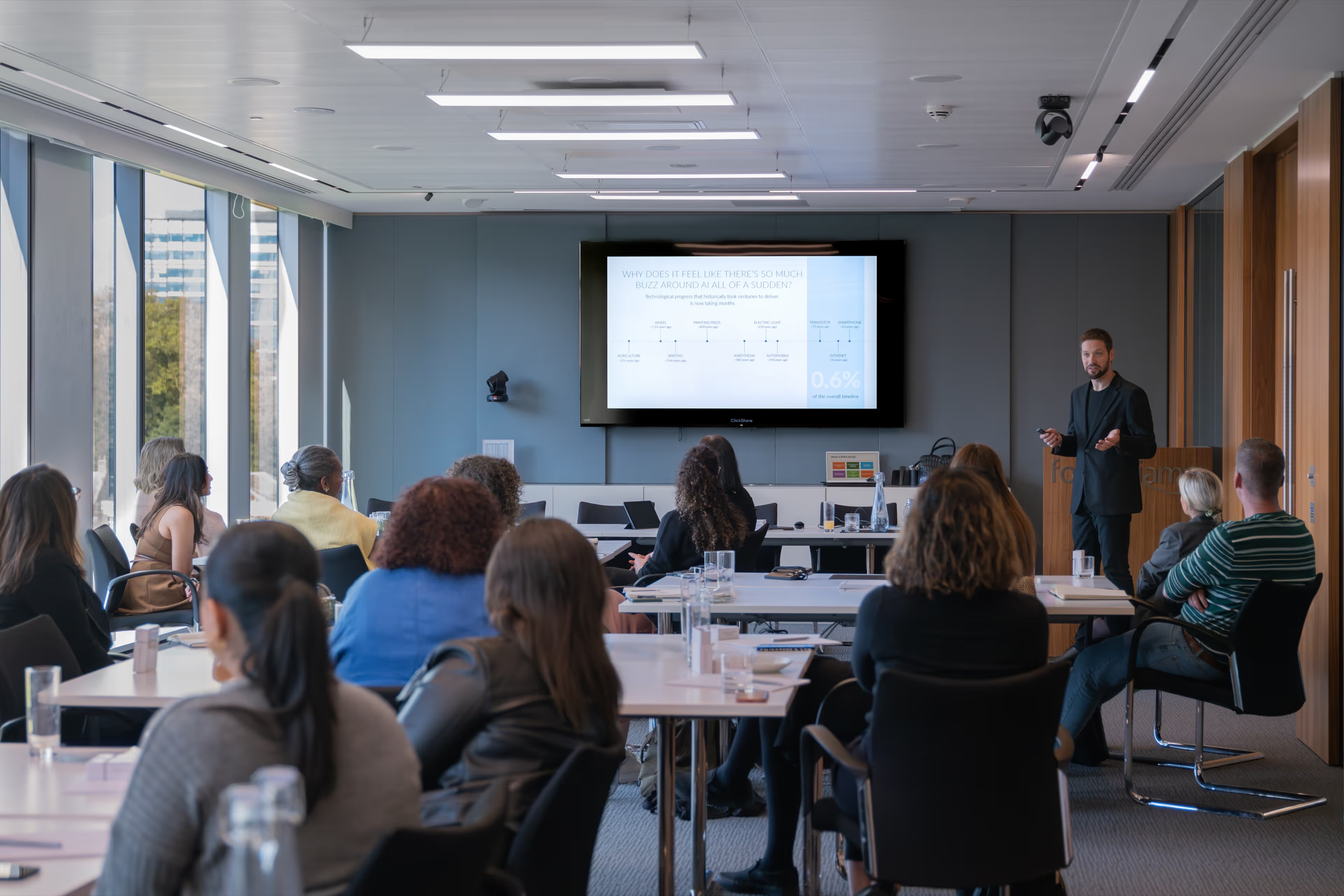
I keynote engineering conferences and executive retreats on zero-cloud AI, local inference economics, and physical AI architecture, grounded in the numbers from running Apple silicon in production.